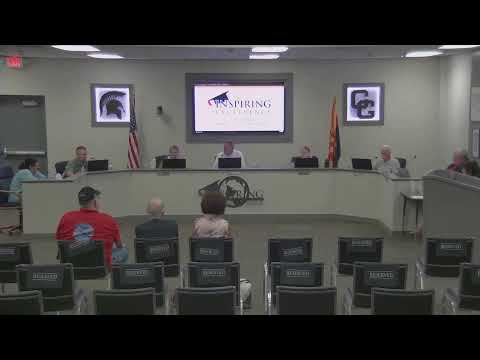
Casa Grande Union HSD adopts state-mandated student cell phone policy after board debate
Loading...
Summary
The Casa Grande Union High School District Board approved final adoption of district policy JICJ to comply with a new state law restricting student use of personal electronic devices during the school day. Board members discussed implementation, communication with parents and limited exceptions for medical needs.
The Casa Grande Union High School District Board of Education on June 9 approved second reading and adoption of district policy JICJ, "Student Use of Digital Communication and Electronic Devices," to align district rules with a recently enacted state law that limits student phone use to educational purposes during the school day.
Board members spent roughly 30 minutes discussing how the new law will be interpreted and implemented in practice, with questions focused on whether passing periods and lunch are counted as allowed educational-use windows and how the district will ensure students and families can communicate in emergencies.
District staff who presented the policy said the board’s committee had originally recommended limited phone access during passing periods and lunch, but that the signed state law narrows allowable use. "The law said that the phone can only be used during the day for educational purposes, and the law said that passing periods and lunch are considered educational purposes," a district presenter stated during the meeting, describing the district’s interpretation after consultation with a state representative.
Board members pressed staff for implementation details. One member said parents have asked whether students will be allowed to call or text during the day and requested a clear written protocol: if families need immediate contact with a student, callers must contact the school office, which will relay urgent messages to the student. Another member expressed concern about staff use of phones in front of students and asked that teachers be held to similar standards except for emergency or job-related communications.
The board discussed limited exemptions in the law for medical needs (for example, monitoring blood sugar) and for clearly defined educational uses the district plans to permit at specific times. Staff said they would develop procedures and communication materials for parents and teachers, and that administrators will work to train teachers and security staff on enforcement and messaging.
The motion to adopt the policy carried on a board vote called after the second reading; the board approved the adoption as presented.
Looking ahead, staff told the board they will monitor implementation, collect questions and concerns from families, and may recommend legislative clarification if ambiguities in the law persist when the district implements it across campuses.