Get Full Government Meeting Transcripts, Videos, & Alerts Forever!
Get email alerts on the Education Finance topic
No spam. Unsubscribe anytime.
Harlandale ISD reviews House Bill 2 impacts on pay, approves notice to post 2025 tax rate
Summary
At a June 5 special meeting, Harlandale ISD trustees reviewed preliminary effects of House Bill 2 on district revenues and pay eligibility, heard public comment urging protection of teacher stipends and custodial supplies, and voted to publish the proposed 2025 tax-rate notice under Texas Education Code §44.004.
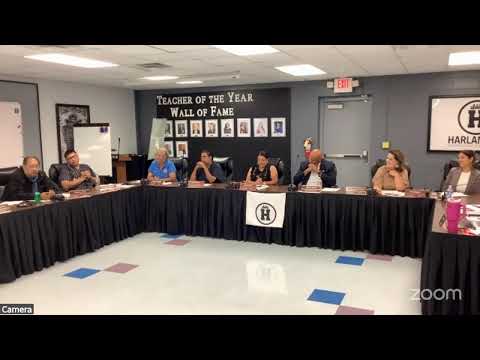
Harlandale ISD trustees on June 5 held a special call meeting to continue budget talks for the 2025–26 school year, reviewed preliminary state funding from House Bill 2 and its eligibility rules for teacher and support-staff pay increases, heard two public commenters urge retention of an attendance stipend and better custodial supplies, and approved posting the proposed 2025 tax rate for public notice under Texas Education Code §44.004.
The matter is consequential because HB2 includes targeted pay increases and a new support-staff retention allotment but ties those dollars to specific eligibility rules the district said remain unclear. District staff presented preliminary revenue and expenditure projections and warned that the district still faces a multi‑million dollar shortfall, leaving the board to weigh how much of the state money can be used locally and whether district funds will be needed to top up pay for staff the state excludes.
Two community speakers urged the board to protect staff pay and campus needs. Maricruz Martinez, identified in the record as HEA local president, asked the board to ensure raises include newer teachers and to preserve a $1,000 teacher attendance stipend that she said is at risk of being tied to campus ratings and student attendance beyond teachers’ control. "Please listen to and protect us, the employees that work on our campuses and in our classrooms daily," Martinez said.
Susan Salinas, identified as TSA staff, told the board the new school finance law does not substantially increase per‑student funding and expressed concern about anticipated voucher spending at the state level. Salinas said districts should use the new retention allotment to help paraprofessionals, counselors, nurses and librarians, and she urged the board not to remove the existing teacher attendance stipend: "Allow teachers who make the effort to be rewarded for their attendance. Do not support the removal of the teacher attendance stipend."
Assistant Superintendent for Business and Finance Miguel Flores (listed in the meeting as Mister Flores) presented the district's preliminary calculations and repeated that the guidance from the Texas Education Agency (TEA) is incomplete. Flores said the district's initial run shows approximately $6,989,461 in additional revenue tied to HB2 but that much of the funding is restricted by eligibility rules. He said the $45 per adjusted ADA support‑staff allotment would generate about $405,319 using an ADA near 10,100, and that an initial TEA-derived list showed 649 teachers qualifying as "teacher of record." Flores and other staff described a larger set of "gray‑area" employees—about 160–171 teachers—who support classroom instruction but who, under the TEA definition, may not be eligible for the HB2 teacher increases because they do not assign grades.
Because TEA has not finalized runs and guidance, Flores said districts are planning cautiously: the district's current projections show projected revenues increasing from an earlier $125 million to about $132,333,131 while projected expenses rose to about $142,857,036. Payroll increases shown in the presentation totaled roughly $4,249,941; earlier deficit projections of about $13,014,037 were revised to a projected deficit near $10,523,905 under the new runs. Flores described a recommended local compensation approach that would: apply HB2 increases where staff qualify, provide a $1,500 district-funded increase for non‑HB2 eligible new hires and 0–2 year teachers, and add a 1% market midpoint adjustment and equitable adjustments across other pay plans. Flores said the $1,500 top‑up would come from the general fund and not from the HB2‑tagged dollars.
Staff also reviewed other funds: the Child Nutrition Fund was projected to be self‑sufficient with revenues of $14,003,918; the district's debt service revenues and expenses were each shown near $17,686,344. Flores said the district is updating five‑year projections and continues to seek expense reductions and revenue increases to close the gap and meet fund‑balance targets in future years.
The board also reviewed preliminary tax‑rate posting details. Staff said updated certified values increased by about $40,979,556 since April and that the district would publish a notice of public hearing using a proposed M&O (maintenance and operations) tax rate of 0.7575 and an I&S (interest & sinking) rate of $0.50—rates unchanged from the 2024–25 approved board rates. A motion was made to approve posting the proposed 2025 tax rate notice as required by law; the motion carried on an electronic vote (vote tallies were not specified in the transcript).
Board members raised additional procedural and policy questions during the presentation, including clarification about homestead‑exemption changes that will appear on a November ballot, the district's lack of discretion to reassign many of the HB2 dollars, and whether the district should pursue one‑time "disaster pennies" (an option staff said the board declined to recommend to avoid increasing taxes during current inflationary pressure).
The meeting opened at 6:15 p.m. and adjourned at about 7:00 p.m. The board scheduled further budget work sessions and a public hearing timeline tied to the tax‑rate notice and the June 16 expected budget action.
Ending: The district emphasized that many HB2 details remain unresolved pending final TEA guidance; board members asked staff to run additional scenarios (including the projected costs to top up pay for the gray‑area teachers) and return with updated numbers at the next budget workshop so trustees can decide whether to use district funds to supplement state allocations.