Get Full Government Meeting Transcripts, Videos, & Alerts Forever!
Get email alerts on the Residency Program Eligibility topic
No spam. Unsubscribe anytime.
Committee adds two residency programs to eligibility, selects funding scenario for FY2026
Summary
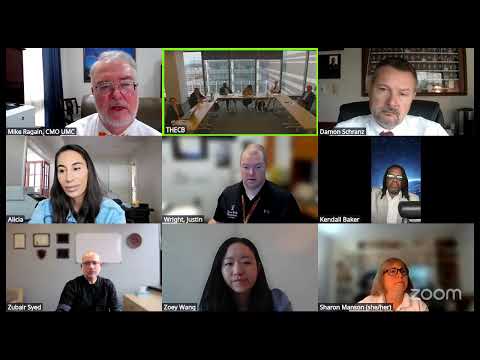
The Family Practice Advisory Committee approved eligibility for two new family-medicine residency programs and recommended a funding scenario (Option 1b) to the coordinating board at its June 10 meeting.
The Family Practice Advisory Committee voted June 10 to recommend eligibility for two new family medicine residency programs and to recommend a funding approach for fiscal year 2026 that maintains program support while slightly adjusting grant support levels.
Ernest Hacchas, senior director for academic and health affairs, presented a roster of programs nearing eligibility and said "Baylor College of Medicine, St. Luke's Health East Texas program, and Texas Tech Trans Mountain" would be eligible for funding this September pending application and approval. Hacchas told the committee those two programs would add 27 residency positions to the funding pool in the current cycle and that, across four upcoming cycles, the cohort of potentially eligible programs could amount to 135 residents.
After discussion about the long-term effect of adding new programs on per-resident funding, a motion "to approve the 2 programs" was made by Hacchas and put to a voice vote; the committee approved the recommendation.
The committee then considered funding scenarios for FY2026. Ernest Hacchas presented three options that vary the per-resident amount by modest shifts in support for the Faculty Development Center (FDC). Under the option the committee approved (Option 1b), the committee recommended keeping FDC support at a level that yields a per-resident allocation of about $8,583. Dr. Damon Strands moved to approve Option 1b; the motion was seconded by Alicia Cantrell, and the committee approved the recommendation. THECB staff said the committee's recommendation will be presented to the coordinating board in July for final action.
Committee members questioned how adding programs affects per-resident funding and urged that THECB use newly required reporting to clarify how GME expansion and family practice residency funds interact. Eric Warwick, identified as an alternate from Baylor College of Medicine, said continuing to extend family-practice grant dollars to newly eligible programs can support administrative and faculty costs that other GME dollars may not cover.
THECB staff agreed to include data in future reports showing how many programs and what positions receive GME expansion funding and to provide breakdowns to inform policy discussion on sustainability and allocation.