Get Full Government Meeting Transcripts, Videos, & Alerts Forever!
Get email alerts on the Education Budget topic
No spam. Unsubscribe anytime.
Pickens County school leaders present FY26 budget with modest net increase, cite state health and TRS costs
Summary
CFO Amy Smith presented a mostly complete FY26 budget showing a net increase under 1%, driven largely by state-mandated health-premium increases and a higher TRS contribution; staff recommended a spending resolution June 30 and will return with more detailed allotments when state/federal numbers arrive.
Amy Smith, chief financial officer for the Pickens County School District, told the Board of Education at a June 9 work session that the FY26 general-fund budget would show a small net increase while state-ordered health-insurance increases and the Teachers Retirement System (TRS) contribution drove most of the new costs.
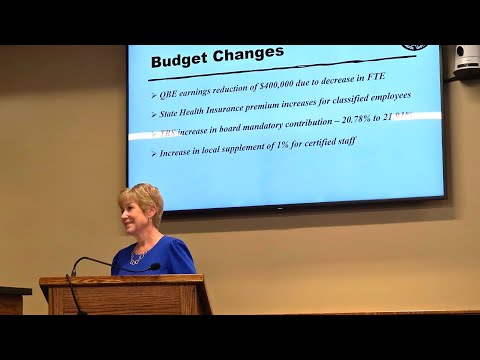
Smith said the district had lost nearly $400,000 in midterm QBE (Quality Basic Education) earnings because of lower enrollment, but that recent state changes to health benefits and to mandatory TRS board contributions added new expense. “The way this increase was approved by the state, it is the board required match,” Smith said, describing the state health premium change as a board liability rather than a direct employee cost.
The nut graf: The presentation showed the district has limited local discretion over major cost drivers — principally state-set health premiums and retirement rates — and that staff tightened other spending lines to keep the overall general-fund increase under 1 percent for FY26.
Smith gave itemized effects: a roughly $483,000 total impact from state health-premium changes rolled forward into a full year, an estimated $442,000 increase tied to TRS contribution growth (from 20.78% to 21.91%), and several local decisions including moving contracted paraprofessionals in house (29 of 32 chose to move from contracted services to district payroll). She said those moves raise salary-and-benefit lines while lowering operating/contracted lines. “We are potentially gonna add a little bit of money to our fund balance,” Smith said, noting revenue collection through August and conservative revenue estimates tied to the tax digest.
Smith also described program-level changes: Pickens High School does not participate in the fund consolidation used for Title I-eligible schools, so its instruction line appears separately; special-education operating funds were shifted to classroom-specific purchases; pupil services increased mainly to reflect payroll moves and Medicaid-related revenue/expense at the central office; and instructional staff development was increased after Cognia accreditation feedback. Smith said the district pared a number of software and subscription costs (for example, slimming the Canvas package) and otherwise tightened non-salary spending.
On revenue, Smith said preliminary numbers — subject to the tax digest and state/federal allotments — suggested the district could see a revenue increase large enough to approach break-even, even after factoring House Bill 581’s estimated effects. She cautioned that allotments for federal grants (Title I, II, IV and others) remained estimates until the Department of Education issues final numbers in late June or after.
Board next steps: Smith asked the board to approve a spending resolution allowing normal operations after July 1 while staff continue to refine figures and return for tentative and then initial budget approvals after the final tax digest and grant allotments are known. No formal budget vote took place at the work session; staff said they would present the spending resolution at the June/July board meeting and return with a one‑page summary when seeking formal approvals.
Ending: Smith and Superintendent Doctor Thomas said staff would continue to monitor the digest, grant allotments and program needs. “The increase is point 95%. I mean, it’s less than 1% increase of the budget,” Doctor Thomas said during the session, emphasizing the constrained size of the requested increase in the context of statewide cost pressures.