Get Full Government Meeting Transcripts, Videos, & Alerts Forever!
Get email alerts on the State Budget topic
No spam. Unsubscribe anytime.
Senate Budget Committee advances AB 101, a $324.7 billion budget package, to the floor with 10-6 vote
Summary
The Senate Budget Committee voted 10-6 to pass AB 101, the budget act of 2025, advancing a two‑house budget agreement that protects K‑14 and university funding while implementing changes to Medi‑Cal, homelessness programs and reserves.
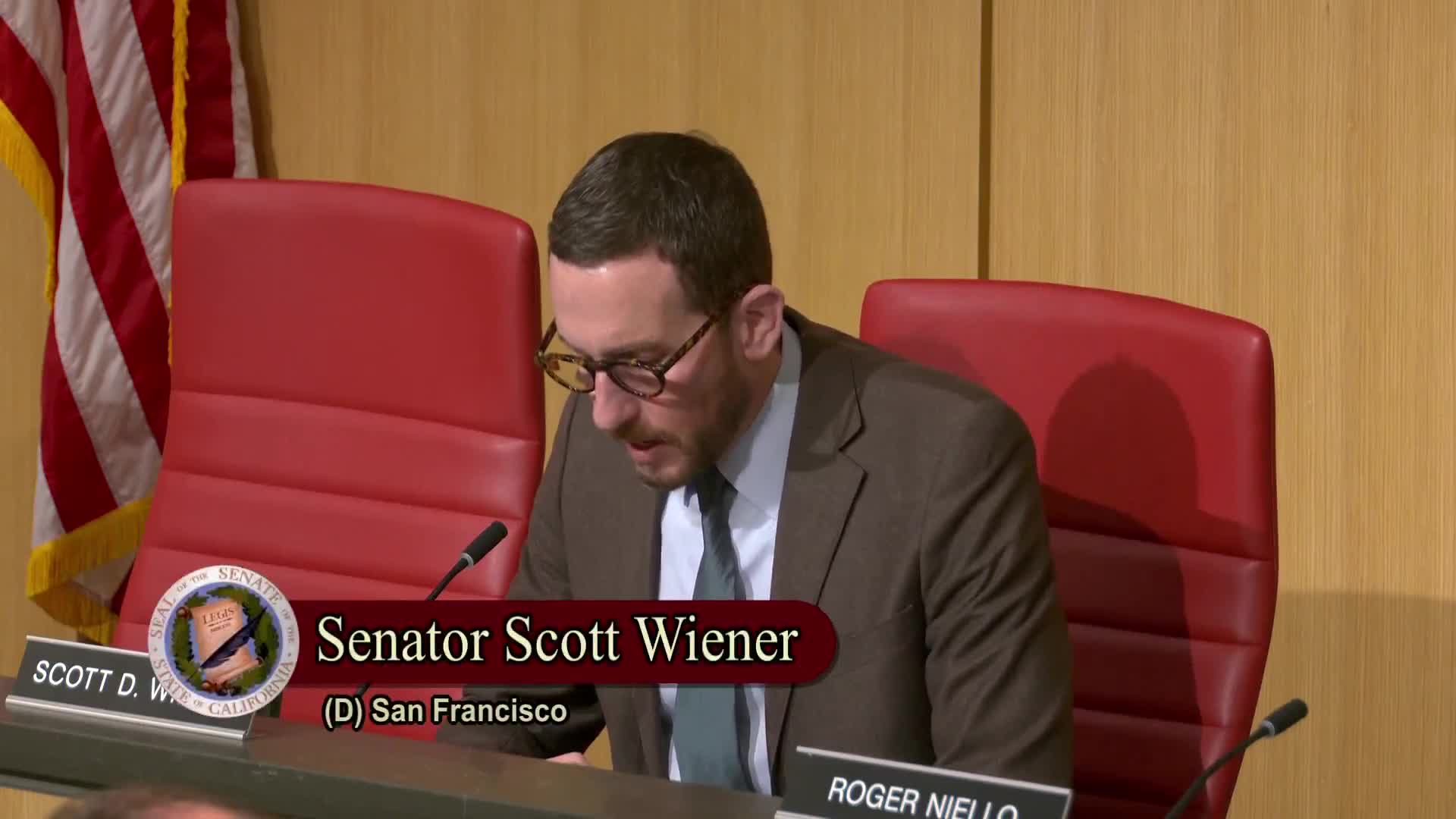
The Senate Budget Committee voted 10 to 6 to advance Assembly Bill 101 — the budget act of 2025 — to the Senate floor after several hours of presentations and member debate. Senator Wiener, chair of the committee, opened the hearing by describing the package as "a budget plan...that includes approximately $324,700,000,000 in total spending, $231,900,000,000 of which is general fund."
Why it matters: AB 101 is the Legislature's two‑house budget agreement for the 2025 fiscal year and sets funding levels for K‑12 and higher education, health programs, homelessness response and disaster recovery. Committee members said the package balances immediate service protections with one‑time measures and borrowing that reduce near‑term cuts but increase out‑year fiscal pressure.
The package presented to the committee protects funding for K‑12 schools and reduces proposed cuts to the University of California and California State University systems. Carolyn Chu of the Legislative Analyst's Office told the committee the package responds to a structural deficit and differs from the governor's May revision by using internal borrowing and reducing the year‑end special fund for economic uncertainties to $2.0 billion while maintaining about $11.0 billion in the Budget Stabilization Account. Chu said the legislature's plan "maintain[s] the $11,000,000,000 remaining in the budget stabilization account."
On health care, the Legislature's package scales back many of the governor's Medi‑Cal proposals while still including solutions to constrain growth. The Legislative Analyst and Department of Finance described a mix of delayed changes, narrower scope on some proposals and continued protections for long‑term care. Department of Finance staff warned the committee that the legislature's package achieves smaller savings than the May revision and that revenue uncertainty tied to federal policy actions remains a key risk.
Several senators used their remarks to press for different tradeoffs. Members praised the restoration or delay of proposed cuts to in‑home supportive services (IHSS), rejection of a 3 percent cut to UC and CSU, and a $500 million restoration for the Homelessness Assistance Program (HAP). The committee also discussed loans to local governments and transit agencies — including a mechanism to provide short‑term assistance to Los Angeles County and Bay Area transit systems — and one‑time general fund loans to assist wildfire recovery in Southern California.
Committee debate repeatedly returned to three themes: (1) protecting core services for vulnerable Californians, (2) the use of one‑time resources and internal borrowing to avoid deeper immediate cuts, and (3) the risk that those near‑term choices increase structural deficits in later years. Senator Niello (vice chair) and others warned that relying on reserves and borrowing without structural reforms will magnify future deficits; the vice chair said, "a budget that's based on hope is a budget that is destined for trouble."
Public commenters and dozens of organizational representatives addressed the committee during the comment period. Speakers included housing advocates urging investments in CalHome and low‑income housing tax credits, health and legal services groups urging protection of immigrant access to Medi‑Cal and additional legal services funding, and local officials seeking wildfire recovery and transit support. Several speakers asked the Legislature to increase state funding for immigration legal services in response to large‑scale ICE enforcement actions described in public comment.
Formal action: Senator Wahab moved to pass AB 101 to the Senate floor. The committee recorded a final tally of 10 yes and 6 no; the chair announced the bill "is out." The committee record includes individual recorded votes during roll call; the final certified tally was 10–6 in favor.
What comes next: With the committee vote, AB 101 proceeds to the Senate floor and then to negotiations with the governor's office. Committee staff and members said further adjustments remain possible during subsequent negotiations and through trailer bill language. Several senators said they expect to revisit out‑year structural issues and revenue options in the months ahead.
"We are not disenrolling anyone as a result of this budget," Senator Weber Pearson said during debate when discussing Medi‑Cal protections, emphasizing the committee's intent to preserve continuous coverage for current enrollees while phasing or delaying some proposals.
The committee adjourned after announcing the vote and thanking staff for the volume of work that led to the two‑house agreement.