Get Full Government Meeting Transcripts, Videos, & Alerts Forever!
Get email alerts on the Historic Preservation topic
No spam. Unsubscribe anytime.
Denton historian presents preservation cases; Gibson Grant log house highlighted after county dedication
Summary
At a Flower Mound Historical Commission meeting, volunteer historian Karen Blucher presented examples of restored North Texas pioneer homes and described the recent dedication of the Gibson Grant log house, part of Denton County's historical-park restoration efforts.
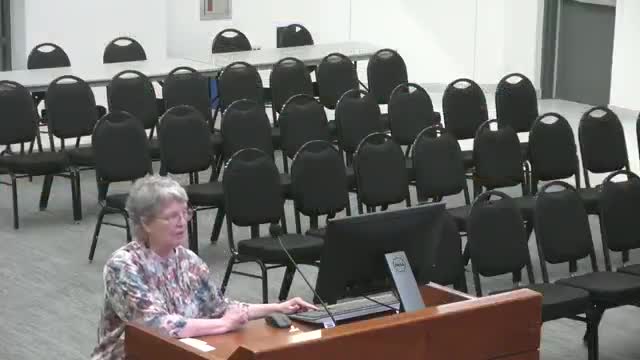
Karen Blucher, a volunteer with the Denton County Office of History and Culture, told the Flower Mound Historical Commission Tuesday evening that county preservation efforts have saved several early North Texas houses and cabins from demolition and loss.
"If the room was 16x16, it probably was an original, pioneer log cabin," Blucher said, describing how the Gibson Grant Log House was identified and restored after workers uncovered intact logs during renovation.
Blucher illustrated how the county and private individuals have moved, restored or preserved multiple properties: the Gibson Grant Log House; the Spencer House and its servant's house; the Bayless-Selby House; Quakertown houses (including the Quaker Town House); the Taylor Cabin, built in 1868; the Woods House; and the Stoney Store. She described each structure's history, recent preservation steps and current public-access status.
The presentation emphasized the sequence that led to the Gibson Grant Log House dedication: homeowners renovating a property discovered an enclosed 16-by-16 log room, contacted county preservation staff and, after documentation and restoration, Denton County held a dedication. "You had the dedication," an attendee observed; Blucher and commissioners noted docents and county staff participated in the ceremony.
Blucher identified several restoration leaders by name. Bill Marquis, a master restorer, oversaw log restoration on the Taylor Cabin; Lucy Billingsley brought a proposal to a Lewisville city council in 2004 that led to movement and restoration of the Spencer House; and local volunteers assisted with chinking and interior conservation. Blucher described the Taylor Cabin restoration process: volunteers used mud and straw to chink logs, and the county contracted a specialist to repair the structure.
She also recounted how private citizens and municipalities interacted with historic structures: Bill Marquis purchased the Stoney Store to stop demolition, then later transferred it to county ownership; parts of houses in poor condition were sometimes left behind when sections were moved (for example, a deteriorated right-side room of the Bayless-Selby house was not moved). Blucher said some restored structures are not yet open to the public because of size or condition; others are being repurposed for docent offices, traveling exhibits or interpretive displays.
Blucher repeatedly attributed technical assessments and identification criteria to the Denton County Office of History and Culture and to its director, Peggy Riddle. She said county staff and local volunteers are central to locating, documenting and restoring vernacular structures, and that several restorations remain ongoing with no fixed public-opening timelines.
The commission's discussion affirmed the value of preserving small historic structures as community resources. Chair Norell, presiding at the meeting, thanked Blucher for the presentation and noted the Gibson Grant dedication was a particularly moving community event.
The presentation did not propose local Flower Mound actions or policies; it was an informational briefing on Denton County preservation practices and local restoration case studies.