Get Full Government Meeting Transcripts, Videos, & Alerts Forever!
Get email alerts on the Special Events Ordinance topic
No spam. Unsubscribe anytime.
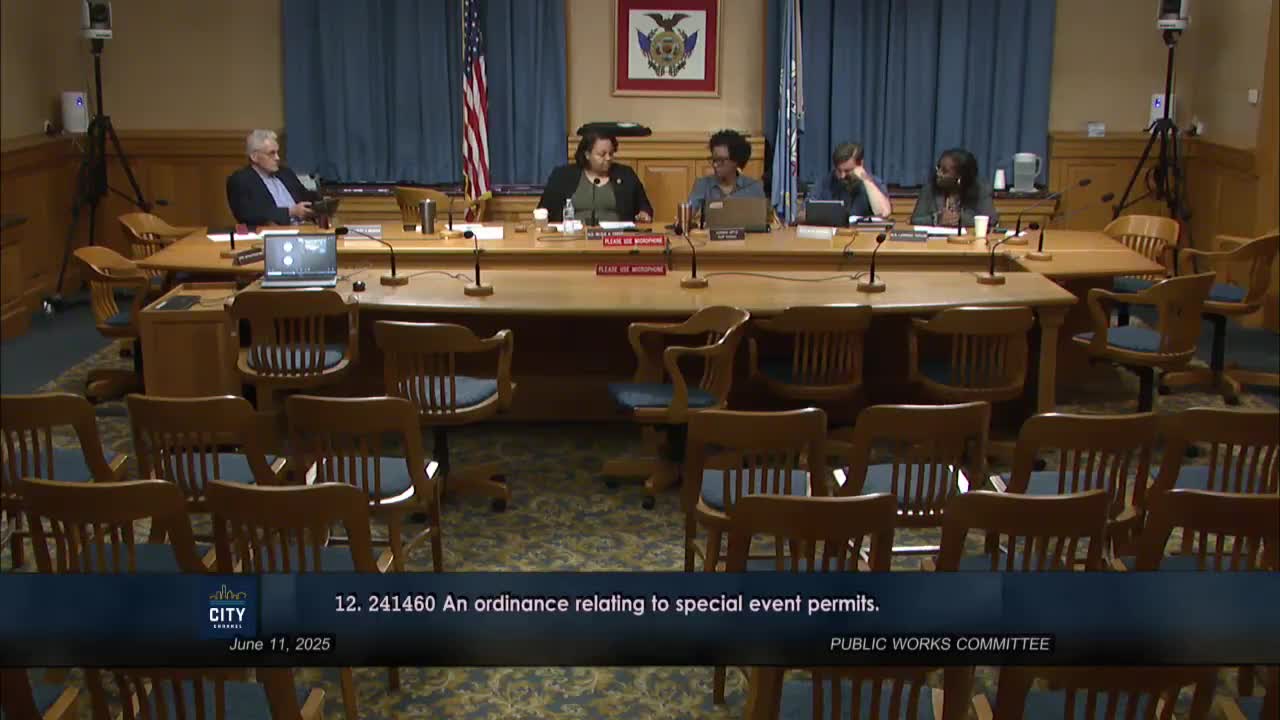
Public Works committee holds revised special‑events ordinance for wording changes after debate on denial authority
Summary
The committee considered a substitute to the city's special‑events permit ordinance that clarifies late‑filing penalties, classification of event types, and the conditions under which permits may be denied for public‑safety reasons; members asked for clearer language and the substitute was held to the call of the chair for further drafting.
The Public Works Committee took up a revised special‑events ordinance (amendment to section 105‑55.5) that would (1) reclassify certain event types, (2) add late‑filing fees, and (3) codify additional reasons the Department of Public Works (DPW) commissioner may deny a permit, including when Milwaukee Police Department (MPD) or Milwaukee Fire Department (MFD) determine the applicant cannot safely secure an event.
James Washington, public works coordination manager, outlined the substitute, saying the change gives the DPW commissioner discretion to require an operating agreement for events that pose an undue demand on city resources, while removing a prior automatic requirement tied to the size of a contiguous city block. Gunnar Rasch of the Legislative Reference Bureau explained the substitute adds two specific reasons to the ordinance’s denial list: untimely filing and an event that presents an unreasonable public‑safety risk if the applicant cannot satisfy required security/hardening measures.
Committee members raised concerns about delegating denial authority. Several aldermen said they prefer the DPW commissioner retain final decision‑making authority after consulting MPD and MFD rather than giving MPD or MFD standalone authority to prevent events. Alderwoman Millele A. Cox and others noted the need to protect public safety, citing recent high‑profile violent incidents elsewhere, but also urged procedural clarity so community events are not unintentionally barred.
Because of lingering confusion about the precise mechanics of denials, consultation and the appeal process, the committee voted to hold the substitute to the call of the chair and asked DPW and LRB to revise the language so it explicitly states how DPW, MPD and MFD interact in the review process and to clarify appeals to the council and judicial review timing.
Why it matters: the ordinance affects how the city processes permits for parades, marches, large festivals and neighborhood block parties. Changes could speed administrative processing for recurring events but also create new grounds for denying permits if public‑safety agencies judge an event cannot be secured.
Next steps: LRB and DPW will work with committee members to clarify the substitute’s language and return it to committee for further consideration. The substitute, as discussed, was not adopted and remains on hold.