Lifetime Citizen Portal Access — AI Briefings, Alerts & Unlimited Follows
Council hearing flags staffing, funding shortfalls that could slow implementation of Fairness in Human Rights changes
Loading...
Summary
At a June 10 Committee on Public Works and Operations hearing, Office of Human Rights officials, advocates and lawyers warned that hiring freezes, proposed budget cuts and limited one‑time funding could hinder implementation of recently passed human‑rights amendments and lengthen complaint backlogs.
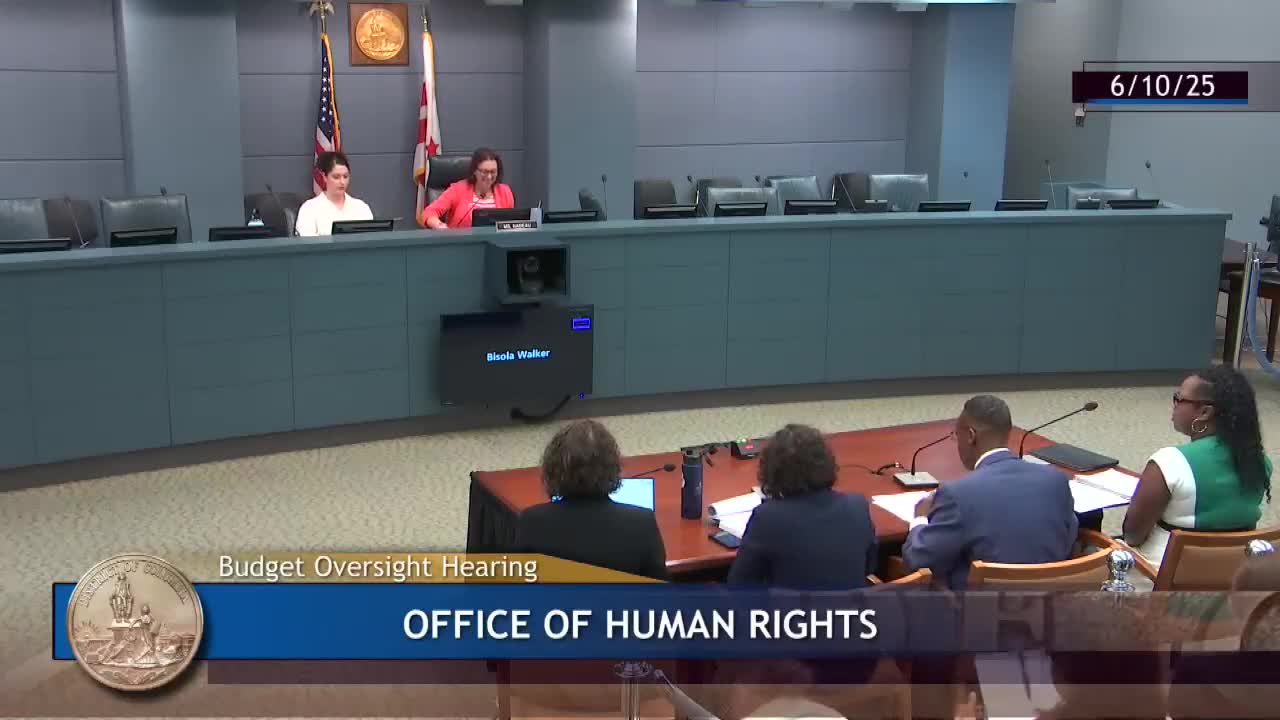
Chairwoman Brianne Nadeau convened the Committee on Public Works and Operations hearing on June 10 to review the mayor's proposed fiscal year 2026 budget for the District's Office of Human Rights and related offices.
The Office of Human Rights' director, Kenneth Saunders, told the committee the mayor's FY26 proposal would set the agency's operating budget at about $9,000,000, composed of roughly $8.6 million in local funds and $400,000 in federal grants. Saunders said new and expanded enforcement responsibilities created by recent amendments will require additional staffing and administrative changes to implement.
“The Fairness Act expands the definition of sexual harassment beyond what the Human Rights Act currently covers, provides additional rights and remedies for district employees, and expands the rights of complainants to remove their cases to court,” Saunders said. “Implementation will require OHR to overhaul our procedural regulations, draft and publish new guidance documents, retrain the agency's intake staff, investigators, and mediators on these new standards, create new legal notices of rights to complainants and respondents at every stage of our process, and conduct a public awareness and outreach campaign.”
Advocates and practitioners who testified warned that a continued hiring freeze and proposed vacancy savings could prevent OHR from filling investigator and intake positions needed to carry out those tasks. Laura Brown, executive director of First Shift Justice Project, said OHR has asked for three staff positions to implement the Fairness in Human Rights Amendment Act and that the estimated personnel cost she found was $339,000.
“OHR needs funding to implement this bill,” Brown said, noting the agency must revise procedural regulations, train staff, and prepare for an anticipated increase in hearings and commission workload.
Other witnesses pressed the committee on vacancy and hiring numbers. Saunders and agency budget staff said OHR's FY26 authorized FTE account is 77.5 but that the office currently has about 21.5 vacancies; 14.5 of those vacancies are frozen and six had been in active recruitment before the freeze. The agency estimated a roughly 18% vacancy savings rate and said frozen positions include investigators in the enforcement unit and an intake manager.
Community partners urged Council action to unfreeze critical positions. Susie McClanahan, Fair Housing Director at the Equal Rights Center, told the committee that OHR has lost two of three investigators on the unit that handles housing and other non‑employment claims and that two investigator positions remain funded in the FY25 and proposed FY26 budgets but cannot be filled because of the mayor's hiring freeze.
“If the mayor does not grant a waiver to these vacancies, the investigation of these complaints at OHR could come to a practical standstill, unfairly denying justice to DC residents reporting discrimination,” McClanahan said.
The transcript and testimony also captured discussion of the agency's case management system and one‑time funding lines. Saunders told the committee that the mayor's proposed budget included $300,000 in one‑time funding for case management system implementation. During follow‑up questioning agency staff described contract and subscription line items that together total roughly $400,000 (contractual services, subscription/membership, and IT hardware maintenance), a discrepancy the committee flagged for clarification.
Saunders said several other recently enacted laws remain unfunded for implementation at OHR, naming the Cannabis Employment Protections Amendment Act and the Medical Necessity Restroom Access Act. He also said OHR has opened five complaints under the Eviction Record Sealing Authority Amendment Act and has published initial guidance and intake materials for that statute.
The hearing record closed on June 24 at 5:30 p.m. and the committee said it would accept additional written testimony.
Ending: The committee did not vote on budget items at the hearing. Members signaled they will follow up with the mayor's office about frozen positions, the composition of the case‑management funding line, and whether temporary contract funding could be used for enforcement work pending any waiver to the hiring freeze.