Get Full Government Meeting Transcripts, Videos, & Alerts Forever!
Get email alerts on the Air Quality Fees And Burn Policy topic
No spam. Unsubscribe anytime.
Lake County air board reviews overhaul of permit fees and proposes Nov. 1 burn-ban lifting with holiday no‑burns
Summary
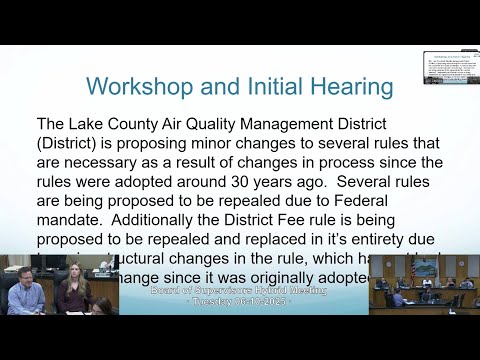
District staff presented a package of rule changes that would replace the 1975 fee structure, add emission fees, clarify residential exemptions and set a fixed annual opening of the burn season (proposed Nov. 1) with specified holiday no‑burn days; board members asked staff for a side‑by‑side fee comparison and delayed submission to state review.
The Lake County Air Quality Management District presented a draft replacement fee schedule and a set of rule changes at a board workshop and public hearing on the district’s proposed revisions to rules 208.2, 226.5, 433.5, 631, 660–668 (fee rules) and 1105, among others. District staff said the package would repeal the district’s existing fee sections adopted in 1975, adopt a modernized fee table based on staff time and split emission‑related fees from permitting charges.
District staffer Doug Gearhart told the board the district’s fee rule has not been structurally overhauled in decades and that recent state mandates and rising personnel costs require a shift to staff‑time based fees to approach full cost recovery. Gearhart said the district currently recovers an estimated 50–60% of permit program costs and has relied on reserves and unfilled staffing to absorb the shortfall. As presented, the draft adds emission fees, pre‑application review fees, CEQA review pass‑throughs, an indirect source fee and other administrative charges.
The package includes non‑fee regulatory changes tied to burning rules. Staff proposed removing a longstanding reliance on Cal Fire’s seasonal “end of fire season” declaration and instead setting a fixed date to lift the district’s annual burn ban. Staff said a review of the last 20 years of local fire‑season declarations produced an average lifting date of Nov. 15, and proposed two options to the board: (1) lift the district burn ban each year on Nov. 15; or (2) lift on Nov. 1 with a set of designated holiday no‑burn days to achieve an equivalent level of total allowable burn days for public‑health equivalency with prior practice. Suggested holiday no‑burn days included Veterans Day, Thanksgiving Day, Christmas Eve, Christmas Day, New Year’s Eve, New Year’s Day, Martin Luther King Day, Presidents Day and Easter (staff said the holiday list could be refined and that equivalency would need state/EPA review).
Staff described the continuing coordination with fire agencies: daily burn‑day evaluations by Cal Fire and local fire chiefs would remain in place, and exceptions would still be available for demonstrated need and a fire‑agency safety determination. The district also proposes to remove a static list of agencies from the rulebook and replace it with a simpler annual agreement process so agencies can opt in to local permitting cooperation without a formal rule change.
Board members and public commenters pressed staff for clearer comparisons and operational details. Supervisors requested a side‑by‑side comparison showing current fees versus the new structure, an explanation of how fees would be phased in (staff noted permit renewal increases are capped at 15% in a single year where the fee is an authority‑to‑construct or permit‑to‑operate renewal), and examples of impacts for specific source categories. Gearhart gave one example: under the draft structure a geothermal power plant’s total permitting fees would reflect about a 75% increase relative to 1996 fee levels; staff also noted the consumer price index since 1996 has risen roughly 122% by their calculation. Gearhart said some facility types that were previously undercharged (for example, service stations) could see larger percentage increases because historical fees did not reflect current staff time.
Public commenters raised implementation concerns. Lakeport Fire Protection District Chief Patrick Reitz said the district must improve customer service and phone/office access before imposing higher fees, noting residents have reported locked doors and difficulty obtaining permits. Reitz also warned that unburned fuel piles increase wildfire risk. CAL FIRE representative Paul Duncan supported the proposed rule changes and urged caution on large fee jumps for residential burners, suggesting incremental increases to avoid deterring safe burning of accumulated debris. Resident Tom Lasek asked how the district will reassess the fixed November date as climate and fire conditions change; staff replied that the daily burn‑day evaluation by fire agencies would continue and that no‑burn declarations could be issued whenever fire hazard conditions warrant.
Board direction and next steps were procedural rather than final regulatory adoption. Several board members said they were willing to move the draft rules forward in concept but asked staff to return with the full fee schedule and a clear side‑by‑side comparison of existing versus proposed charges before sending the packet to state and EPA for equivalency review. One board member expressly said they were prepared to adopt local code changes but did not want the district to submit the fee package to the state until the requested analyses and clarifications were provided. Staff said they would clean up and release the internal fee study, aim to return with a revised draft in early July and prefer to send the entire rule package together for state and EPA review.
The board did not take a formal vote at the workshop. Staff will prepare the detailed fee comparisons, a holidays list for the Nov. 1 option, and the refined draft rules for a subsequent board meeting and for the required state/EPA equivalency review.