Get Full Government Meeting Transcripts, Videos, & Alerts Forever!
Get email alerts on the Law Attorney General topic
No spam. Unsubscribe anytime.
Attorney General urges council to restore litigation support fund spending authority and protect Cure the Streets
Summary
At a June 9 committee hearing Attorney General Brian Schwab said the mayor’s FY26 budget cuts the office’s litigation support fund (LSF) authority sharply and would eliminate or reduce the Cure the Streets violence-interruption program and key litigation tools including the Relativity e-discovery license.
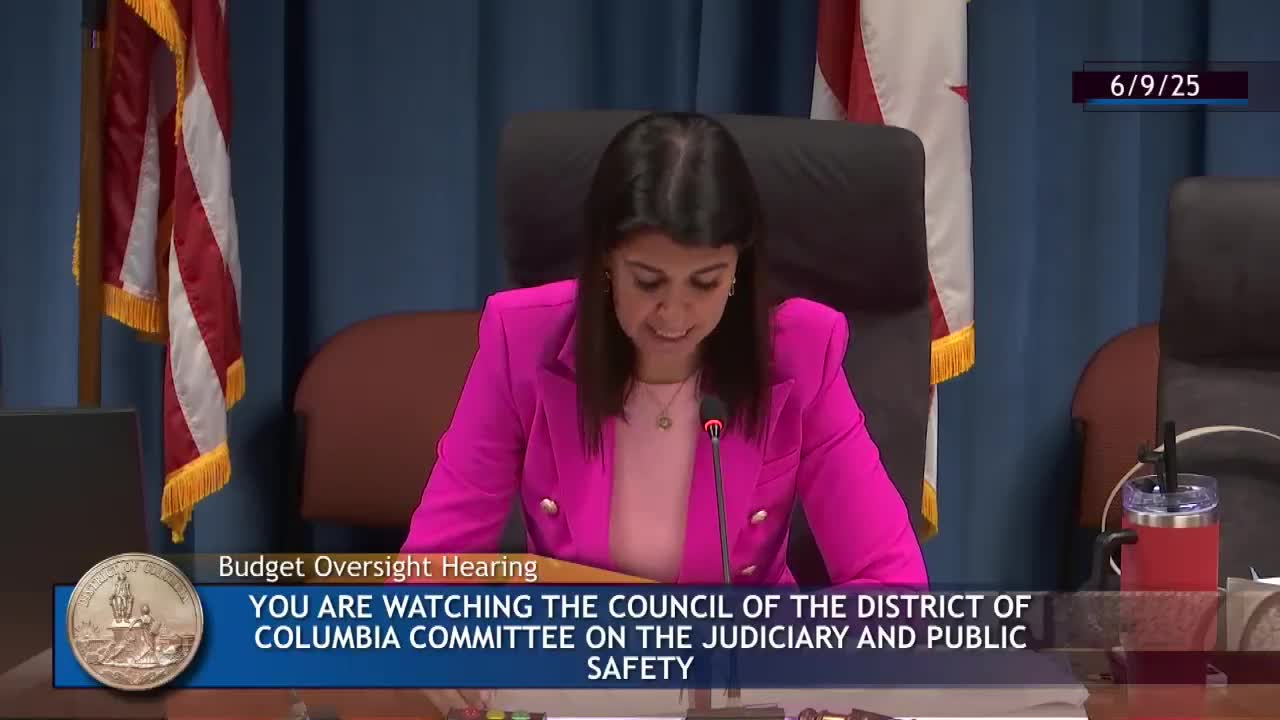
Attorney General Brian Schwab told the Committee on Judiciary and Public Safety on June 9 that the mayor’s FY26 proposal would sharply reduce the Office of Attorney General’s (OAG) litigation support fund (LSF) spending authority and would force programmatic and technology cuts that, he said, would impair the office’s litigation, child-support and gun-violence intervention work.
Schwab said OAG has worked to reduce local spending this year but that the mayor’s proposal reduces LSF authority “by more than 60%,” cutting the LSF from a $27 million cap to roughly $11 million in the proposed budget. He said that would remove funding for key litigation infrastructure — including the Relativity e-discovery platform — and would “force OAG to shut or cure the streets altogether” unless the council restores funding.
Why it matters The litigation support fund is financed with recoveries and enforcement proceeds that under the council’s 2015 authorization are available to support OAG litigation and related nonpersonal services. Schwab said the LSF historically funds expert witnesses, depositions, transcripts, litigation platforms and some public-safety grants such as Cure the Streets; OAG’s ability to bring and defend high‑cost cases depends on that spending authority.
OAG’s case for restoring LSF and program funding - LSF authority and uses: Schwab said OAG’s FY25 LSF spending authority was $27 million and that in typical years actual LSF spending has been about $22–24 million. The mayor’s proposed FY26 would reduce LSF NPS authority to about $4 million (a roughly 60% reduction in NPS authority), the attorney general said, and he requested restoring LSF spending authority to about $22.6 million (or $17.6 million if Cure the Streets is funded from another source). - Cure the Streets: The AG said Cure the Streets cost roughly $9 million in FY25 (funded primarily through LSF) and that OAG planned a smaller FY26 footprint of six Cure sites, estimated to cost about $5 million. Schwab urged the council to preserve funding for the program or move an equivalent amount into local funds while a potential merger with the Mayor’s Office of Neighborhood Safety and Engagement is planned and vetted. - e‑discovery and litigation platforms: Schwab identified a $4.4 million LSF line-item for Relativity — an electronic‑discovery platform OAG’s litigating divisions use — as particularly critical. He said eliminating Relativity would impede OAG’s ability to manage discovery for more than a thousand active matters and to support partner agencies’ document review needs. - TANF sweep and child‑support: The AG warned that a proposed $2.6 million sweep of OAG’s TANF fund (child support collections) would forgo $5.2 million in federal matching funds over time and would make modernization of the child-support case-management system and day‑to‑day operations more difficult.
Committee questions and follow-up Committee members pressed Schwab on the LSF projections, Cure the Streets site selection and the implications of reducing LSF authority. Schwab said the office reduced or reallocated some local fund spending voluntarily and that staff could provide a line‑by‑line crosswalk of LSF commitments and planned spending. Councilmember Wendell Felder, Denise Lewis‑George and others voiced strong support for preserving Cure the Streets funding in neighborhoods where the program operates; Lewis‑George urged restoration for Ward 4 specifically and said her constituents view the program as an effective intervention.
What OAG asked the council to do Schwab asked the council to: - Restore LSF spending authority to roughly $22.6 million (or $17.6 million if Cure the Streets is funded elsewhere) so OAG can keep Relativity and other litigation supports and operate a six‑site Cure footprint; - Avoid prospectively sweeping LSF balances in FY26–28 and instead determine any end‑of‑year sweep amounts through the supplemental/supplemental budget process when balances and needs are known; and - Refrain from a $2.6 million TANF sweep that would forgo federal match funds for child support enforcement and system modernization.
Ending Schwab said OAG will work with the council to identify a feasible end‑of‑year sweep and to preserve litigation infrastructure and public‑safety programs funded through LSF, and urged the committee to consider the operational risks of the mayor’s proposed reductions before finalizing FY26 appropriations.