Get Full Government Meeting Transcripts, Videos, & Alerts Forever!
Get email alerts on the Personnel Reorg Ppm topic
No spam. Unsubscribe anytime.
Rockville council creates two departments and approves pension changes; personnel policy manual revisions prompt further review
Summary
The Mayor and Council on June 9 created Departments of Procurement and Communications & Community Engagement, approved resolutions moving certain executive positions to non‑merit status and amending the pension plan (effective July 1, 2025), and discussed proposed personnel policy manual (PPM) changes including the role of the Personnel Appeals
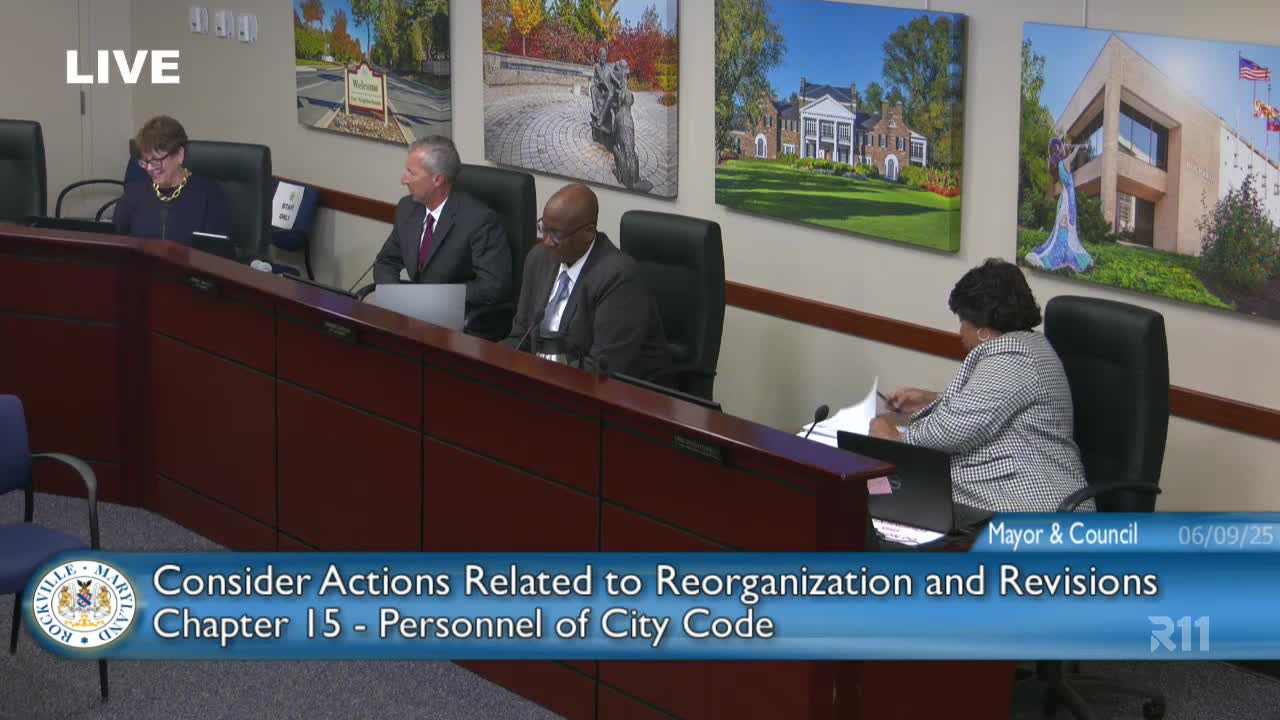
The Rockville Mayor and Council on June 9 adopted ordinances to create a Department of Procurement and a Department of Communications and Community Engagement, and approved resolutions to add specified executive positions to non‑merit civil service and to amend the city pension plan to cover those positions.
Staff told the council the organizational changes reflect items already included in the FY 2026 budget and are intended to improve operational efficiency, recruitment and retention. Susan Selig, presenting the staff recommendations, described four recommended measures: create the two new departments, place specified executive positions in non‑merit civil service, amend the pension plan to align with that list, and revise Chapter 15 of the city code to reflect related procedural changes.
Council approved the ordinance creating the two departments after a motion to waive the layover period. Council Member Van Grama introduced the ordinance; Council Member Fulton moved to waive and Council Member Shaw moved to adopt. The measure passed by voice vote.
Separately, the council adopted a resolution to establish and modify the list of at‑will classified civil service positions to be placed in non‑merit civil service and adopted a resolution to amend the City of Rockville pension plan document. Council Member Valeri moved to adopt the resolutions and Council Member Jackson seconded; the motions passed by voice vote. Staff said adding the deputy city attorney and other executive positions to the pension plan would increase pension costs by roughly $63,000, of which about $23,000 is new and budgeted within FY26.
Council then discussed a suite of proposed changes to the Personnel Policy Manual (PPM) and Chapter 15 that would (a) move administrative approval of the PPM from the Mayor and Council to the city manager, (b) require mayor and council approval for the contracts of the three appointed officials while allowing appointed officials to approve contracts for non‑merit positions under their supervision, and (c) limit the scope of Personnel Appeals Board findings to whether an employee violated any law, city policy, rule, regulation or directive. Staff said the proposed code edits align the code language with current practices on contracts and appointments.
Several council members expressed concern about removing checks and balances from Mayor and Council oversight. Topics raised during discussion included whether the city manager would notify the council of PPM changes, whether existing employee contracts would be honored, and how the proposed edits would affect employees who oversee elections. The council asked staff to return with clarifying language and a written legal opinion on whether state law permits municipalities to adopt local restrictions beyond those set in the Local Government Article on political activity by government employees.
On the Personnel Appeals Board proposal specifically, council discussion highlighted tradeoffs between efficiency and independent review. Staff described a hybrid model in which the Personnel Appeals Board would make written factual findings about whether a law or policy was violated and then transmit those findings to the city manager, city clerk or city attorney (as applicable) for a final decision. Some council members said that approach could undermine employee confidence in an independent appeals forum; others said the hybrid approach provides additional factual analysis to inform the final administrative decision. The council agreed to extend certain procedural timelines (for example allowing 30 calendar days in one step where the draft had used 15 days), to ask staff for a clean redline and to return with additional legal analysis and union input before finalizing the broader PPM changes.
What happens next: staff will update the code and pension documents, implement the new departmental structure consistent with the FY26 budget, and return to Mayor and Council with a cleaned‑up PPM draft, written legal analysis on the political activity/local law question, and summaries of union input before any final action on the PPM changes.
Proper names, authorities and clarifying details from the meeting are listed below.