Get Full Government Meeting Transcripts, Videos, & Alerts Forever!
Get email alerts on the Elections topic
No spam. Unsubscribe anytime.
Kaufman County elections office warns of equipment cost, forms changes after new federal and state actions
Summary
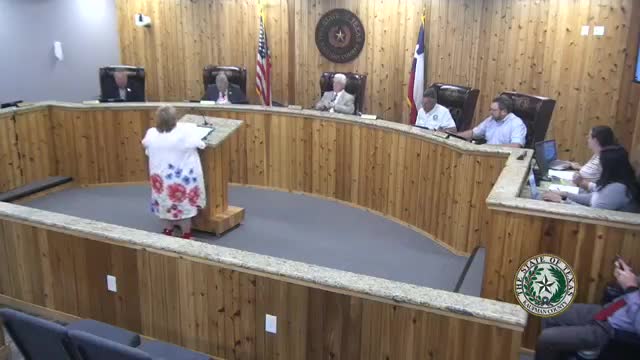
Joanie, an elections official for Kaufman County, told the commissioners that recent state bills and a presidential executive order could force one‑time costs and require changes to voting equipment and forms.
Joanie, an elections official for Kaufman County, told the commissioners that recent state bills and a presidential executive order could force one‑time costs and require changes to voting equipment and forms.
Joanie said about 49 election‑related bills were going to the governor and that the Election Assistance Commission (EAC) still must advise counties how a presidential executive order affects equipment, especially the county’s marking devices because the county’s paper ballots include barcodes. “While our current voting equipment is a paper ballot, it does contain a barcode and part of that executive order prohibits those barcodes,” Joanie said.
The elections office is budgeting for equipment and related contingencies. Joanie said the office plans to carry over $50,000 for voting equipment and $130,000 for software into the next fiscal year and is requesting an additional $215,000 for voting equipment. If the EAC concludes barcodes are not lawful under the executive order, Joanie said the county would need to either replace marking devices or obtain an entirely new system from a different vendor: “If they tell us we can no longer use this barcoded system, we would have to, a, replace the system, or, b, get an entirely new system from a different vendor.”
As a possible interim measure, Joanie said the vendor discussed applying outstanding payments on recently purchased equipment toward a ballot‑on‑demand system, but she cautioned that would not cover the full cost. She also described a ballot‑on‑demand option that would add printers in polling places and noted operational complexity and higher costs for staffing and supplies.
On routine election operations the office requested several budget changes: an increase in pay for election judges and clerks by $2 per hour (proposed new rates were $18/hour for judges and $16/hour for clerks), two 4‑wheel‑drive vehicles (to replace a leased van expiring in December and to provide safer transport in hazardous conditions), a $75 per month cell stipend for the chief deputy ($900 annually), and purchases of an election management software and online training portal. Joanie described the web/voter education portal as a $30,000 initial cost with a $6,000 annual fee and the online training portal as $38,000 year one and $8,000 thereafter.
Joanie said some costs are expected to be reimbursable: the elections office typically charges participating entities for judge and clerk pay during elections, and the office plans to use existing printing contingency funds for some of the forms changes if the state releases final forms by August. She also warned that several forms will change (for example the federal postcard application for military voters), and that those forms changes will create a one‑time printing expense. "The forms changes are gonna be a one time hit," she said.
On operational choices, Joanie said the office is considering whether to replace pollbooks immediately or hold funds in case voting equipment or other urgent needs arise. “If it's still working right now, don't spend the money. Hold it. That way, we know we have the money,” she said.
Commissioners and other officials asked questions about equipment lifecycles, vendor options and contingency plans; Joanie said the office will consult the EAC and vendors as guidance arrives. The office also requested modest increases to postage and legal notice budgets because of rising rates and larger mailings, and noted that some line items previously labeled “miscellaneous” are being replaced by specific operational line items.
No formal action or vote was recorded during the segment; commissioners said the budget requests would be reviewed in additional rounds of budget work sessions.