Get Full Government Meeting Transcripts, Videos, & Alerts Forever!
Get email alerts on the Marine Conservation topic
No spam. Unsubscribe anytime.
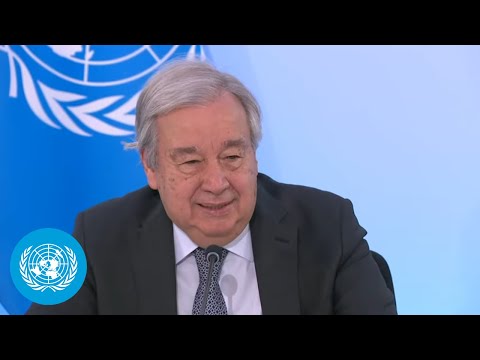
UN Secretary-General urges urgent global action to protect oceans, warns against ‘Wild West’ seabed mining
Summary
The United Nations Secretary‑General outlined four priorities for ocean protection — sustainable fishing, a 30% conservation target by 2030, a legally binding plastics treaty and caution on seabed mining — and answered reporters’ questions at a press conference.
The United Nations Secretary‑General urged swift, coordinated global action to protect the ocean at a press conference, listing four priorities including stronger enforcement against illegal fishing, conserving at least 30% of marine and coastal areas by 2030, pursuing a legally binding treaty on plastic pollution, and proceeding “with great caution” on deep‑sea mining.
The remarks came as the secretary‑general described the ocean as “the lifeblood of our planet,” responsible for about half of the oxygen produced globally and underpinning food security, jobs and trade. He warned that climate change, plastic pollution and illegal fishing are driving “troubling signs” that recovery may become impossible and said powerful interests are accelerating the threat.
The secretary‑general opened with the conference slogan, “Save the ocean to save our future,” and said, “When we poison the ocean, we poison ourselves.” He listed sustainable fishing, protected areas, a plastics treaty and ocean‑based climate solutions among the priorities and called on governments, business leaders, fishers, scientists and civil society to act.
On protected areas, he reiterated support for the international “30 by 30” goal: “deliver[ing] on the 30 by 30 target to conserve and manage at least 30% of marine and coastal areas by 2030.” He urged countries to finalize an “ambitious legally binding global treaty to end plastic pollution,” saying all countries must “quickly finalize” such an agreement.
The secretary‑general also highlighted progress on an agreement for marine biodiversity in areas beyond national jurisdiction, congratulating “the 134 countries that have signed and the 49 and counting that have ratified the agreement, including 18 new signatures and 18 ratifications yesterday alone,” and saying entry into force is “within our sights.”
When asked about deep‑sea mining by Adam Vaughan of The Times of London, the secretary‑general said the International Seabed Authority has “a key role to play” and that he trusts it “will be doing what is necessary to avoid the Wild West that I mentioned.” He later said, “the deep sea cannot become the Wild West.”
Reporters asked follow‑up questions on implementation and urgency. Asuri Fernando of The Daily Morning (Sri Lanka) asked how the UN can help small states with limited enforcement capacity to stop illegal, damaging fishing practices; the secretary‑general called for stronger international accountability mechanisms, acknowledging current mechanisms are “extremely limited and inefficient.” Nick Perry of AFP asked whether the 1.5°C target is slipping; the secretary‑general said scientists are clear that 1.5°C is still achievable but that current progress is too slow and urged countries to present national plans aligned with that limit at the next UN climate conference.
He repeatedly linked ocean health to climate action, urging protection of mangroves, seagrass beds and coral reefs as ocean‑based climate solutions and calling for increased financial and technological support to developing countries to respond to extreme weather and sea‑level rise. He emphasized the existential stakes for coastal communities and small island developing states.
The press session closed with the secretary‑general urging countries to turn pledges into commitments and funding, saying, “The ocean has given us so much. It's time we return the favor.”