Get Full Government Meeting Transcripts, Videos, & Alerts Forever!
Get email alerts on the Environment Water Alewife Cso topic
No spam. Unsubscribe anytime.
Residents, students press City Council and MBTA to address Alewife sewage in redevelopment
Summary
Large public turnout urged the City Council and state agencies to require Alewife redevelopment plans to prioritize eliminating combined sewer overflows (CSOs), endorsing wetlands and underground storage as tools while staff said a formal CSO control planning process is already under way.
Hundreds of residents, students and environmental advocates told the Cambridge City Council on June 9 that redevelopment of the MBTA’s Alewife Station site presents a once-in-a-generation chance to fix chronic sewage discharges into Alewife Brook.
Speakers at public comment urged the City to press the MBTA, the Massachusetts Water Resources Authority (MWRA) and the governor to require concrete CSO mitigation in the MBTA redevelopment request for proposals (RFP). Many recommended a mix of “green” solutions — constructed wetlands and rain gardens — and “gray” solutions such as underground storage tanks to hold stormwater and combined flows until they can be routed to treatment.
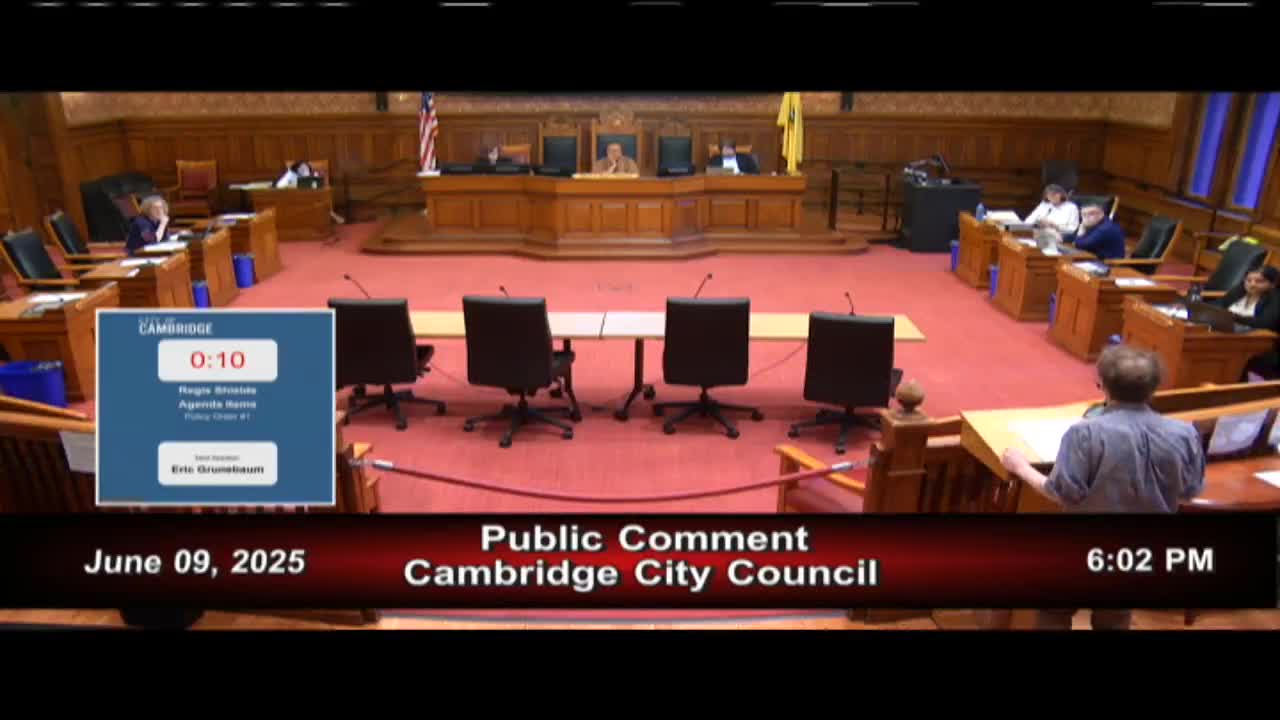
Eric Grunenbaum, a North Cambridge resident who has tracked overflows, told the council the site is “a unique opportunity” to pair new wetland creation with storage and to reconnect fragmented green space. “Who has authority over the authorities?” he asked, appealing for state and regional agencies to coordinate with the city. Students from the Ringe Avenue Upper School and younger schoolchildren described smelling sewage and losing recreational access to the brook; 7‑year‑old Ellie Sailor said she could not “walk [or] play near a beautiful brook without a stinky stench.”
Councilors pressed staff and invited agency officials to explain the timeline and options. Kathy Watkins, the city official leading Cambridge’s work on the CSO control plan, told the council the city is already in a formal, multi‑party process with the MWRA and neighboring Somerville to develop long‑term CSO controls. “The draft plan is due at the end of this year, with the final plan due in January 2027,” Watkins said, urging that feasibility and sequencing be worked through in that process rather than prescribing a single piece of infrastructure without the larger context.
Speakers and advocacy groups asked that the MBTA RFP be amended to treat on‑site storage and wetland construction as priorities rather than optional elements. Supporters said state land at the MBTA garage is a logical place for storage and wetlands because it sits adjacent to known overflow points and to the Alewife Wetland already maintained by the city.
Councilors gave the matter extended attention during the policy‑order agenda, with several members stressing the urgency of the CSO control plan deadline and the need to coordinate multiple agencies. Staff briefed the council on prior projects (including the earlier Alewife wetland) and warned that implementation requires technical analysis, land‑use tradeoffs and funding decisions across several authorities.
The issue drew residents from Cambridge and neighboring towns and repeated calls for the city to use its voice with the governor and MBTA. Councilors did not adopt a single prescriptive engineering approach in the meeting; rather, the hearing produced an apparent consensus that the Alewife redevelopment be shaped to address sewage overflows and that the city press the MBTA and state partners to incorporate CSO mitigation into the site plan and RFP process.
The council and city staff said they would continue to press for coordination with the MBTA and MWRA, to review RFP language as it is finalized, and to advance the technical CSO control planning required by state regulators.