Get Full Government Meeting Transcripts, Videos, & Alerts Forever!
Get email alerts on the Summer Learning topic
No spam. Unsubscribe anytime.
Dallas Public Library outlines Smart Summer learning program; staff say it is privately funded and serves thousands
Summary
Library staff told the Quality of Life Arts and Culture Committee on June 9 that Smart Summer, the library’s summer learning program, runs May 31–Aug. 9, is funded by Friends of the Dallas Public Library and partners, and recorded about 9,000 registrations, nearly 42,000 program attendees and nearly 16,000 free meals last year.
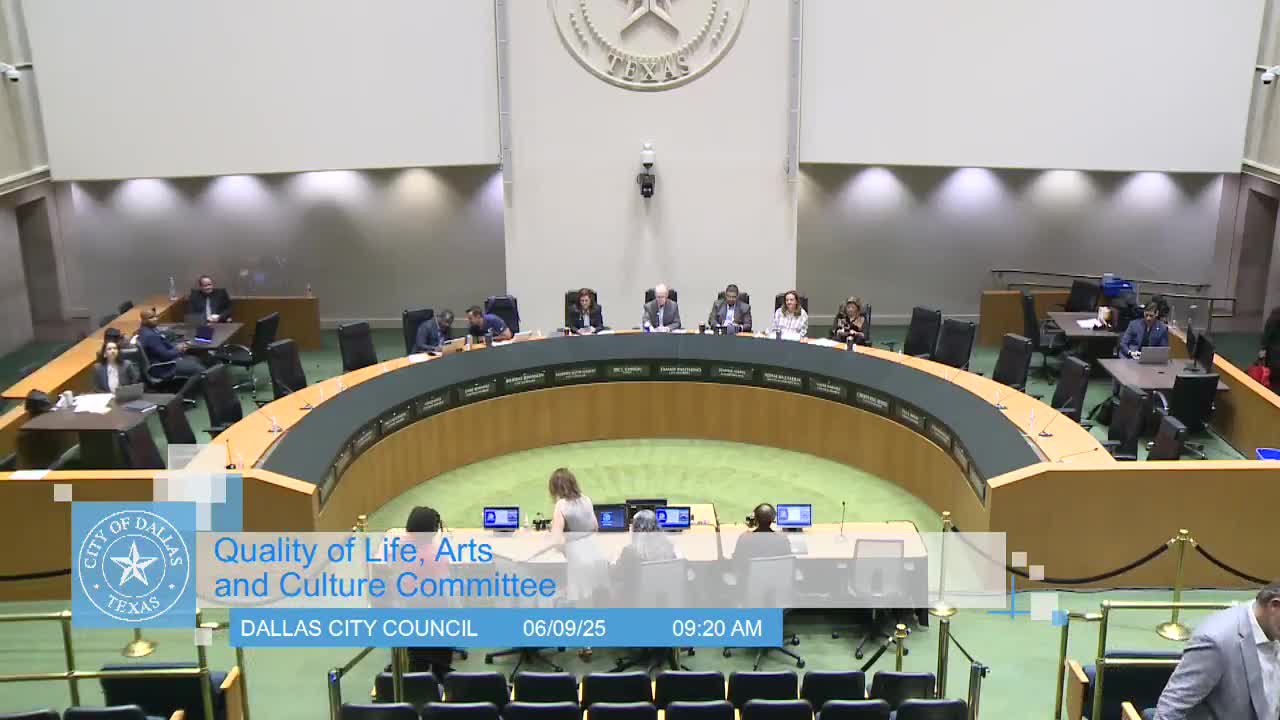
Heather Lowe, interim library director, and Melissa Deese, interim assistant director, briefed the Quality of Life Arts and Culture Committee on June 9 about Smart Summer, the Dallas Public Library’s annual summer learning program.
Melissa Deese said Smart Summer runs May 31 through Aug. 9 and “is completely privately funded,” noting that the Friends of the Dallas Public Library raise funds each year and that the library attracts regular corporate and nonprofit sponsors. She said the program uses the SMART acronym—science, math, art, reading and technology—and that the library shifted from a summer-reading model to a broader summer-learning model to address declines in multiple academic areas during the summer.
Deese provided participation figures from the prior year: about 9,000 children and adults registered, more than 2,000 library programs were offered, and nearly 42,000 people attended events across the library’s 30 locations. She said roughly half of branches provide free summer lunches and that last year the library served nearly 16,000 free meals to children through partners, which Deese cited as Education PV and the Texas Department of Agriculture.
The committee questioned program measurement and outreach. Committee member Blackman asked whether the library evaluates learning loss by coordinating with school districts. Deese said the library has tried but that Dallas Independent School District (DISD) privacy rules limit data sharing; she said library staff receive anecdotal feedback from teachers and that the library will continue outreach and media efforts—including an upcoming Univision segment—to raise awareness.
Committee member Gracie asked about age ranges and teen programming. Library staff said the dominant registrants were preschool and early-grade children and that teen-targeted programs exist separately from parks-run summer camps. The library said it partners with the Park and Recreation Department to host parks summer camps at 10 branches; Deese and staff listed the parks branches hosting camps as White Rock Hills, Polk Wisdom, Pleasant Grove, Grauwiler Park, Skyline, Forest Green, Dallas West, Arcadia Park, Hampton, Illinois and Prairie Creek.
Deese described program mechanics: children are asked to read 20 minutes a day for 10 days, discover 10 things and create 10 things; each set of 10 activities earns a free book, and completing 30 days/20 activities enters children in a grand-prize drawing. Adults are asked to read 30 minutes a day for 15 days with a similar reward structure. The library also ramps up adult programming at the Central Library with “Summer Saturdays” and other events designed to activate downtown.
Committee members suggested benchmarking and collecting metrics for funder reporting and outreach; committee members also requested marketing materials the library can use in constituent communications. Library staff agreed to share flyers after the meeting. The committee did not take formal action on the program during the June 9 briefing.