Get Full Government Meeting Transcripts, Videos, & Alerts Forever!
Get email alerts on the Zoning Rezoning topic
No spam. Unsubscribe anytime.
Grand Prairie staff opposes rezoning at 2033 Galveston to allow attached single‑family units
Summary
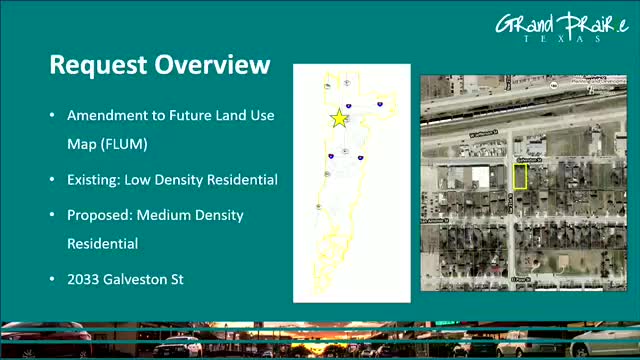
Planning staff recommended denial of a future land use map amendment and rezoning request at 2033 Galveston that would allow a single‑family attached (duplex) development on a lot currently designated low‑density residential.
Sheryl Smith, chair of the Grand Prairie Planning and Zoning Commission, opened the staff briefing by introducing a combined presentation on a comprehensive plan amendment and zoning change for 2033 Galveston.
Staff told commissioners the applicant seeks a future land use map amendment to change the parcel’s designation from low‑density residential to medium‑density residential and a concurrent rezoning from Single Family 6 to Single Family Attached (SFA) to allow two attached dwelling units on the lot. Staff said the proposed uses do not align with the current future land use map and recommended against the change.
Commissioners asked about surrounding land uses and potential impacts. Staff said properties to the east and south are low‑density single‑family and properties to the north and west are commercial retail/office. One commissioner asked whether the neighboring parcel immediately east contained an existing house or looked vacant; staff clarified there is a single‑family home to the east. Staff explained that SFA zoning would allow two units on the single lot and that requests for attached single‑family zoning in older single‑family neighborhoods have occurred elsewhere as the market seeks to increase unit yield on smaller lots.
Staff noted the application would require subdivision and compliance with SFA district standards if approved. The briefing concluded with staff available for questions; no formal action was taken at the briefing. The item will be considered at the public hearing during the regular meeting, where the public may comment and the commission may take action.