Dallas Aurora organizers pitch expansion of light-and-technology festival as a city signature event
Loading...
Summary
Organizers of Dallas Aurora told the Quality of Life Arts and Culture Committee on June 9 that the 15-year light-and-technology festival has grown to hundreds of thousands of attendees and is seeking a formal city partnership, funding pathways and a national communications plan to scale into a signature international event.
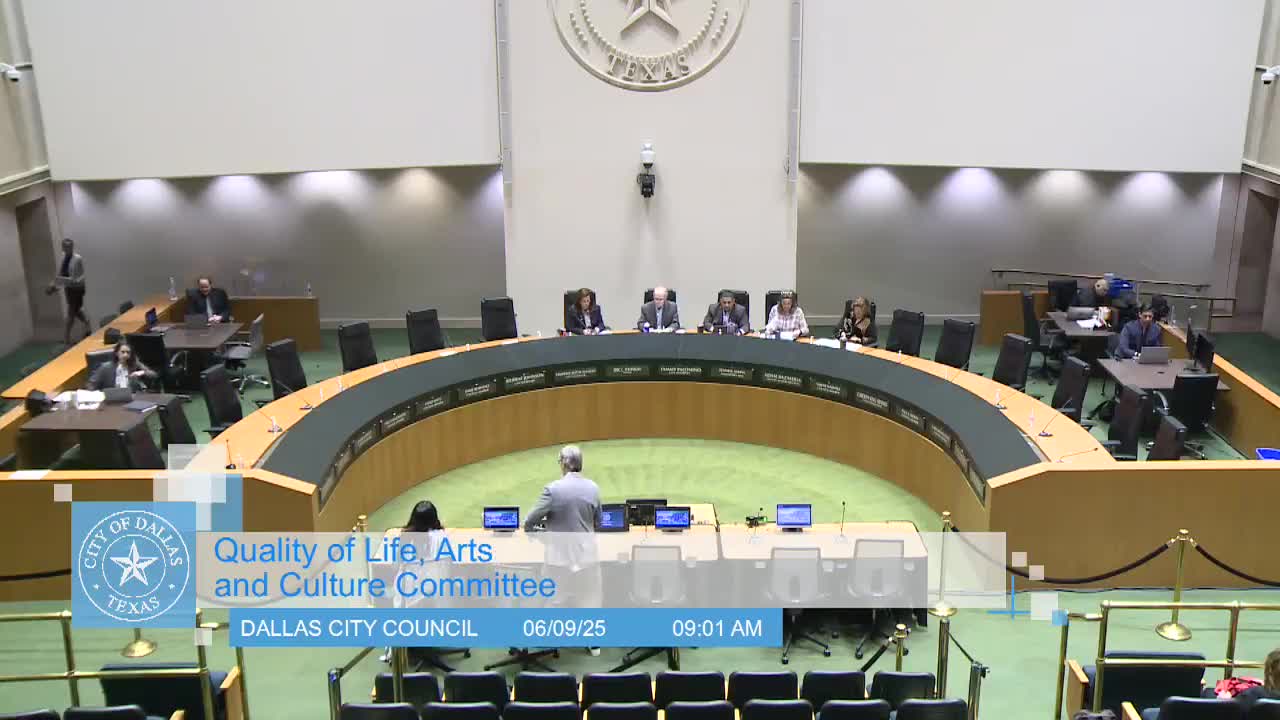
Martine Philippe, director of the Office of Arts and Culture, introduced Joshua King, founder of the Aurora Festival, who briefed the Quality of Life Arts and Culture Committee on June 9 about plans to grow Aurora into a Dallas signature event.
King said Aurora was founded on Nov. 19, 2010, at the Dallas Heritage Village and that its central premise is that “art should be for everybody,” meaning art staged across public spaces rather than confined to institutions. He told committee members Aurora has attracted more than 200,000 visitors to its programs over 15 years, commissioned about 413 artists from more than 70 countries on more than 200 acres of public land, and recorded what he summarized as roughly 90 million media impressions and substantial social-media engagement.
The presentation stressed both cultural and economic ambitions: King compared Aurora to Nuit Blanche (Toronto) and Vivid Sydney, noting those events’ multimillion-dollar economic impacts, and said Aurora’s board believes the festival can become a global-drawing free public event that also improves quality of life across Dallas neighborhoods.
Committee members asked how the festival would convert local programming into sustained growth. Committee member Schultz asked about specific goals and strategies to build a beloved, community-based event that then attracts tourism. King replied the organization has focused on community programming since the pandemic and is seeking longer-term financial commitments and strategic alignment with city tourism bureaus and major partners rather than purely organic growth.
Committee member Willis pressed on revenue channels and what the city currently provides. Willis said she had asked Martine Philippe about city support and was told the city provided a $25,000 line item in 2024 and that the city has in the past waived permitting fees and provided in-kind assistance such as barricades and parking meter hooding through the Office of Special Events. King and Philippe said those operational waivers help but do not replace the significant private and philanthropic resources needed to stage an event that, King said, can cost “millions of dollars to pull off.”
King described community programs Aurora runs year-round to sustain neighborhood impact, including an Art Quest scavenger-hunt program partnering with groups in Pleasant Grove, Bachman Lake and South Dallas and collaborations with organizations such as Los Primos Dallas, Jubilee Park, the African American Museum, Dallas Parks and Recreation and others. He also listed philanthropic supporters and partners, naming the McDermott Foundation, the J. Eric Johnson Fund, the Addy Foundation, the Levy Family Fund and the Tomah Foundation, and programming partners including the AT&T Performing Arts Center, the Dallas Museum of Art and Dallas Public Libraries.
King asked the committee to consider a formal city–Aurora alliance to identify funding and shared resources and to develop a national communications plan. He did not present a specific funding request at the June 9 meeting; he said he would return with more detail after consulting the committee and partners.
Committee members, including Vice Chair Rezendes, praised Aurora’s outreach to grassroots organizations in Southeast Dallas and Pleasant Grove and encouraged staff and council members to consider how to support scaling while keeping neighborhood programming intact. Several members offered to help convene partners or provide channels for coordination; no formal direction or funding commitment was taken at the meeting.
The committee’s next steps were not set during the briefing; King said he would follow up with the committee to identify how the city can form revenue channels, communications channels and a formal partnership with Aurora.