Get Full Government Meeting Transcripts, Videos, & Alerts Forever!
Get email alerts on the Zoning Map Amendments topic
No spam. Unsubscribe anytime.
Residents press commission over recent rezones; commissioner and staff debate rezone process and Tri Point lots
Summary
Public commentators objected to the recent Fulshear Crossing rezoning and raised questions about a small Tri Point/KIPP tract where houses were built; staff and special counsel said rezoning must follow statutory process and the city is investigating several contested parcels
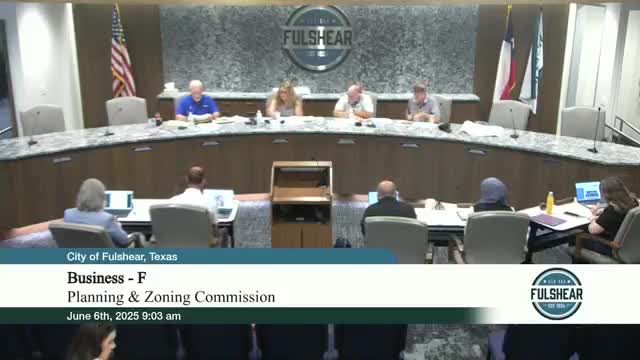
Public commenters at the June 6 Planning and Zoning Commission meeting sharply criticized recent rezoning decisions and asked the commission and city council to reconsider approvals affecting the Fulshear Crossing tract and a small tract where Tri Point has already built lots.
A long, sometimes heated public comment from a resident who identified himself as representing nearby homeowners said "The proposed zoning map amendment disgusts me," and alleged misinformation or missing analyses at the City Council hearing for the Fulshear Crossing rezoning. The speaker asserted that five of seven adjacent property owners had prepared protest petitions but that the petitions were not filed in time to trigger a super-majority review at council. He urged a council member to initiate a reconsideration or rezone process if possible.
The same speaker and other residents also questioned how Tri Point was permitted to build four lots on a five-acre tract they said had always been "estate residential" (R-1). They provided maps and said county appraisal-district materials show the KIPP track was excluded from the adjacent PUD; they asked how two houses were already built and whether the city would enforce zoning or pursue injunctions for violations. One resident said, "If my arithmetic is correct, they can only have 2 houses," and urged the city to investigate whether the developer exceeded permitted density.
City planning staff responded that a general site plan presented with a rezoning application is an initial concept and "is not the finish line," explaining that detailed items such as ADA parking counts, handicap stalls and final lighting plans are evaluated during permitting. Staff said the Fulshear Crossing rezoning was approved by City Council consistent with law and that, following rezone approval, the city enforces development standards at the platting and permit stages. Staff also said there is a recorded public-access easement associated with Fulshear Crossing and that the city will investigate the Tri Point / KIPP tract issues raised by residents.
Special counsel Charlie Zeck (Denton Navarro) clarified legal limits for reversing a zoning decision in open session: he declined to answer a specific question in public, citing attorney-client privilege, and offered to answer council legal questions in closed session. Later in the discussion he stated generally that, under Texas zoning law, a council cannot simply "reconsider" a zoning decision without initiating the statutory rezoning process; a new rezoning initiation and full hearing sequence would be required to change a final rezoning decision.
Commissioners and staff emphasized the distinction between a rezoning decision (a legislative land-use action) and the later technical reviews that govern parking counts, lighting, and similar code compliance. Commissioner voices on the dais said they will continue to review rezoning requests and investigate the specific Tri Point concerns raised by residents.
No formal action to rescind or initiate a rezone was taken at the meeting; commissioners recorded that staff would further investigate the Tri Point tract and the Fulshear Crossing public-access and development-agreement records.