Get Full Government Meeting Transcripts, Videos, & Alerts Forever!
Get email alerts on the Leesburg Gateway Town Plan topic
No spam. Unsubscribe anytime.
Planning commission sends Leesburg Gateway town‑plan amendment to July work session after public concern over data‑center option
Summary
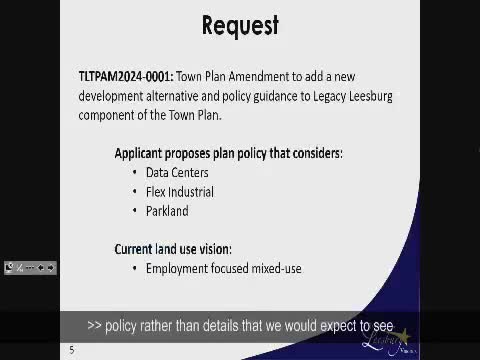
Commissioners voted to send the proposed town‑plan amendment (TLTPAM 2024‑1) for the Leesburg Gateway to a July work session after extended public comment and staff/applicant presentations on an alternative land‑use option that would allow data centers, flex industrial and parkland on roughly 101.9 acres north of Route 7.
The Leesburg Planning Commission on June 5 voted to forward the proposed town plan amendment TLTPAM 2024‑1 (the “Leesburg Gateway” amendment) to a commission work session in July 2025 for further discussion and refinement after an extended public hearing that included dozens of questions and multiple public speakers.
Staff presented background showing the subject area—about 101.9 acres north of Route 7 bounded by Potomac Station Drive, Battlefield Parkway and the Leesburg outlet mall—was previously designated in the Eastern Gateway Small Area Plan as a walkable mixed‑use neighborhood and innovation center. Rich Klusick, presenting for staff, explained that the applicant seeks to add an alternative land‑use policy to the town plan that would allow data centers, flex industrial and a substantial area of parkland as an alternative to the existing mixed‑use vision. The staff memo outlined pros and cons: potential for substantial tax revenue and reduced vehicle trips from low‑traffic data centers versus loss of residential opportunity, reduced pedestrian amenity and compatibility concerns with adjacent neighborhoods.
Applicant representatives said the land’s roadway context and the completed Battlefield Parkway–Route 7 interchange make the originally envisioned high‑density mixed use difficult to support and that a different, lower‑trip alternative (data centers, flex uses and a park) could preserve large swaths of trees and deliver at least 20 acres of parkland to the town. Molly Novotny, an urban planner with Curata Partners, said the applicant’s illustrative concept dedicates roughly 22 acres for a future town park, preserves existing mature tree stands in tree‑conservation easements, and locates data‑center buildings in lower topography so their visual presence would be limited; she also noted the data‑center buildings would be subject to the town’s 65‑foot height limit for such buildings.
Public comment included repeated questions and objections from nearby residents and groups. Residents and speakers raised concerns about power supply and the potential need for additional substations and transmission/distribution infrastructure (Brian Wegener and Jen Bingle of the Piedmont Environmental Council pressed the issue), noise from backup generators and mechanical equipment, increased construction traffic and sediment tracked onto local streets, loss of walkable mixed‑use amenities, and compatibility with the adjacent Sycamore Hill neighborhood. Several speakers urged the commission to deny the amendment or to hold a comprehensive community review of the quadrant rather than approving an amendment that applies only to the applicant’s parcels.
Commissioners on the planning commission said they wanted more analysis and time to weigh tradeoffs. Commissioners raised questions about how the proposed policy would affect the “donut” parcel not controlled by the applicant, where future mixed‑use development could become isolated, and asked staff and the applicant to provide additional information on utility capacity (power and water), transportation assumptions given the Route 7 interchange, buffering and noise mitigation (applicant cited a proposed 55 dBA noise proffer for some property lines), and the public‑park planning process. The applicant said the rezoning package (under separate review) will provide more detailed plans, elevations and proffers and that the applicant is prepared to discuss noise and buffering in the rezoning.
The commission voted to send the town‑plan amendment to a work session in July 2025 to address those issues. The action does not approve a rezoning or authorize data‑center construction; such steps would require separate rezoning and special‑exception approvals and additional public hearings.