Get Full Government Meeting Transcripts, Videos, & Alerts Forever!
Get email alerts on the Zoning Cdo Amendment topic
No spam. Unsubscribe anytime.
Fulshear planning panel recommends CDO changes to allow apartments in commercial zones, limits digital signs to public schools
Summary
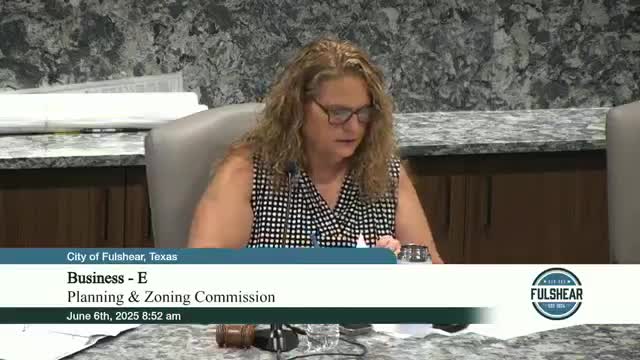
The Fulshear Planning and Zoning Commission on June 6 recommended approval of ordinance 2025-1495, which amends the city's Coordinated Development Ordinance to permit apartments under conditions in General Commercial zones and to allow electronic message-board signs only for public schools.
The Fulshear Planning and Zoning Commission on June 6 recommended approval of ordinance 2025-1495, which amends Chapter 28 (the Coordinated Development Ordinance, or CDO) to update allowed uses and sign rules including (1) permitting apartments as a conditional use in the General Commercial district under several conditions and (2) restricting electronic message-board signs to public schools.
The vote came after public comment from Randolph Elementary parents and school volunteers urging the city to allow a digital marquee at the school, and a lengthy staff presentation describing proposed conditions that would apply when multifamily is allowed in general commercial areas.
City planning staff said the proposed amendment would add apartment uses to the General Commercial table of allowed uses and add conditions in section 28-2-16. Among the conditions listed by staff: the parcel must be subject to a development agreement executed before July 16, 2019; civic-orientation features and a minimum of 10% publicly accessible open space; clearly defined internal pedestrian circulation separated from vehicular lanes; a required traffic impact analysis; a Type C buffer; at least 50% of a site preserved for commercial use; installation of a license-plate reader meeting police standards; and adherence to downtown architectural standards for multifamily buildings (architectural standards only). Staff also described edits to sections 28-3-32 (electronic boards) and 28-3-33 (signage in the extraterritorial jurisdiction) to align ETJ signage with the General Commercial district.
Several parents and PTA leaders from Randolph Elementary, which is in Cross Creek Ranch, told the commission they supported electronic signage for school communications. "A digital marquee would allow us to communicate more clearly, more quickly, and more efficiently," said Lauren Ganz, who identified herself as speaking on behalf of Randolph Elementary. Lindsey Rock, who said she will be PTA president next year, added that the sign would be used "strictly for school functions and things like that" and not for sponsorships. Holly Sailors, a Katy ISD staff member, and Nadita Singh Ganesh, a former PTA president and parent, said the sign would reduce staff time changing manual letters and could be used for fundraising messages such as birthday recognition.
Commission discussion focused on public-safety and nuisance concerns tied to electronic message boards. Commissioners asked staff to draft explicit operational limits for electronic signs including hours of operation, brightness controls, limits on scrolling or flashing, message-dwell times, and maximum lettering size. Commissioner Dowdall suggested shortening proposed operating hours (staff had described an example schedule of 6:30 a.m. to 9:00 p.m.); the commission generally indicated interest in an earlier sign shutdown and a brightness-reduction requirement after dusk.
Staff and the commission also discussed administrative issues: the version of the amended use table included with the packet reflected an older Municode export, and staff said they would ensure codified tables match the adopted ordinance. Staff confirmed that the phrase "public schools" in section 28-3-32 would use the existing Article 9 definition, and would not extend electronic-board permissions to day cares or preschools.
After discussion, Commissioner Dowdall moved to recommend approval of ordinance 2025-1495 with direction that staff incorporate the commission's clarifications and sign-specification details; Commissioner Amen seconded. The motion passed. The commission recorded no roll-call tallies in the minutes; the action was recorded as "motion carries." The recommendation will go to city council for final consideration on June 17 at 6:00 p.m.
The commission also asked staff to coordinate final ordinance language to: (1) ensure the General Commercial multifamily conditions track the referenced development agreement terms, (2) add clear, enforceable sign specifications (hours, brightness, scrolling limits, message duration, and maximum lettering size), and (3) correct the online codified table so it reflects the latest approved amendments.
What happens next: Because the Planning and Zoning Commission made a recommendation, city staff will prepare a final ordinance and corrected codified tables for City Council consideration at the June 17 meeting; the commission specifically asked staff to return with tightened sign standards before council action.