Get Full Government Meeting Transcripts, Videos, & Alerts Forever!
Get email alerts on the Rebeach Pilot Reef topic
No spam. Unsubscribe anytime.
Oceanside describes pilot "Living Speed Bumps" reef to Carlsbad; commission votes to reopen review of its anti-structure resolution
Summary
Oceanside staff outlined ReBeach, a pilot sand-retention project featuring a submerged artificial reef and headlands. Commissioners agreed to request a formal reevaluation of Carlsbad's 2022 resolution opposing devices that could affect natural sand flow.
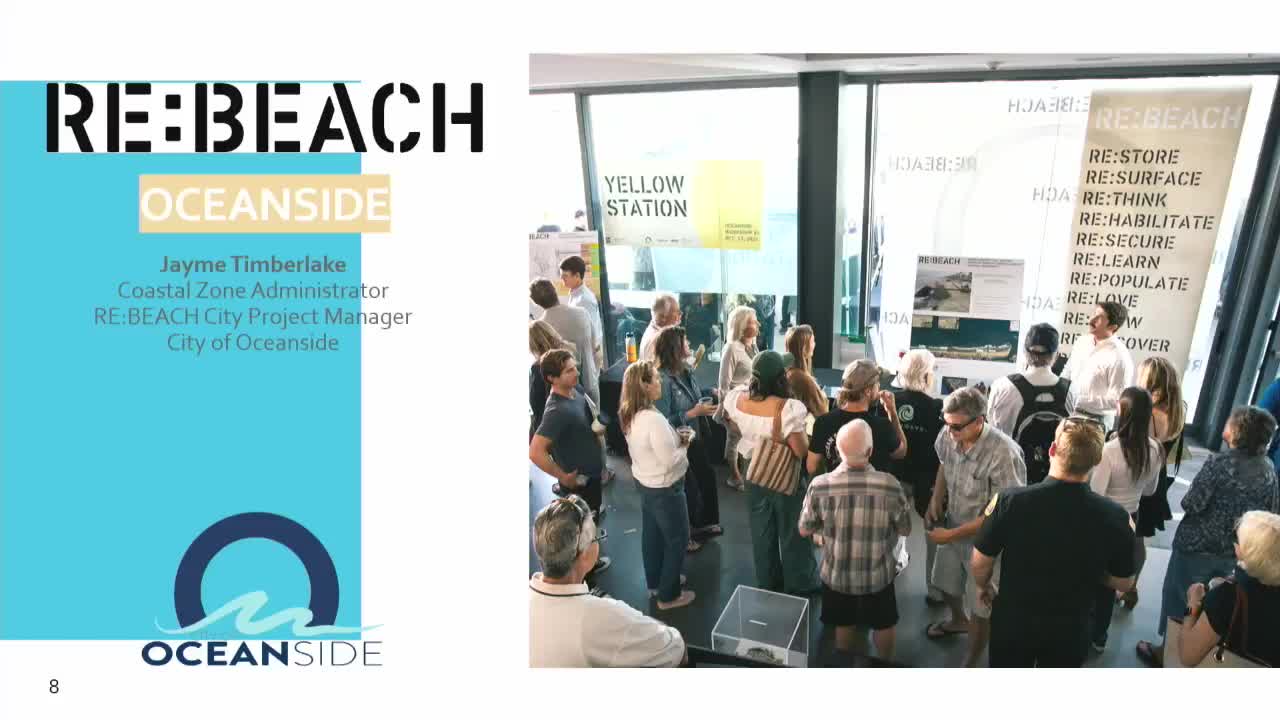
Oceanside presented its ReBeach pilot sand‑retention project Thursday to the Carlsbad Beach Preservation Commission, describing an artificial submerged reef, new headlands and on‑beach and nearshore nourishment intended to retain sediment and slow chronic coastal erosion.
The presentation from Jamie Timberlake, coastal zone administrator for the City of Oceanside, emphasized numerical modeling, baseline monitoring and public outreach as Oceanside moves from a concept selected in an international design competition toward refined design and permitting. Timberlake said the pilot would combine a submerged reef, short shore headlands and both nearshore and on‑beach nourishment and described the reef as “about 10 acres” and placed roughly 900 feet offshore in 30–40 feet of water.
The proposal is intended to trap some portion of sand moving in suspension so it can accumulate onshore; Timberlake told the commission Oceanside anticipates bringing “about a million cubic yards of sand” to the pilot and said the design team expects the reef to retain roughly 20% of delivered sand in the lee of the structure.
Why it matters: Carlsbad commissioners and staff said they want better, locally relevant analysis before formally supporting any structure that could alter regional sediment transport. Carlsbad has a standing council resolution adopted Jan. 12, 2022, opposing construction of devices that could interfere with the natural flow of sand into Carlsbad; commissioners moved and voted to add a future agenda item to reevaluate that statement of opposition so the council can consider it in light of the new ReBeach design and monitoring commitments.
Oceanside described technical steps already underway: a baseline monitoring program funded through a California Coastal Commission grant, enhanced numerical modeling using shore transects and bathymetry, and advisory committees on topics including surf resources and reef biology. Timberlake said the baseline monitoring will cover Oceanside’s coast “south of the pier all the way down to Tamarack,” and that the data will be used in an adaptive management plan that could include triggers to change operations if downstream shorelines — including Carlsbad’s — show negative effects.
Public commenters and some commissioners said the concept may be appropriate for Oceanside but is not automatically appropriate for every city. Mitch Silverstein, senior San Diego policy coordinator for Surfrider Foundation, who served on the project’s design selection committee, said ReBeach “is a cool project” but cautioned that such structures “are the worst way possible to save a beach” if the underlying causes of erosion are not addressed. Diane Nygaard of Preserve Calavera urged city action in a separate public‑access issue (see related article).
Commission reaction: Commissioners pressed Oceanside staff on the geographic limits of the modeling and the anticipated monitoring triggers; Timberlake said the project team could explore additional model runs to clarify potential effects south of Tamarack. Commissioners and staff also discussed an existing Carlsbad council resolution opposing “devices that interfere with the natural flow of sand”; staff confirmed the resolution remains in effect and had been noted at the regional Shoreline Preservation Working Group meeting. After discussion, the commission voted unanimously to add an agenda item asking the council to reevaluate (noted in the motion as a rescind/reevaluate action) that 2022 resolution, so the council can consider whether to modify it in light of the current project and new monitoring commitments.
Next steps: Oceanside plans a public webinar on the headland concepts and design options; Timberlake advised signing up at rebeach.org. Timberlake and SANDAG staff encouraged Carlsbad to participate in the adaptive management and advisory committees and to identify council priorities and monitoring triggers so any regional pilot can better reflect downstream needs.
Ending: Oceanside officials said the Army Corps of Engineers’ regional study remains delayed (Timberlake said the Corps’ study is now projected for 2027) and that ReBeach permit and design steps will continue while the city seeks public and agency review. The commission scheduled a future agenda item to reconsider Carlsbad’s 2022 resolution and to review any additional ReBeach materials the staff brings forward.