Get Full Government Meeting Transcripts, Videos, & Alerts Forever!
Get email alerts on the Budget topic
No spam. Unsubscribe anytime.
San Francisco HSH outlines budget cuts, preserves shelter beds and pushes 'Breaking the Cycle' integration with public health
Summary
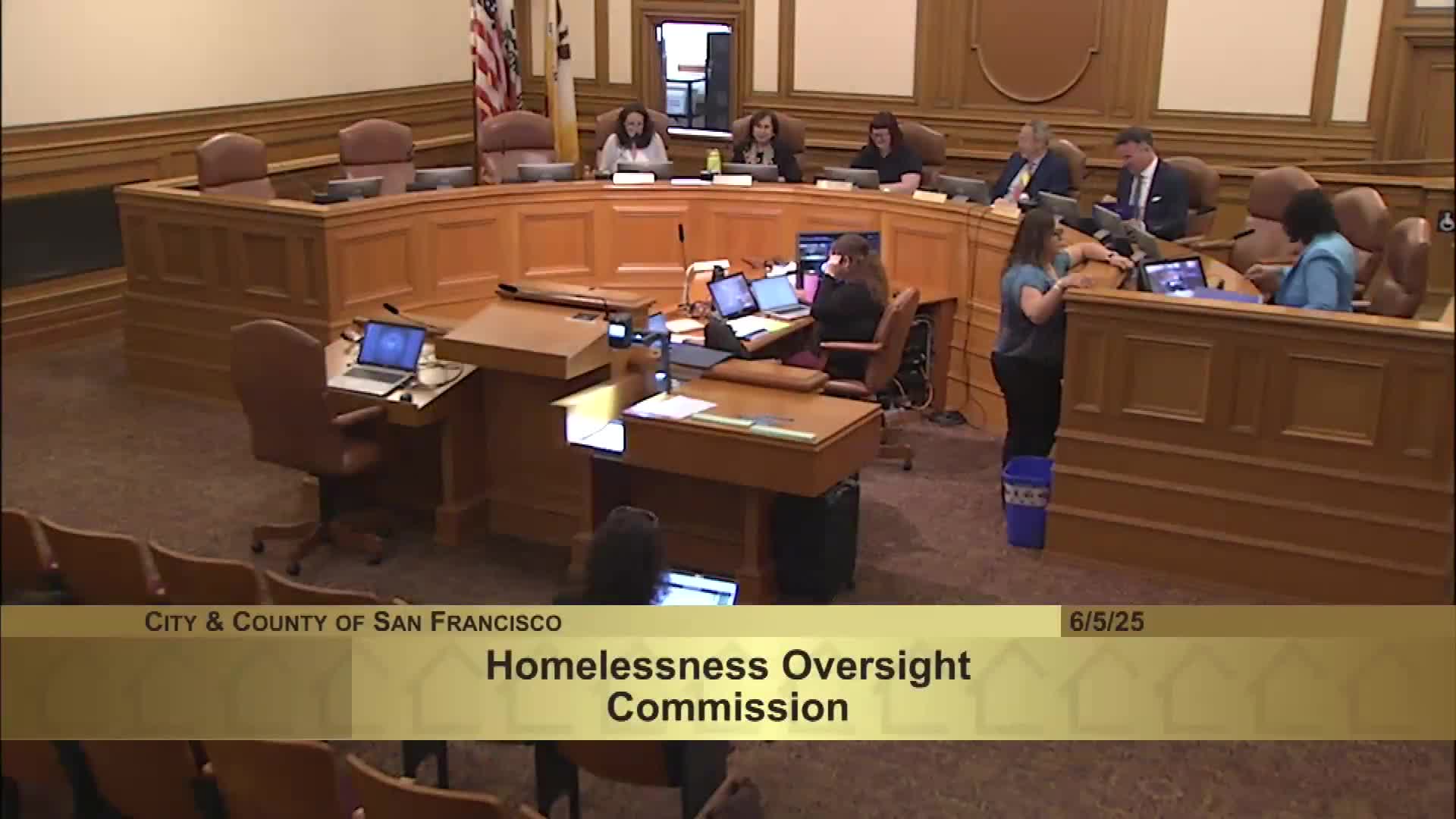
The San Francisco Department of Homelessness and Supportive Housing (HSH) on June 5 presented Mayor Lohrey’s proposed fiscal 2025–27 budget and a new “Breaking the Cycle” cross‑agency initiative that would expand interim housing and align behavioral health services with homelessness response.
The San Francisco Department of Homelessness and Supportive Housing (HSH) on June 5 presented Mayor Lohrey’s proposed fiscal 2025–27 budget and a new “Breaking the Cycle” cross‑agency initiative that would expand interim housing and align behavioral health services with homelessness response.
HSH Executive Director Shereen McSpadden told the Homelessness Oversight Commission the mayor’s proposal aims to protect interim housing beds and subsidies despite a nearly $800 million citywide shortfall. HSH would largely preserve existing shelter capacity and the department’s filled positions, McSpadden said, while shifting some program funding to prioritize shelter, outreach and a new vehicular‑homelessness strategy.
Why it matters: The proposal tries to hold program capacity steady while addressing more intensive street conditions through integration with the Department of Public Health (DPH). Commissioners and providers said the plan’s tradeoffs — especially reassigning some prevention and set‑aside funds — could have lasting effects on families and transitional‑age youth (TAY).
Budget priorities and tradeoffs HSH Chief of Administration and Finance Gigi Whitley walked commissioners through the two‑year budget. The department’s overall appropriation falls from last year largely because one‑time funds and an administrative transfer (the Local Operating Subsidy Program) move out of HSH’s line items. The proposed budget includes: - No cuts to interim housing beds, permanent housing units or rental subsidies in year one; - An expansion plan that funds roughly 630 new interim housing beds over three years, financed in part from Our City, Our Home (the city’s gross‑receipts homelessness fund) fund balance and interest; - A roughly $1.4 million proposed reduction to Project Homeless Connect (PHC) general‑fund support, and a roughly $3.9 million reduction to community based grants overall that the department said it may cover through underspending or seek alternative sources for during the fiscal year; - Deletion of about 20 vacant general‑fund positions (the mayor restored the department’s attrition target to match current conditions), and transfer of 11 behavioral‑health clinicians from HSH to DPH to better align clinical staffing with the public health system.
McSpadden described the “Breaking the Cycle” initiative as a mayoral directive to integrate homelessness response, substance‑use and behavioral‑health services to improve outcomes and street conditions. The initiative emphasizes four principles: matching services to need, locating services where the need is, increasing transparency and accountability, and treating the planned expansion as surge capacity to buy time to fix system flow.
State and federal funding risks Whitley warned commissioners the department expects a large drop in some state grant funds in year two — including reductions tied to the HAP program — and said continued federal funding carries legal and political risk. HSH noted that litigation and new federal conditions have delayed some HUD Continuum of Care grants and that the city has pursued a temporary protective order to secure those funds.
Our City, Our Home (Prop C) and contingency use The mayor proposes reallocating certain unencumbered fund balances and interest in the Our City, Our Home fund to help pay for interim‑housing expansions and other mayoral priorities. The proposal would temporarily relax some of the ordinance’s allocation caps for up to three years. Commissioners and public commenters — including TAY and family providers — urged caution, noting Prop C’s set‑asides were intended to sustain housing exits for young people and families.
Commission response and public comment Commissioners expressed broad support for better integration with DPH but concern about long‑term impacts of shifting prevention and TAY set‑aside funds to shelter expansion. Providers and advocates at public comment said TAY and family homelessness have increased and urged the commission and Board of Supervisors to protect funds targeted to those groups. Multiple commenters said the proposed PHC cut threatens continuity of low‑barrier access services.
Next steps The mayor’s budget will be considered and amended by the Board of Supervisors in public hearings in June, with adoption expected in July. HSH staff said they will brief supervisors and return to the commission with further details on program impacts and the department’s plan to reconcile provider cost increases with largely flat grant lines.
Ending note McSpadden characterized the budget as an attempt to hold core shelter and housing capacity while redirecting resources to the mayor’s street‑conditions priorities and a more clinical, outcomes‑oriented model. Commissioners emphasized the need to preserve prevention and TAY set‑asides to avoid increasing long‑term demand on the system.