Get Full Government Meeting Transcripts, Videos, & Alerts Forever!
Get email alerts on the Water Infrastructure topic
No spam. Unsubscribe anytime.
Heath council presses staff for faster action, clearer costs on water bridge plan and proposed CO financing
Summary
Council members pushed staff to accelerate the water bridge plan, question a $7.5 million-per-well estimate and asked for a design‑build RFP to speed parallel well development. Hilltop Securities presented a plan of finance for certificate-of-obligation debt to fund utility projects and road/drainage needs.
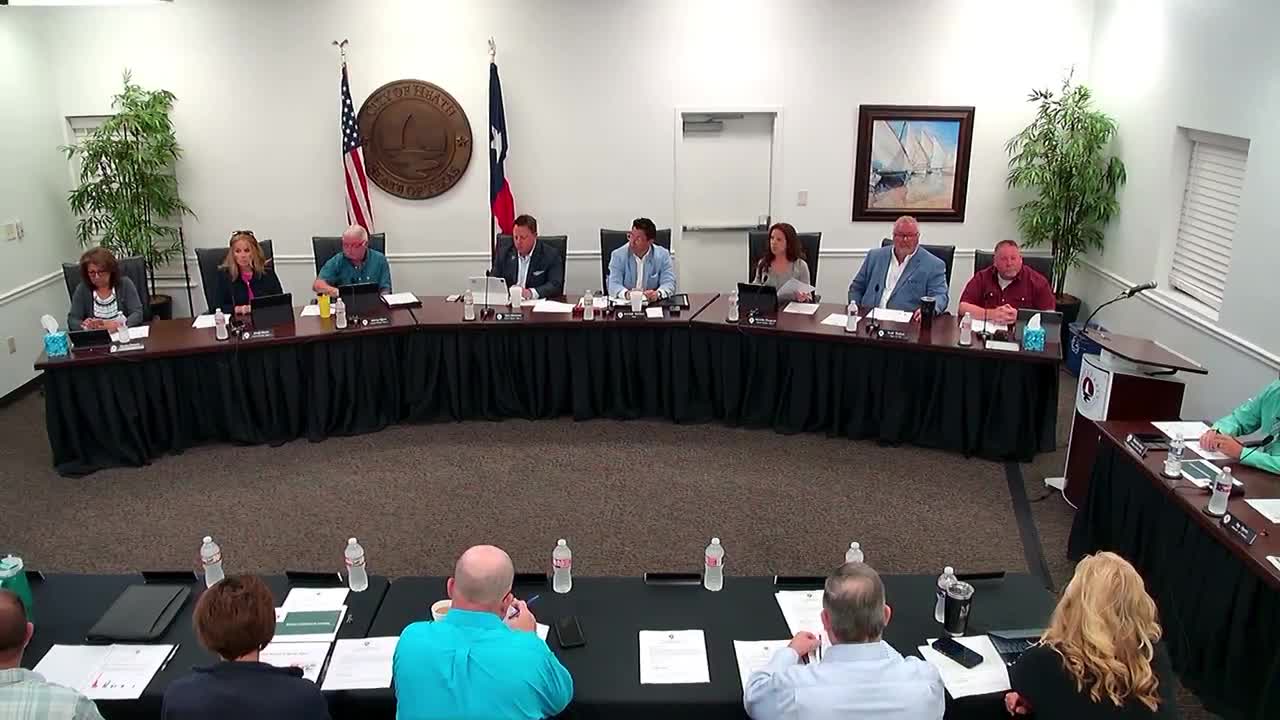
Councilmembers at the June 4 Heath budget workshop focused significant discussion on a proposed water-bridge capital program and related debt financing, pressing staff and consultants for clearer cost estimates and a faster schedule.
Jay Ayers introduced the capital items in the packet and noted a plan-of-finance will be needed to fund water- and drainage-related projects. He listed planned projects including multiple water wells, an elevated storage tank (a 3,000,000‑gallon tank is shown in the packet), and road and drainage improvements such as the Hover Drive final phase and the Meadowview culvert and bridge work.
Council members expressed frustration over pace and cost clarity. Several members said the workshop’s $7.5 million per‑well figure in the consultant materials was “jarring” and inconsistent with earlier figures. Councilman Dodson and others pressed staff to broaden the procurement approach and obtain competitive pricing. Council direction coalesced around issuing a design‑build or multi‑well RFP so bidders could propose parallel builds rather than sequential wells that would slow delivery.
Ayers and staff said the $7.5 million figure came from the Grantham consulting work and reflected prior engineering numbers; council members asked staff to confirm whether Grantham produced independent, line‑item cost estimates or relied on other firms’ numbers. Several council members urged staff to bring back more specific, dated estimates and to move concurrently on design and procurement steps rather than waiting for sequential feasibility checks.
Jim Sabones of Hilltop Securities described a financing approach the city could use if it chooses to issue certificates of obligation (COs). Sabones said COs can carry a combination pledge of ad valorem taxes and utility revenues and typically are issued with a 10‑year call feature and 20‑ to 25‑year amortizations for different project types. He recommended a phased funding approach aligned to actual bid schedules so the city borrows only when it needs cash, noting current long‑term interest rates are historically high and that issuing too much debt at once may be inefficient.
Sabones also said the city’s credit profile — a strong AA+ rating — should allow market access for the size of the program discussed, and that the rating agencies will focus on the city’s liquidity and budget performance even as overlapping debt statistics affect the “debt profile” measure. He outlined a practical timeline: a notice-of-intent resolution and statutory publication, a 45‑day waiting period, then council authorization and an attorney-general review period before sale — a roughly two‑month legal/timing window for an issuance.
Why it matters: the water-bridge program and associated COs would affect utility rates, the utility fund’s cash position and the city’s long-term debt service. Council members repeatedly said they wanted parallel procurement to accelerate reliability improvements for the city’s water supply.
Council direction and next steps: staff will (1) confirm the provenance of the $7.5 million estimate and provide dated, granular cost estimates, (2) draft an RFP option for a design‑build or bundled procurement to allow multiple wells to be bid in parallel, and (3) return with a phased plan-of-finance that ties issuance amounts to project bid and cashflow timing. Sabones and finance staff indicated phased CO issuances could be structured to minimize interest-paid-on-unspent-proceeds and preserve flexibility.