Get Full Government Meeting Transcripts, Videos, & Alerts Forever!
Get email alerts on the Comprehensive Plan topic
No spam. Unsubscribe anytime.
Maricopa County summarizes public outreach for comprehensive plan update; water, trails and housing emerge as top concerns
Summary
County planning staff reported results from two rounds of public outreach for the county's comprehensive plan update, saying water availability, protection of the natural environment, trails and affordable single-family housing topped respondents' priorities. Staff said a draft plan is expected by late summer or early fall.
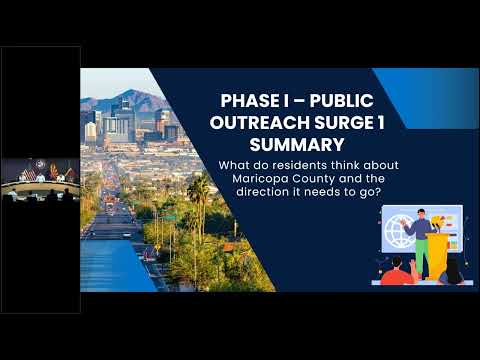
Maricopa County planning staff updated the Planning and Zoning Commission on the countywide comprehensive plan update and public outreach, saying water availability, preserving natural areas and housing affordability were the leading concerns reported in two rounds of public participation.
Adam Cannon, of Maricopa County Planning and Development, told commissioners the comprehensive plan "is the long range plan for the county and how it will grow and serve its community members in the future," and that the update is state-mandated and intended to align the county's policies with more recent plans such as the parks and transportation master plans.
Cannon said staff completed a first round of outreach earlier this year and a second round that included five in-person meetings (one in each supervisor district) and a grand virtual meeting. County staff used a community survey, an idea wall, and a virtual mapping tool on the Framework2040.com site to gather feedback, he said. "There wasn't 1 person who responded to the survey that didn't say water availability [was important]," Cannon said, describing water as the survey's top concern.
Why it matters: the comprehensive plan covers Maricopa County's unincorporated areas, sets broad policies used in rezoning and land-use decisions, and will guide development over the next decade. The plan was last adopted in 2016; state law requires updates at regular intervals.
Staff summarized survey demographics and priorities. Cannon reported that about 80% of respondents said they live in Maricopa County, roughly 65% reported they own property in the county and about 37% reported they work in the county. Respondents most often prioritized water availability, protection of the natural environment and trails; trails were mentioned 35 times in open-ended comments, Cannon said. On housing, 75% of respondents identified the availability of affordable single-family homes as the top housing challenge, and respondents flagged middle-housing options such as townhomes and duplexes as important.
Commissioners asked about the representativeness of survey respondents. Steven (planning staff) and Cannon said responses skew older, which they attributed to typical participation patterns and to the county's unincorporated population; they said staff made efforts to reach a broader cross-section by contacting businesses and stakeholders and working across supervisor districts.
Staff said the public engagement tools remain open through late summer or early fall, and they expect to post a draft plan for review by the end of the summer or early fall and to return to the commission with a formal draft. Cannon said the vision report and outreach results are posted at Framework2040.com and that staff will continue online outreach, social media and e-blasts to raise participation.
The commission did not take a formal vote on the comprehensive plan at the meeting. Staff encouraged commissioners and members of the public to complete the round-two survey focused on draft goals and policy statements.
Next steps: staff said they will prepare a draft plan for public review in late summer or early fall, continue outreach, and bring the draft back to the commission before formal hearings.