Get Full Government Meeting Transcripts, Videos, & Alerts Forever!
Get email alerts on the Housing Element topic
No spam. Unsubscribe anytime.
City Plan Commission recommends housing element amendment, sends plan to zoning committee
Summary
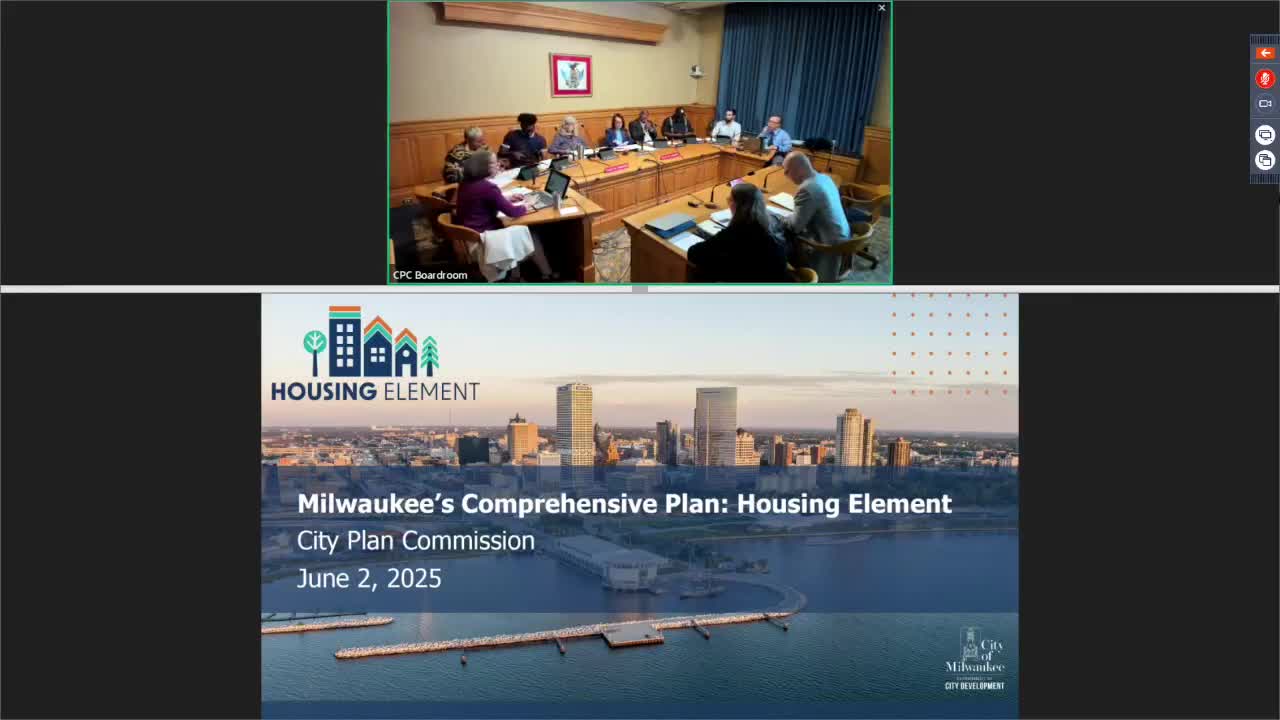
The Milwaukee City Plan Commission on June 2 recommended approval of File 240,402 (substitute ordinance A), adopting the housing and neighborhoods element as the housing element of the citywide policy plan and directing implementation.
The Milwaukee City Plan Commission on June 2 recommended approval of File 240,402 (substitute ordinance A), adopting the housing and neighborhoods element as the housing element of the citywide policy plan and directing implementation. The commission voted to close the public hearing and forward the updated plan to the Zoning, Neighborhoods and Development Committee, with staff committing to several refinements before that hearing.
The recommendation followed presentations by Sam Leitling, deputy commissioner of the Department of City Development (DCD), and Amy Oth, senior planner, who summarized a year of follow-up engagement since the plan was first heard in July 2024. Leitling said the updated draft reflects a May 1, 2025 draft plan and that the commission was considering the proposed substitute ordinance A. Oth said the department engaged thousands of Milwaukee residents directly and indirectly and produced a benefit-and-harm analysis to guide near-term zoning strategies and mitigation steps.
The updated housing element keeps the plan’s high-level purpose — to guide zoning text changes, policy initiatives and implementation steps — while narrowing several near-term zoning recommendations that had raised neighborhood concerns. The draft retains citywide recommendations to permit accessory dwelling units (ADUs) and to reduce regulatory barriers to multifamily housing on commercial and transit corridors. It removes earlier near-term proposals to allow duplexes, triplexes and fourplexes citywide in single-family districts; the department said those housing types will be considered later through area planning and neighborhood-level processes.
Public testimony was extensive and mixed. Sponsors on the Common Council — Alderman Jocasta Zamarripa, Alderman Mark Chambers and Alderman Charlene Moore — urged the commission to pass the plan and described it as a first step toward addressing Milwaukee’s affordability crisis. "This update to the city's overall comprehensive plan that we now call the housing element is that first step," Zamarripa said. Community groups including Metcalfe Park Community Bridges, Midtown Neighborhood Association, Reclaim Our Neighborhoods Coalition, the Community Development Alliance, Via CDC and Rooted and Rising testified in support, while residents from historic and single-family neighborhoods asked for exemptions or stronger design protections to preserve neighborhood character.
Several speakers raised ADUs repeatedly. Commissioners and staff clarified that a separate ordinance to implement ADUs citywide is pending before the Common Council; that ordinance, as it was drafted for Council consideration, includes an owner-occupancy requirement for properties adding ADUs. DCD said that requirement — and limits on external front-facing fire stairs for third-story conversions in historic areas — were added after hearing neighborhood concerns. "Before someone can add an ADU, they would have to demonstrate that they themselves are an owner occupant," Leitling said during the hearing.
Commissioners and staff emphasized that adoption of the housing element would not itself change zoning map designations or automatically alter property-specific zoning. The plan is an amendment to the citywide policy plan and is intended to guide later zoning text changes, area plans and implementation programs. DCD committed to ongoing monitoring: staff said existing annual reports (housing affordability reports and neighborhood indicators) will incorporate new measures from the benefit-and-harm analysis and that the department will publish results to track ADU permitting, housing production and displacement indicators.
The commission’s recommendation to approve included a list of amendments and acknowledgments that staff will add before the item is considered by ZND, and commissioners said they expected additional council-level edits. The procedural next steps are a Zoning, Neighborhoods and Development Committee public hearing, a Common Council vote and, if adopted by the council, transmittal to the mayor for signature.
Commission action and public testimony reflected several consistent themes: (1) support for tools that expand housing choice and repair existing housing; (2) insistence on stronger anti-displacement measures and landlord accountability; and (3) requests from some neighborhoods for design- or district-specific protections to preserve historic character. Staff repeatedly noted the plan’s stated priority: center solutions for existing Milwaukee residents, including commitments to homeownership and anti-displacement strategies.
The commission closed the public hearing and approved the recommendation on a voice vote (motion made by Commissioner Willie Smith; second by Commissioner Tariq Moody). The record shows no recorded opposition during the voice vote; commissioners indicated the motion carried.