Get Full Government Meeting Transcripts, Videos, & Alerts Forever!
Get email alerts on the Municipal Budget topic
No spam. Unsubscribe anytime.
Revere City presents $309.6 million FY2026 budget, warns fixed costs will squeeze departments
Summary
The Revere City administration presented a $309,608,179 FY2026 budget to the Ways and Means Subcommittee on June 5, balanced on paper but strained by rising fixed costs including health insurance, pensions and debt service.
The Revere City administration presented a $309,608,179 fiscal year 2026 budget to the Ways and Means Subcommittee on June 5, with Chief Financial Officer Rich Vasquez saying revenues and expenses are balanced but that rising fixed costs present the largest near-term pressure.
Vasquez told the committee the budget "is balanced, before you" and reviewed estimates that underpin the proposal, including $126.3 million in property tax revenue and $23.5 million in local receipts. He said the administration will seek fee increases and other recurring revenue sources to avoid deeper cuts to departmental programs.
Why it matters: the budget funds core municipal operations, schools and enterprise funds while the city prepares for a multiyear borrowing program tied to a new high school and other infrastructure projects. Rising fixed obligations — notably health insurance and retirement assessments — could force choices in later years if revenues underperform.
Vasquez said the budget is prepared to the Government Finance Officers Association format and that the city will submit it for the GFOA distinguished budget award after adoption. He described the main revenue categories (property tax, local receipts, state aid and enterprise revenues) and highlighted estimates used to balance the plan.
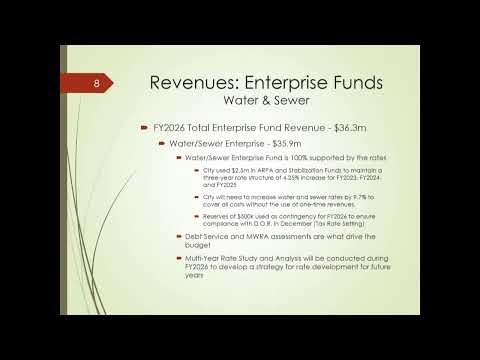
Key figures and trade-offs cited in the presentation: - Total proposed budget: $309,608,179 (revenues equal expenses). "So, essentially, what you have before you is $309,608,179 dollar budget. Revenues equal expenses. The budget is balanced, before you," Vasquez said. - Estimated property tax levy revenue: $126.3 million (with projected new growth of about $3 million for FY2026 under Proposition 2½). - Local receipts estimated at $23.5 million (examples: motor vehicle excise, room excise, investment income). - State aid (cherry sheet) totals cited at roughly $123.6 million, with chapter 70 school aid singled out at $107.2 million. - Enterprise revenues (water and sewer, solid waste) and proposed utility rate changes to reduce reliance on one-time funds.
Vasquez and other department presenters flagged several cost pressures that shaped the budget: a 17% increase in health insurance premiums for active plans, a 16% increase in property and casualty insurance, higher state assessments for charter school and school choice costs, and growing debt service driven by recent and planned capital borrowing.
Mayor (name not specified) told the subcommittee the administration was "very confident in what we put put in front of you" and said department heads will have an opportunity to explain line items in subsequent hearings.
The administration also noted reliance on American Rescue Plan Act (ARPA) funds in recent years for certain projects and positions; those ARPA commitments begin to expire in 2026 and the city is planning how to transition services that were temporarily ARPA-funded.
What comes next: department-by-department hearings will continue; the administration expects to submit the finalized budget to the GFOA for review 90 days after adoption. The Ways and Means Subcommittee will consider departmental details in follow-up sessions this month.
Ending: The presentation set the stage for a longer series of department hearings. Councilors asked follow-up questions on specific line items (transportation, revaluation, and consultant use for water/sewer projects) as department heads took turns explaining changes and efficiencies.