Get Full Government Meeting Transcripts, Videos, & Alerts Forever!
Get email alerts on the City Budget topic
No spam. Unsubscribe anytime.
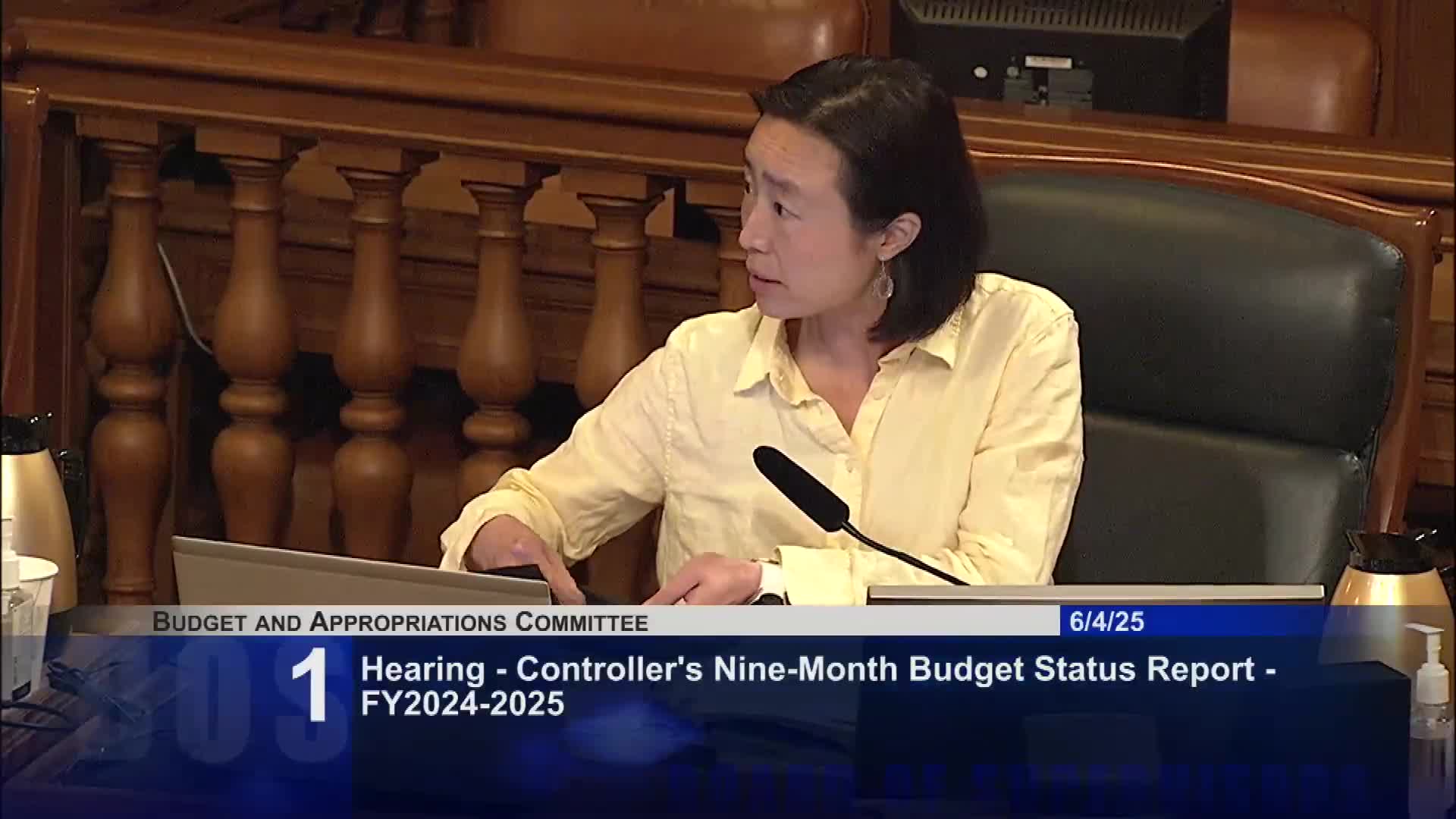
Supervisors hear controller's 9‑month budget report; FEMA reimbursements and proposed layoffs dominate public comment
Summary
At a June 4 Budget & Appropriations Committee hearing, the controller's office reported a $32.7 million general‑fund shortfall and flagged $410 million in FEMA non‑congregate shelter claims now largely disallowed; dozens of city workers and union representatives urged supervisors to reject layoffs and restore program funding.
The Budget and Appropriations Committee on June 4 heard the controller's nine‑month budget status report showing an estimated $32.7 million net shortfall in general fund discretionary revenues for fiscal 2024–25, and received extensive public comment urging the Board of Supervisors to avoid layoffs and preserve community programs.
Michelle Elersema, a budget analyst in the Controller's Office, told the committee the nine‑month results largely continued the trends reported at six months: revenue weakness in hotel and some sales taxes, offset in part by stronger business tax receipts and some recovery in real property transfer taxes. The controller's office reported a $145 million net operating surplus across departments driven partly by patient revenue at the Department of Public Health and salary savings from restrained hiring. The office also identified a roughly $11 million shortfall at the Sheriff's Department and continuing revenue pressure in Planning and Public Works.
The report noted a major uncertainty tied to FEMA reimbursements for non‑congregate sheltering during the pandemic, including shelter‑in‑place (SIP) hotel costs. Elersema said the city submitted about $410 million in non‑congregate shelter expenses, has been reimbursed about $148 million to date, and that FEMA has indicated an initial determination that would render most — all but about $10 million — of those SIP hotel costs ineligible. If FEMA pursues that position, Elersema said, the city could face a potential clawback on roughly $140 million; the city would have 60 days to file an administrative appeal and FEMA may take up to 180 days to respond.
The mayor's proposed budget includes about $400 million in reserves to address potential federal and state funding reductions and other exposures. According to the controller's office presentation, that $400 million package is composed of the remaining federal and state emergency grant disallowance reserve (projected to end the year at about $43 million), a fiscal cliff reserve component (discussed in the presentation as roughly $182 million less amounts already spent in the current year), and an assumed $225 million in revenue from unclaimed medical reimbursement accounts created under the Health Care Security Ordinance that would revert to the general fund if not claimed within the statutory timeline (a three‑year claims period noted in the report that runs through next April).
Public comment filled the committee room after the presentation. Dozens of city employees, union leaders and community members spoke during a one‑minute public‑comment period, urging supervisors to restore or avoid cuts to services and to rescind planned layoffs. Speakers represented multiple city departments and labor bodies, including IFPTE Local 21, SEIU 1021, IBEW Local 6 and other unions. Common themes included opposition to layoffs, concern about cuts to community wellness programs at HOPE SF sites (Hunters View, Alice Griffith, Potrero Hill and Sunnydale), requests to preserve CityBuild and other workforce programs, and warnings that contracting out work raises costs and reduces accountability.
Bianca Polavina, president of IFPTE Local 21, said, “When you cut workers, you're not just eliminating jobs. You dismantle the infrastructure that attracts businesses and residents to our city.” Multiple speakers repeated the refrain, “Protect public services. No layoffs.”
Supervisor Shamann Walton pressed the controller's analyst on the FEMA issue and stressed that the city's projection at the time of the report still assumed FEMA reimbursement; Walton noted newer indications from FEMA that could materially change the outlook. Several supervisors—Chair Connie Chan, Vice Chair Matt Dorsey, President Rafael Mandelman and others—thanked public‑commenters and emphasized the difficulty of the budget choices ahead. Chan described the coming weeks as “a very difficult budget process” and urged public engagement as the board considers changes to the mayor's proposal.
The committee took a procedural action at the close of the meeting: Chair Connie Chan moved, Supervisor Shamann Walton seconded, and the body voted 5–0 to hear and file the controller's nine‑month report. The committee did not take further budget amendments or votes at this meeting.
The controller's presentation and committee discussion make clear the city's fiscal outlook remains sensitive to (1) the pace and final amount of federal FEMA reimbursements for COVID‑era sheltering, (2) the results of high volumes of assessment appeals that are driving property‑tax refunds, and (3) policy choices in the mayor's proposed budget, including the mayor's proposed $400 million reserve package. The board's next formal budget hearings and amendments are scheduled as part of the regular budget process in the coming weeks—supervisors said they expect additional staff reports and appeals information before making final appropriations.
Votes at a glance: the committee voted unanimously to "hear and file" the Controller's nine‑month budget status report (motion carried 5–0).