Get Full Government Meeting Transcripts, Videos, & Alerts Forever!
Get email alerts on the Land Use Warrant Poinciana topic
No spam. Unsubscribe anytime.
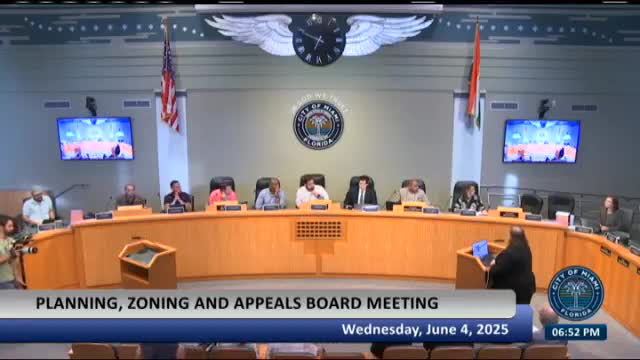
Miami planning board grants warrant to split 4055 Poinciana into three lots with conditions
Summary
After extensive public comment and a split initial vote, the Planning, Zoning and Appeals Board approved an appeal allowing a 21,000-square-foot lot at 4055 Poinciana Avenue to be divided into three lots, subject to increased green-space and tree commitments and other design conditions.
The Miami Planning, Zoning and Appeals Board voted 6-3 on June 4 to grant an appeal allowing the owner of 4055 Poinciana Avenue to split a single 21,000-square-foot building site into three parcels, provided the applicant meets new open-space and tree canopy conditions.
The applicant’s request sought a warrant to diminish the historic building site in the Coconut Grove Neighborhood Conservation District (NCD 3). The board’s approval requires an average of 40% landscaped open space per lot and a minimum of 18 trees across the three lots, and it instructs that tree and landscape measures comply with Article 4, Table 12 and Florida-friendly landscaping practices, the board said.
The decision reverses the planning department’s recommendation. Savannah Steiner, assistant director in the City of Miami planning department, told the board the department recommended denial after re-running multiple lot-size analyses and reviewing potential mitigation measures. Steiner said the original lot is about 21,000 square feet and that dividing it into three lots would yield parcels of roughly 7,000 square feet each. She summarized the city’s data: the quarter-mile neighborhood study area contains 408 properties with an average lot size of about 9,300 square feet; the larger NCD 3 inventory totaled 3,861 parcels with a mean of about 10,943 square feet and a median near 7,800 square feet. Steiner also reported that about 44% of parcels in the NCD 3 are under 7,500 square feet and roughly 9.5% are under 5,000 square feet.
Mark Grafton, an attorney for the applicant, said the applicant’s analysis found a mode of 7,000 square feet across the NCD 3 and offered voluntary proffers, including a commitment to 40% landscaped open space and to double the code-required tree minimum so the site would plant 18 trees if split. “We would like to double the requirement of 3 trees per lot, resulting in 18 total trees for this property,” Grafton told the board.
More than 40 members of the public spoke during the item’s public-comment period. Speakers who live near the property argued the lot split would harm the area’s tree canopy, increase traffic and pedestrian risk on Poinciana Avenue, and alter the neighborhood’s character. “This is a simple case of a developer wanting more than the law allows,” said Elvis Cruz, a Coconut Grove resident, urging the board to uphold the staff denial. Multiple neighbors cited traffic and safety on Poinciana, tree removal on nearby redevelopment projects, and a desire to preserve large lots and canopy.
The first motion on the appeal — to deny the appeal and uphold the planning department’s warrant denial — failed on a roll-call vote (4 yes, 5 no). After discussion the board took a second motion to grant the appeal with conditions; that motion passed 6-3. The board directed that the conditions be memorialized in the development agreement connected to the warrant and that landscape/tree provisions follow the city’s tree ordinance and Article 4 guidance.
Board members who spoke in support of approval said the proffers offered a net environmental gain on tree canopy and open space compared with an alternative scenario in which a single large house could be built with minimal landscape. Members opposing the appeal cited the Neighborhood Conservation District’s purpose and said NCD 3 provisions should prevail where they conflict with Miami 21 form-based code.
The board’s action is appealable to the City Commission and or via judicial processes within statutory deadlines.
Votes at a glance: The board first voted 4-5 to deny the appeal (motion failed). On a subsequent motion to grant the appeal with the listed conditions, the board approved it 6-3.
The board discussion and the public record show the key unresolved issue remains precedent: neighbors and several board members warned that allowing this split — even with proffers — could encourage future lot diminishment across Coconut Grove’s NCD 3 and change long-term neighborhood character.