Get Full Government Meeting Transcripts, Videos, & Alerts Forever!
Get email alerts on the Electrification topic
No spam. Unsubscribe anytime.
Consultants tell Los Alamos board electrification could add up to 44 MW by 2055; substations flagged as pinch point
Summary
Consultants for an interim electrification study told the Los Alamos Board of Public Utilities the county could see between about 13.5 megawatts and 44 megawatts of additional peak load by 2055 under three scenarios and recommended planning upgrades focused on substation capacity and service transformers.
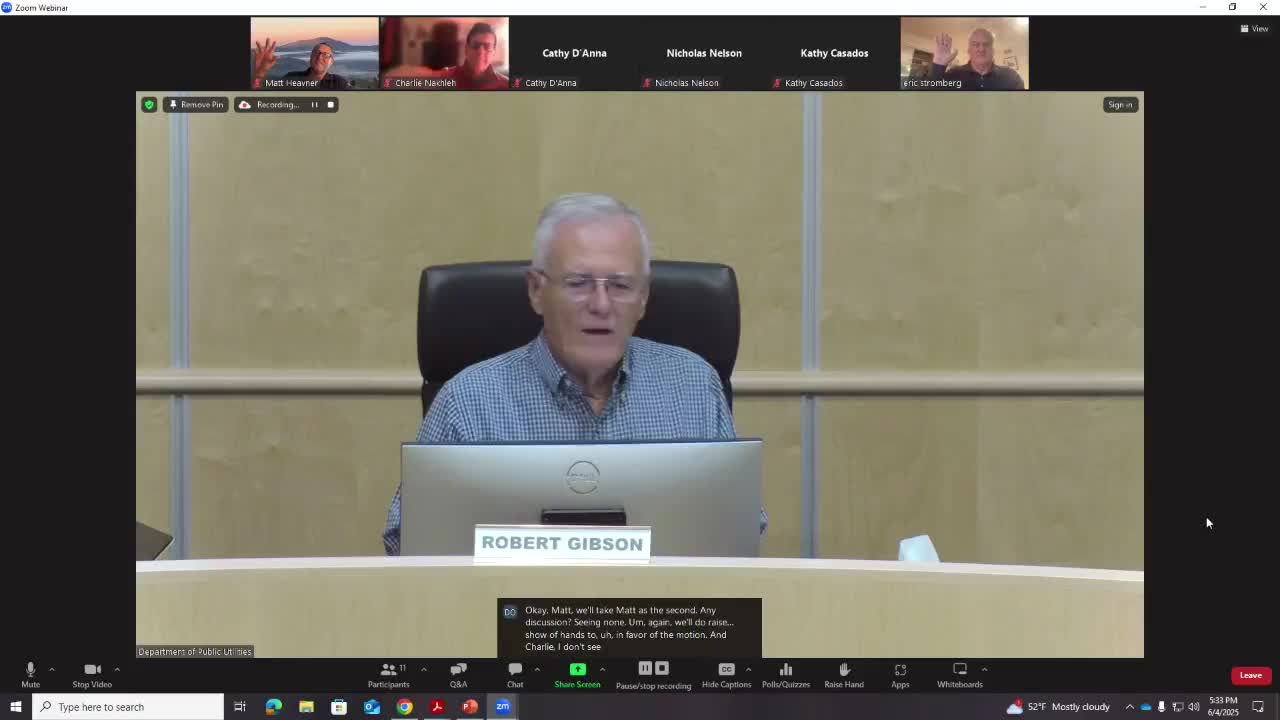
Jacob Wells, a consultant with 1898 & Company, and Elliot Popel of Burns & McDonnell presented an interim electrification study to the Los Alamos Board of Public Utilities on June 4, saying utility planning should start for a large rise in electric demand over the next 30 years.
The consultants outlined three scenarios that model residential and commercial electrification, vehicle electrification, rooftop solar and home battery adoption. "You've all signed up for a really ambitious climate action plan," Popel told the board, adding the study examines what the grid would need to accommodate widespread electric vehicle (EV) adoption and building electrification.
The study’s high scenario — the one closest to the county’s climate-action goals — projects about 44.0 megawatts of additional peak load by 2055. The mid scenario estimates about 28 megawatts of growth, and a low “natural behavior” scenario projects about 13.5 megawatts. In the high scenario, consultants attributed roughly 22.4 MW to EV charging and about 33.3 MW to building electrification; peaks do not sum exactly because the EV and heating peaks occur at different hours.
Why it matters: the consultants said distribution feeders generally have remaining capacity, but substation capacity and the transformers and service conductors that serve small groups of homes are the likely pinch points. Jacob Wells told the board that, when modeled, the existing system shows distribution feeders are “relatively lightly loaded,” but adding the electrification forecasts can create low-voltage violations and conductor overloads unless capacity is added or the system is reconfigured.
The report identified near-term constraints and examples: the study uses a 20 MVA figure for remaining TA3 substation capacity in town-site contingency configurations and noted the White Rock substation has two transformers rated roughly 7,500 kVA and 5,000 kVA respectively; the consultants said the smaller 5,000-kVA transformer leaves less spare backup capacity if a transformer must carry the entire White Rock load.
The consultants described other key assumptions and inputs: a 30% diversity factor for EV charging, an assumption that 80% of EV charging occurs at home, and three EV charging behavior groups (30% plug-in-on-arrival, 40% deferred/scheduled charging, remainder relying mainly on slow Level 1 charging). For building efficiency the report clarifies the scenario means a +20% reduction in building energy use under the high case (scenario 1), +10% for scenario 2 and 0% for the natural-behavior scenario.
The presentation also covered hosting-capacity mapping for distributed solar, noting that protection settings and two-way power flow (reverse power) are likely to limit rooftop solar growth at some locations unless protection and relay schemes are upgraded. The consultants said hosting-capacity maps will be produced for every distribution feeder to show the line-section limits under minimum-load conditions.
Board members and staff discussed policy interactions. Popel and Wells warned time-of-use (TOU) rates often produce sharp shifts in charging behavior (a late-evening “cliff” once a TOU on-peak window closes), and Steven Mares and others noted the county is considering a TOU/demand residential rate to begin no sooner than July 1 next year. The consultants said their baseline scenarios do not assume a specific TOU implementation but include behavior that some customers would schedule charging overnight.
Next steps and schedule: the consultants said they plan to deliver a full draft report on July 9, appear in person July 16 for discussion, and provide a near-final draft by July 30. They said the final study will include more detailed assumptions (vehicle counts and commute distances), estimates for the number of service-transformer upgrades likely required over time, hosting-capacity maps, and a financial and staffing analysis for the utility.
The board asked for earlier chapters to be distributed before the July meeting to allow more time for a data-driven review. "If we could get anything we could get by next meeting it would probably be helpful," a board member said during the session.
Ending: The consultants emphasized the uncertainty of exact outcomes but said needed system improvements are similar across a broad range of scenarios, with substation capacity and aggregate asset replacement—and planning for service-transformer upgrades—appearing in every modeled outcome.