Get Full Government Meeting Transcripts, Videos, & Alerts Forever!
Get email alerts on the Municipal Climate Action Plan topic
No spam. Unsubscribe anytime.
Toledo committee hears final draft of municipal climate action plan, with 10 priority projects identified
Summary
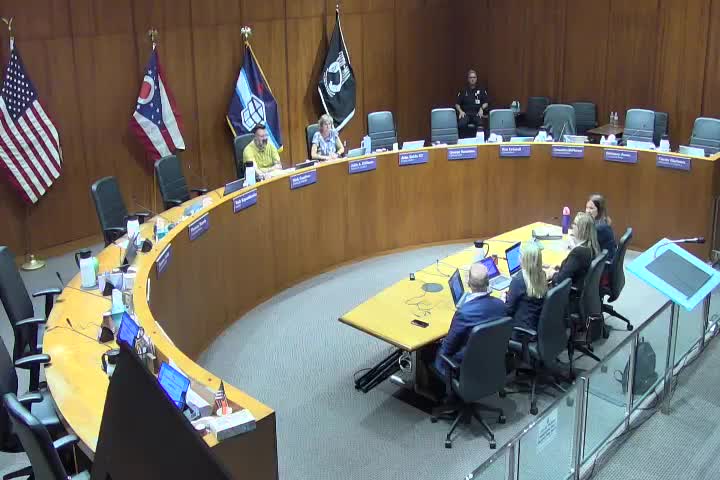
City staff and a private consultant presented the final draft of Toledo’s municipal climate action plan to the City Council Mobility, Sustainability and Beautification Committee on June 4, 2025, outlining eight strategies and 72 actions intended to make city operations more sustainable.
City staff and a private consultant presented the final draft of Toledo’s municipal climate action plan to the City Council Mobility, Sustainability and Beautification Committee on June 4, 2025, outlining eight strategies and 72 actions intended to make city operations more sustainable.
“This plan has one simple goal, and it's to make the city's operations sustainable,” said Dana Rising, sustainability manager for the city of Toledo, during the committee meeting. Melanie Nutter, principal of Nutter Consulting, said the plan pairs that goal with “one goal, eight strategies, and 72 actions” and includes an implementation matrix and a set of 10 priority projects the city can start on immediately.
The plan’s authors said the municipal greenhouse gas inventory prepared for the plan attributes 52% of municipal emissions to electricity use, 15% to solid waste, 10% to stationary combustion (building fuels), 10% to mobile combustion (fleet and vehicles) and smaller shares to employee commute, wastewater and other sources. Presenters said the plan focuses actions where emissions are highest and where the city has direct control or influence.
Nutter and Rising described recommended actions across the plan’s sectors: buildings and energy, transportation, materials and waste, water and wastewater, air quality and public health, food systems, natural areas and land use, and overall municipal operations. Examples cited as near-term priorities included: installing renewable energy on municipal facilities after conducting a solar feasibility study; updating energy-efficiency assessments and implementing high-return upgrades; expanding electric vehicle charging on city property and assessing fleet electrification; converting outdoor municipal lighting to LED; piloting single-stream recycling at city facilities; and expanding municipal compost drop-off sites.
Presenters said the plan includes a matrix assigning estimated greenhouse-gas reduction potential, cost (low/medium/high), responsible authority, suggested funding sources, and key performance indicators for each action. Nutter said the matrix is intended as an internal implementation tool and the plan includes abbreviated tables for council and the public.
The committee heard that the plan’s climate risk assessment relied on local and regional documents, including the 2024 Lucas County Hazard Mitigation Plan, the Midwest chapter of the Fifth National Climate Assessment and a 2021 Toledo Climate Change Vulnerability Assessment for stormwater. Presenters listed flooding, harmful algal blooms, severe thunderstorms and severe winter weather as Toledo’s highest-risk hazards.
Rising and Nutter identified specific program and policy recommendations already in place that the plan builds on: the city’s 1% for the environment fund (passed in 2021), an existing municipal greenhouse-gas reduction goal, conversion of most indoor lighting to LED, advanced metering for residential water meters, and a fleet assessment. The presentation also advocated setting an updated municipal emissions target—presenters recommended 50% reduction by 2030 and net zero by 2050—and updating the municipal greenhouse-gas inventory every five years to benchmark progress.
Council members commended the plan’s emphasis on implementable steps. Councilmember Gaddis said the plan “breaks it down into doable chunks” and welcomed the priority projects and near-term “quick wins.” The chair praised the administration and staff for prior work on sustainability and urged departments to help execute the plan.
Presenters and council members emphasized the plan is intended as a city-management strategy—focused on resource efficiency, cost savings and risk reduction—rather than an environmental manifesto. The plan’s priority projects include renewable energy installations, municipal building efficiency upgrades, EV charging infrastructure assessment and installation, expanded recycling and composting at city facilities, rainwater-capture infrastructure for high nonpotable demand sites, remediating vacant lots for repurposing, and pilots for electric mowers and green infrastructure on flood-prone properties.
No formal motions or votes on the plan were recorded in the committee meeting transcript; presenters asked the committee for direction and said they are prepared to provide implementation steps, cost ranges and suggested funding sources for the priority projects. Dana Rising and Nutter said the implementation matrix assigns responsible authorities (individual departments, the council or staff) and a set of suggested grant and funding sources for each action.
The presentation identified several internal next steps included in the plan: (1) conduct facility-level solar feasibility and microgrid opportunity studies; (2) update municipal facility energy-efficiency assessments and identify guaranteed savings or revolving-fund mechanisms to finance improvements; (3) assess and expand EV charging for municipal and public use; (4) pilot single-stream recycling and expand compost drop-off locations at city facilities; and (5) prioritize remediation and reuse of vacant lots. Presenters also recommended joining peer networks such as the Urban Sustainability Directors Network to share best practices.
The committee session closed with council members expressing support for staff to advance implementation planning. Council staff and presenters named county and regional partners and city employees who contributed to the plan, and Rising singled out colleagues Ben Pushka and Beatrice Marengu for assistance in developing the document. The committee did not take a formal vote during the June 4 meeting.
Ending: City staff said the plan and supporting materials include a public-facing executive summary, implementation charts and KPIs; presenters and council members indicated the next steps will focus on refining cost estimates, aligning responsible departments and identifying funding sources before the council considers any formal approvals or ordinance changes.