Get Full Government Meeting Transcripts, Videos, & Alerts Forever!
Get email alerts on the Voted Bond Package topic
No spam. Unsubscribe anytime.
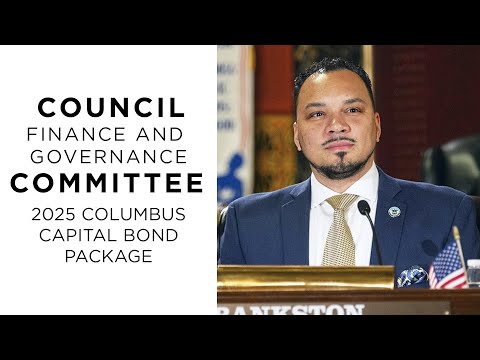
Columbus committee reviews $1.9 billion voted bond package proposed for November ballot
Summary
City finance staff briefed the Finance and Governance Committee on a proposed $1.9 billion voted bond package that would provide authority for capital projects across five categories, clarify the timeline for council actions and ballot deadlines, and prompted questions about millage language and requirements for affordable-housing services.
The Finance and Governance Committee of the Columbus City Council heard a presentation from the Department of Finance about a proposed $1.9 billion voted bond package that the administration plans to submit to voters this November. The package is divided into five propositions covering affordable housing, public utilities, public service, recreation and parks, and safety and infrastructure.
The proposal would provide voted authority — not immediate cash — for future capital improvement budgets the council will consider later this year. Director Long of the Department of Finance told the committee that voted authority “does not represent cash in hand” and that bond sales would occur as projects come online. The package would be presented to voters as separate propositions so each category’s funds are restricted to the intended uses, officials said.
The committee was given the proposed funding breakdown: $500 million for affordable housing, $500 million for public utilities, $400 million for public service, $250 million for recreation and parks, and $250 million for safety and infrastructure. Finance staff outlined example uses: affordable housing construction and preservation and permanent supportive housing; sanitary sewer, water and stormwater improvements for public utilities; roadway resurfacing, bikeways and pedestrian safety for public service; facility renovations and new acquisitions for parks and recreation; and police, fire and a proposed municipal court building under safety and infrastructure.
Committee members and finance staff also discussed how the package would be paid. Finance staff reiterated the city’s practice to use a 25-cent set-aside of income-tax receipts to support general obligation debt service and said the city has not raised property taxes for this purpose since 1956. The director explained that voter-approved (voted) debt typically carries lower interest costs — cited as roughly 10 to 25 basis points cheaper than unvoted debt — and that the savings would be in the millions of dollars overall, a figure the administration offered to calculate in detail for council.
Council members asked about public-utility borrowing because previous voted-authority issuances remain unused while the Division of Power and Water has leveraged Ohio Water Development Authority (OWDA) loans. Director Long said OWDA loans are a “more flexible funding source” and “a low cost funding source,” and that recent OWDA caps on lending prompted the administration to request $500 million in voted authority as a backstop so utilities would not be constrained if OWDA limits tighten.
Members also raised a concern about a change in how millage is described in sample ballot language. The director explained that past ballot language showed cost as cents per $100 of property valuation; new sample language shows the calculation on a per $100,000 basis, which could appear to voters as a materially different number even though the underlying millage rate has not changed. The director said staff and bond counsel are seeking clarification and told the committee, “we're trying to get more information.”
A public speaker, Dr. Sean Birch, executive director of Resident Resources Network, urged the committee to require integration of resident services for any affordable-housing development that receives bond financing. Birch said that “housing with services becomes a launching pad for workforce inclusion, for education enrollment, for long term tenancy,” and asked the administration to condition capital financing on baseline, funded resident services embedded in operating budgets.
Committee members and finance staff noted next steps and deadlines: the administration plans to present a resolution of necessity to council (a June 9 target was mentioned), certified resolutions would be provided to the Franklin County Auditor to calculate millage (a minimum two-week turnaround), a resolution to proceed with ballot language would follow in July, and the final ballot language must be filed with the Board of Elections by Aug. 6. No formal votes on any of those resolutions took place at the hearing.
With questions remaining about ballot wording and program details for the housing component, committee members asked administration staff to follow up and provide additional data — including the finance office’s estimate of the dollar savings from lower interest rates and the administration’s detailed plan for how affordable-housing dollars would be allocated. The committee closed the hearing and directed staff to return with further information as the council moves toward consideration of the capital budget and the formal resolutions required to place the measures on the ballot.