Get Full Government Meeting Transcripts, Videos, & Alerts Forever!
Get email alerts on the Capital Improvement Plan topic
No spam. Unsubscribe anytime.
Eau Claire plan commission recommends draft CIP after questions on $24M sewer project and housing funding
Summary
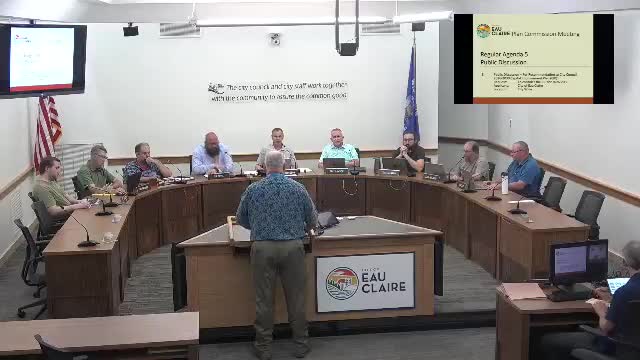
The Eau Claire Plan Commission voted 8–1 on June 2, 2025, to recommend the draft 2026–2030 Capital Improvement Plan to city council after a presentation by city staff and requests for more detail on a $24 million headworks and disinfection rehab and limited spending for flexible housing.
The Eau Claire Plan Commission voted 8–1 on June 2 to recommend the City of Eau Claire’s draft 2026–2030 Capital Improvement Plan to city council after a staff presentation and follow-up questions from commissioners about large-cost sewer work and the small share of CIP funding targeted to housing.
Aaron White, a city staff presenter, told the commission, “We are presenting the annual capital improvement plan budget tonight to the planning commission.” The commission then reviewed the plan’s major project categories and asked staff to provide more detail on a multi‑million‑dollar sanitary plant project and on whether a small parks line item should instead be funded from the water utility.
Why it matters: The CIP directs planned capital spending and is a key step before council public hearings and final approval. Commissioners singled out the headworks and disinfection rehabilitation at the City’s wastewater treatment plant — listed in the CIP at roughly $24,000,000 — and the modest level of funding for affordable housing as items needing clearer explanation before council finalizes the budget.
Key projects and figures discussed - Water mains: White explained replacement and extension projects, noting an itemized total of about $17,400,000 for replacements and roughly $4,000,000 for expansions in the packet. - Water supply evaluation and treatment work: $6,050,000 was listed for a supply/treatment evaluation and related work. - Headworks and disinfection rehabilitation (sewer): commissioners flagged a roughly $24,000,000 line, spread over multiple years, and asked staff for a more detailed breakdown and justification. - Chippewa River crossing: included to extend reliable water piping across the river to support growth. - Stormwater: upgrades and detention‑pond rationalization that in one case freed an 18,000‑square‑foot parcel near Jeffers Road for potential redevelopment. - Downtown parking (Gibson Ramp): staff described a replacement concept for a smaller two‑deck ramp of about 240 stalls to replace an existing structure that currently contains more than 400 stalls but averages roughly 200 daily demand; demolition and rebuild cost estimates were described as substantial. - Fire Station 2: staff said replacement costs for a new, full station were in the range of $15,000,000; rehabilitation of the existing, older structure was also under consideration and federal grant opportunities are being explored. - Flexible Housing Initiative: the plan includes a small allocation for flexible housing; staff referenced a prior $250,000 local contribution that supported a low‑income housing tax credit (LIHTC) project and acknowledged that the initiative’s funding to date has yielded limited direct housing production. Commissioners noted the CIP’s overall scale (discussed in the meeting as “around $200,000,000” over multiple years) and the relatively small percentage assigned to housing, and asked councilors to consider changes during the amendment process. - Transit and urban area planning: the CIP includes funds for a transit development plan (including micro‑transit pilot work), multi‑area urban area plans leading into a 2026 comprehensive plan update, and park and trail investments (including implementation steps such as converting low‑use park turf to pollinator habitat). - Transportation/rail safety: staff reported a Federal Railroad Administration grant for a Galloway Street overpass is secured but the city is awaiting federal guidance on disbursement and matching requirements. - Tax Incremental District (TID) projects: TID 12 (Water Street corridor) and TID 15 (Country Jam/County T) were described with infrastructure and intersection work; staff said TID 17 improvements are linked to new apartment and mixed‑use projects and cited guaranteed tax value commitments connected to recent private developments.
Commissioner questions and staff follow-up requests Commissioners pressed staff for more technical detail on the wastewater plant headworks and disinfection rehab (noting the item’s large share of the CIP), and asked whether certain items currently budgeted in Parks & Recreation (for example a well pump at Owen Park) could instead be funded through utility budgets. Staff and the finance department agreed to provide follow‑up materials to commissioners and to flag these concerns for council during the CIP review.
Votes at a glance - Consent agenda (approval of May 19, 2025, Plan Commission minutes): motion by Commissioner Brewster, second by Commissioner Leonard; passed 9–0 (all commissioners present voted aye). - Recommendation to city council on the 2026–2030 Capital Improvement Plan: motion by Commissioner Leonard, second by Commissioner Reid; passed 8–1. Commissioner Davis voted no; Commissioners Erickson, Holzman, Lawson, Leonard, Reid, Zoid, Brewster and Chair Helgeson voted aye.
What comes next The plan commission’s recommendation moves the CIP to city council for a public hearing and a council work session next week, followed by opportunities for council amendments and an anticipated council approval session in July. The commission requested that staff and finance provide a more detailed breakdown of the headworks/disinfection rehabilitation scope and costs and clarify the funding source for the Owen Park well pump so council members can review those items closely.