Get Full Government Meeting Transcripts, Videos, & Alerts Forever!
Get email alerts on the Wildfire Home Hardening topic
No spam. Unsubscribe anytime.
Lake County pilot hardens homes against wildfire; program seeks to expand after first-year results
Summary
North Coast Opportunities updated the Lake County Board of Supervisors on a state pilot to retrofit homes against ember intrusion. The pilot has hardened 24 homes in the Kelseyville Riviera cluster, averages about $55,000 per home, and aims to complete 500 homes in the target area if further funding is secured.
North Coast Opportunities (NCO) presented an update to the Lake County Board of Supervisors on a state-backed home hardening pilot that retrofits houses to resist ember intrusion and other wildfire hazards.
The presentation was led by Diana Fernway, program manager for the Lake County Home Hardening Grama with North Coast Opportunities, with remarks from Jay Lopez, a development partner and speaker representing the California Wildfire Mitigation Program. Supervisor Pyska sponsored the agenda item.
The program matters because Lake County is a high-risk wildfire area and hardening homes reduces the risk of structure loss: presenters said more than 90% of homes lost in wildfires are attributed to ember intrusion rather than direct flame. "Wildfires are a solvable crisis," Fernway said, summarizing the program's approach.
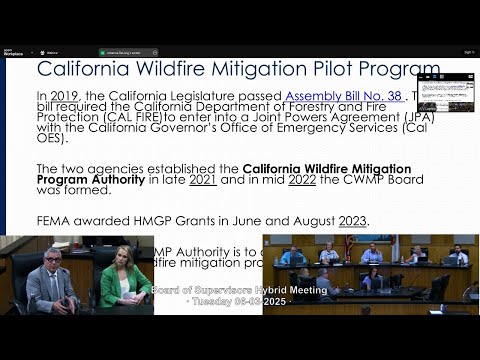
NCO and the state program trace the effort to Assembly Bill 38 (2019), which led to creation of a California wildfire mitigation authority and a grant model that pairs state funding with FEMA match money for retrofits. Jay Lopez said the authority was created in 2021, the governing board formed in 2022, and Lake County became the first grantee in 2023.
How the pilot works
NCO is using a cluster strategy that concentrates retrofits in tight neighborhoods to build contiguous resilience. Its initial pilot area is the Kelseyville Riviera Association (KRC) neighborhood. NCO staff said they toured 11 communities before selecting Kelseyville Riviera because of its housing density, vulnerable ingress and egress, nearby vegetation, and prevailing afternoon winds off the lake.
In its first year the program completed hardening on 24 homes, Fernway said, with six homes in active construction and about 10 more in development. NCO maintains an "interested parties" map that currently lists roughly 300 homes in the broader outreach area; the program's stated goal for this cluster is to harden 500 homes.
Work scope and standards
The retrofit work includes a mix of low- to high-cost measures. Fernway emphasized lower-cost homeowner actions such as replacing vents and window screens, clearing the first five feet around the house ("zone 0"), and installing gutter covers. Mid- and higher-cost work noted in the presentation includes enclosing decks, installing noncombustible siding or framed eaves, tempered double-pane windows, and roof replacement.
Lopez described a set of Minimal Quality Standards (MQS) NCO uses to define acceptable retrofit materials and workmanship; he said the MQS was developed with input from the State Fire Marshal and other technical experts and is intended to give contractors and homeowners a clear, testable benchmark.
Costs and eligibility
Program staff reported an average retrofit cost of about $55,000 per home; that figure includes defensible-space work. Fernway said the program uses an income-based sliding scale: lower-income households receive work at no cost, while higher-income homeowners may share 10% or 25% of project costs.
NCO said the pilot is funded largely by a $22,000,000 grant (as presented) combined with FEMA matching funds and state support. Fernway and Lopez said NCO has applied for additional home hardening grants and is pursuing other funding opportunities, including state climate bond money referenced in the presentation (described as a November climate bond with $135 million set aside statewide for home hardening programs).
Site-selection and regulatory constraints
Project selection for FEMA-funded work requires environmental, historical and biological review (the presenters referred to this process as the EHP review). Lopez said those reviews can delay award and implementation and that FEMA grant rules also impose eligibility constraints: participating homes must have no outstanding code violations and historic properties can present complications. The presenters said the program targets homes built before 2008; homes constructed after 2008 typically do not require the same retrofits.
Connections to insurance and other programs
NCO aligns its retrofit documentation with California Department of Insurance programs (referred to in the presentation as the "Safer from Wildfires" program) so homeowners can request insurer discounts or eligibility for wildfire risk designations after retrofits are completed. Lopez said the program will provide a detailed report to each homeowner documenting the work performed for insurance and other purposes. Presenters also noted coordination with CAL FIRE, Cal OES, Firewise USA, the California Department of Housing, and the Governor's Office of Planning and Research/land-use and climate innovation programs.
Questions from supervisors and next steps
Board members asked about average cost, ongoing funding, and whether other Lake County communities could be added. Fernway and Lopez said the pilot focuses on the Kelseyville Riviera cluster for the FEMA-funded phase and that homeowners outside the pilot area may still undertake hardening on their own at their own expense. Lopez and NCO staff said they are seeking further grants to expand to other neighborhoods, and they noted pending state legislation (identified in the presentation as AB2469 and a bill to extend the program beyond its initial five-year authorization) that could affect program continuity and funding.
Meeting presenters emphasized that the pilot also serves as a statewide model: Lopez told the board the authority intends to consolidate lessons learned and present a program model to the state legislature and agencies so other communities can replicate the approach.
No formal board action was taken during the presentation. NCO staff said they will continue outreach and fundraising and continue to provide individualized home assessments and resources to Lake County residents.