Get Full Government Meeting Transcripts, Videos, & Alerts Forever!
Get email alerts on the Reentry Prop47 topic
No spam. Unsubscribe anytime.
Sacramento County outlines Prop 47 reentry pilot with 70 dedicated shelter beds and July 1 launch
Summary
County staff told the Community Corrections Partnership on May 29 that a Prop 47-funded reentry pilot will begin July 1, with a contractor-embedded care coordination team, 70 shelter beds available 24/7, prerelease screening and data collection to evaluate outcomes.
Julie Wherry, interim chief probation officer and chair of the Community Corrections Partnership for Sacramento County, heard a status update May 29 on the county's Prop 47 grant aimed at rehousing and reentry services.
Tiana Hammock, health services administrator for adult correctional health, told the partnership the program's goals are to reduce returns to custody, increase rehousing and reduce unemployment among people exiting jail, and expand access to mental health and substance use treatment. "Ultimately, it's to reduce homelessness for program participants. That's our primary focus," Hammock said.
The county will launch the pilot July 1 and has set a July 8 board date to retroactively approve the start. A local evaluation plan was submitted March 28; Kevin O'Connell was named as the lead evaluator and Amanda (listed in the record as Amanda Rain Ren) will serve as a lead operational contact. County staff said they will provide quarterly updates to the partnership and report final outcomes to the Board of State and Community Corrections (BSCC) at the end of the three-year grant period.
Key elements of the implementation plan presented May 29
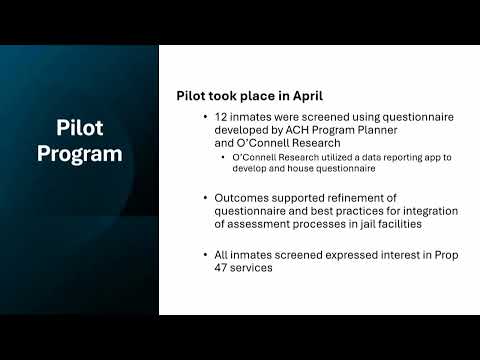
- Screening and intake: County medical intake now includes a homelessness indicator and additional checkboxes to flag potential Prop 47 participants. The county piloted the screening questionnaire in April with 12 inmates; Hammock said all 12 screened were interested in Prop 47 services.
- Care coordination and CBO role: A community-based organization (CBO) contractor will be embedded in the jail to perform assessments, do prerelease coordination with shelters and treatment providers, arrange transportation at discharge, and provide ongoing postrelease support.
- Shelter capacity and pathways: The county has secured 70 shelter beds dedicated to the Prop 47 population, with 24/7 admission capability. One shelter allows stays of at least 90 days (and up to six months for longer-term placements); another partner provides more intensive transitional housing for higher-motivation participants. While shelter case management and employment services will be available, county staff said they are still finalizing referral criteria and workflows.
- Workflow and timing challenges: Presenters said the short notice of some releases creates a coordination challenge: medical and custody staff may learn of a release only hours before it occurs, leaving a tight window to confirm shelter availability and arrange transport. The CBO will maintain daily communication with shelters to monitor bed availability, and staff said they are working to streamline notification processes.
Questions from partnership members focused on operational details. Member Scott Triplett asked whether the new intake screening would lengthen booking; Hammock said the added fields are two checkboxes tied to an existing homelessness indicator and should not add meaningful time. Member Scott Lutz and others urged closer coordination with probation, suggesting the county share shelter placements with probation intake so mobile outreach teams can locate clients who are on probation and reduce failures-to-report.
Hammock said staff intend to work with probation and other county partners to add a prompt in assessments asking whether participants are on probation and whether they must report to probation, to ensure appropriate notifications.
Next steps and data: Staff said the pilot will go live July 1, with a retroactive board item July 8. The county will collect data under the local evaluation plan and begin fuller evaluation after launch; quarterly updates will be provided to the partnership.
Ending
Partnership members offered operational suggestions and asked that probation be looped into discharge notifications. County staff asked members for feedback on partner engagement and said Amanda will be a primary contact for implementation questions.