Get Full Government Meeting Transcripts, Videos, & Alerts Forever!
Get email alerts on the Annexation topic
No spam. Unsubscribe anytime.
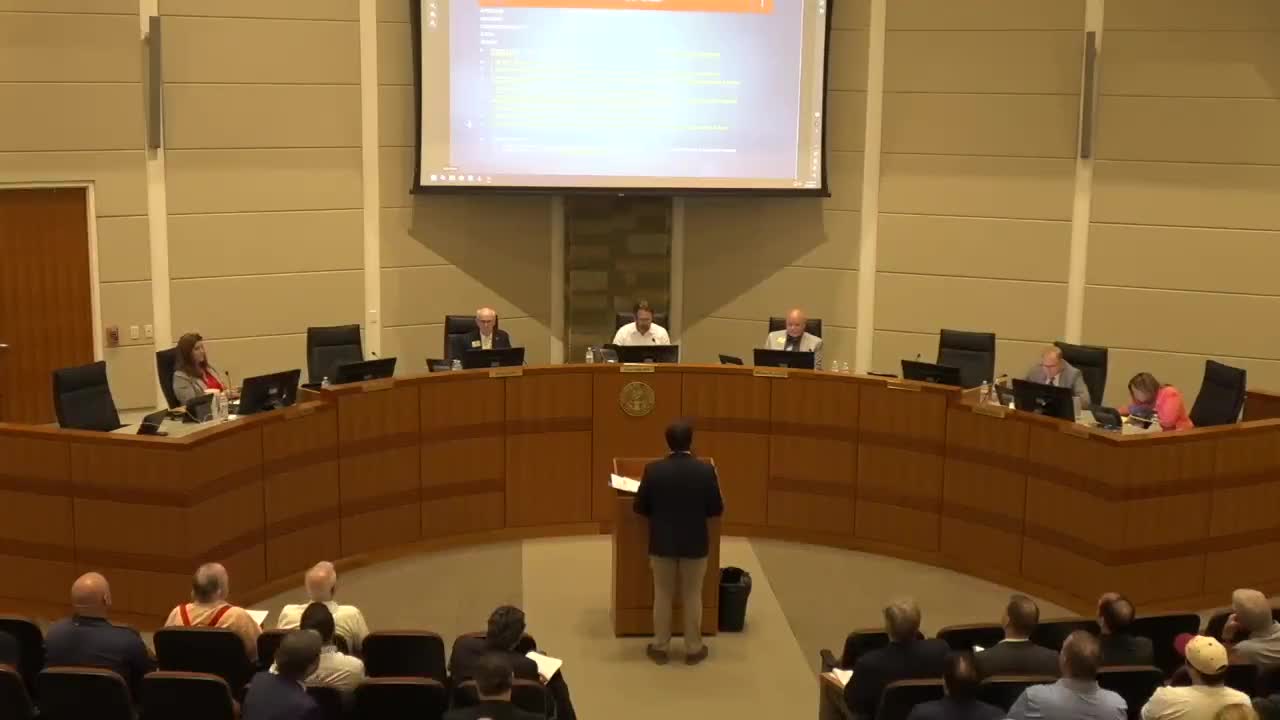
Cherokee County directs attorney to object to Holly Springs annexation at 301 Lower Union Hill Road
Summary
The Cherokee County Board of Commissioners voted unanimously June 3 to direct the county attorney to object to a City of Holly Springs annexation of 20.11 acres at 301 Lower Union Hill Road, citing inconsistency with the county—s growth-boundary agreement and increased infrastructure burdens.
The Cherokee County Board of Commissioners voted unanimously June 3 to direct the county attorney to assert an objection to the City of Holly Springs— proposed annexation of 301 Lower Union Hill Road.
County planning staff told commissioners the 20.11-acre parcel lies outside the county—s agreed growth boundary with Holly Springs and that the city—s proposed mixed-use zoning (TND/MXD) would allow substantially higher residential density and commercial intensity than the county—s current AG/NC designations. County Attorney briefing materials cited the Georgia statutory annexation dispute resolution process as the legal path for the county—s objection.
The item drew detailed staff analysis and legal counsel. Planning staff noted the Holly Springs concept calls for 92 townhomes and about 60,000 square feet of medical office, retail and restaurant uses; staff said that density (about 4.5 units per acre) conflicts with Cherokee County—s suburban-growth guidance (approximately 2 units per acre) and with surrounding country-estate land uses. County counsel told the board the annexation would create a "material burden" on county services because it would shift costs and reduce impact-fee revenue that helps pay for libraries, parks, law enforcement, fire and roads.
Vice Chairman Ragsdale made a motion (text summarized below) directing the county attorney to assert objection to the annexation under Georgia annexation law on grounds that the change would substantially alter allowable density and impose increased infrastructure and maintenance costs on the county. The motion was seconded and approved with all commissioners present voting aye.
The board—s action directs the county attorney to pursue the statutory objection process and to cite, among other points, (1) inconsistency with the county-city growth-boundary agreement, (2) substantial change in intensity and residential density compared with county zoning, and (3) likely increased costs and shortened useful life for county capital projects and infrastructure.
What happens next: the county attorney will file the formal objection under Georgia law and pursue the dispute-resolution steps set out in state statute. Holly Springs' application will proceed through that process and the city council will hear the annexation on its schedule (staff materials indicated the city public hearing would be June 12 followed by a city council decision on July 7). The county—s objection does not itself veto the annexation but begins the formal dispute-resolution path under state law.
Commissioners and staff framed the objection as a matter of plan consistency and fiscal impact rather than a challenge to local control. Planning staff also noted several technical concerns identified in their review, including required buffer widths to adjacent residential areas, the need for a traffic analysis, fire access and hydrant/water-flow testing, sidewalk/curb/gutter requirements, and the location of an existing 275-foot cell tower relative to proposed structures.
The board—s vote was 3-0 in favor of directing the county attorney to object.