Get Full Government Meeting Transcripts, Videos, & Alerts Forever!
Get email alerts on the Rental Registration topic
No spam. Unsubscribe anytime.
Forney reports $253,000 in initial rental-registration fees; staff flags hundreds of unregistered units
Summary
City staff told the Forney City Council on June 3 that the city has registered hundreds of rental properties since Oct. 1, 2024, collected $253,000 in initial fees and opened hundreds of code-enforcement cases tied to unregistered units; staff said the fee revenue is funding a rental-inspector position and an additional code-enforcement officer.
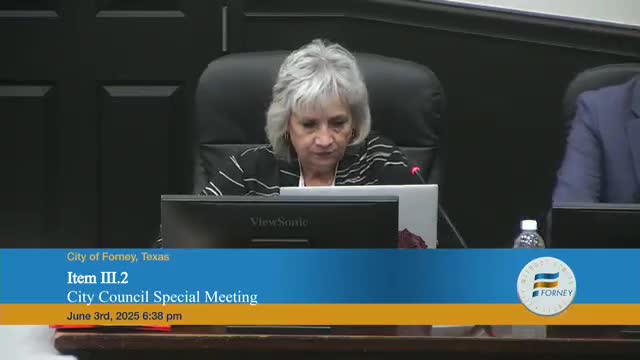
Forney city staff presented an update on the city’s rental-property registration program at the June 3 City Council meeting, reporting hundreds of registrations since October 2024 and $253,000 in initial fee revenue.
The update noted that the program’s records since Oct. 1, 2024, show 743 unique properties registered for the 2025 annual registration cycle and that initial rental fees collected totaled $253,000. Peter Morgan, city staff, told council the fee revenue is being used to fund a new rental-registration inspector position and an additional code-enforcement officer “which we are using to, start to provide services on the weekend.”
Morgan said the city saw an increase from 596 registered properties in 2024 to 785 registered properties in 2025 in another portion of his presentation, which he explained reflected both the city’s intensified identification work and new registrations. “The main reason for that is because we do have the new position which is working very hard over the last couple months to identify properties that are not registered and to get them registered,” Morgan said.
City staff also provided enforcement data. Year-to-date in 2025 the city had opened 709 total code-enforcement cases; 285 of those cases were opened after staff identified properties that were not registered under the rental program. Staff said there were 424 other code-enforcement violations in 2025, and only 69 of those were registered rental properties. Morgan cautioned the data do not show that registered rental properties are inherently more likely to violate codes: he said the numbers reflect the large number of rentals overall and the city’s recent emphasis on finding properties that had not registered.
Council members asked how the city enforces the program’s required crime-prevention lease addendum for rental contracts. Morgan said the police department notifies staff when reported criminal activity meets the ordinance criteria, and the city then notifies the property owner that eviction proceedings should be initiated. If an owner cannot initiate eviction because the lease lacks the required addendum, Morgan said the owner can be cited for violating the rental-registration ordinance and the city would pursue a notice of violation. Morgan added that requiring a copy of each lease or addendum at every tenant turnover would be “real tricky” administratively and that he would want to discuss formal enforcement mechanics with legal staff before changing the intake process.
Council members and at least one private-sector speaker recommended making the crime-prevention addendum an inspection checklist item or an application requirement so the city can confirm compliance before issuing a registration permit; Morgan said staff would review that suggestion with legal.
Council members also asked how the city identifies suspected unregistered rentals. Morgan said staff cross-checks partial data from the county appraisal district and looks for indicators such as an owner address outside Forney’s 75126 ZIP code, different owner and property addresses, or ownership by an LLC.
Morgan summarized enforcement timing and penalties: notices are issued and reinspections scheduled (for example, seven days to correct high grass/weed violations, then a final notice and another seven days), and municipal-court fines for zoning-code violations can be up to $2,000 per offense, subject to the court’s discretion. He said the court typically pursues compliance rather than punitive fines on a first-offense case.
Morgan concluded by saying the presentation materials would be posted prominently on the city website and invited council and residents to request further details.
Why it matters: the registration program affects landlords, tenants and neighborhoods by creating a city record of rental properties, funding additional enforcement resources and tying compliance to possible municipal-court action. The city’s next steps include legal review of enforcement mechanics for required lease provisions and continued identification of unregistered units.