Get Full Government Meeting Transcripts, Videos, & Alerts Forever!
Get email alerts on the Zoning Parking topic
No spam. Unsubscribe anytime.
ZBA discusses parking rule wording for eating‑and‑drinking uses; asks staff to draft ordinance language
Summary
Petoskey planning staff and the Zoning Board of Appeals reviewed parking‑requirement language for eating and drinking establishments and agreed to ask staff to draft formal ordinance language and options for the planning commission to consider.
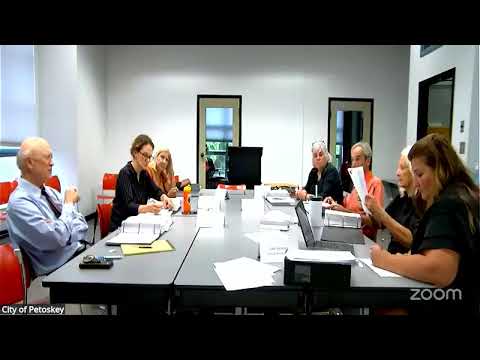
Petoskey zoning officials on June 3 discussed whether the city's parking table unintentionally omits employee parking for eating and drinking establishments and asked staff to draft language options for the planning commission.
Why it matters: The zoning table lists parking requirements for many commercial uses. For eating and drinking establishments it sets parking at "2 spaces for every 5 seats." Staff noted that language, as written, would produce zero required on‑site parking for a drive‑through operation with no seats and could leave employees without on‑site parking in some configurations.
Lisa (planning staff) told the board the city—s parking schedule treats the minimum parking requirement as the maximum: "The minimum parking requirement is also the maximum parking requirement," she said, noting the table's numeric limits. Staff asked the board whether the eating‑and‑drinking line should also account for employees, as other categories explicitly do.
Board members discussed how downtown and other districts function. Several members said downtown exceptions and street parking mean small operations commonly expect employees to park nearby, but they acknowledged the table could cause problems in non‑downtown commercial corridors where on‑site parking is needed for employee turnover and adjacent uses.
The board and staff agreed not to treat the meeting discussion as a formal binding interpretation under the state zoning enabling act (which requires public notice for that process). Instead, the ZBA asked staff to draft recommended ordinance language and at least two alternative options for handling employee parking and for clarifying the relationship between required and allowed parking. The board suggested the planning commission and city council would consider formal amendments and that staff should return with proposed redline language.
No votes were taken on parking standards at the June 3 meeting. The board characterized this as a policy and drafting task for staff and the planning commission rather than an immediate interpretive order from the board.
Next steps: Staff will prepare draft ordinance language (option A/B/C) addressing whether eating and drinking establishments should have parking requirements sized to include employees, and whether the table's "minimum = maximum" rule should be modified. The planning commission will review any formal amendment proposals before council action.