Get Full Government Meeting Transcripts, Videos, & Alerts Forever!
Get email alerts on the Short Term Rentals topic
No spam. Unsubscribe anytime.
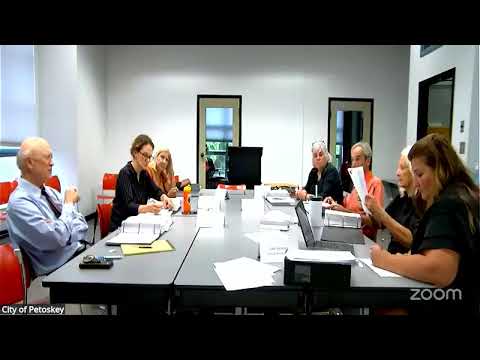
Petoskey ZBA delays decision on Powell short-term rental vested-rights remand to seek legal opinion
Summary
The Petoskey Zoning Board of Appeals continued its review of whether the Powells established a vested right to operate a first-floor short-term rental at 215 West Mitchell Street, scheduling a special meeting and legal briefing after extended testimony about construction work, permits and county coordination.
The Petoskey Zoning Board of Appeals on June 3 postponed a decision on whether property owners John and Mallory Powell established a vested right to operate a first‑floor short‑term rental at 215 West Mitchell Street, remanding the matter for a special meeting and a written legal opinion.
The board voted to continue deliberations and hold a special meeting on June 17, 2025, after more than two hours of evidence and testimony about the scope of construction at the property, whether required building permits were obtained, and communications among city and Emmet County staff. The board asked the city attorney to draft legal options it could use when it reconvenes, including a closed‑session legal briefing before public deliberation.
Why it matters: The circuit court remanded the case to the board to decide whether the Powells established a vested right in operating a first‑floor short‑term rental before a late‑2023 ordinance change. A determination could allow the applicants to proceed under the old zoning rules even though the city later amended short‑term rental rules.
Joseph Zines, attorney for the applicants, told the board the core question is factual: whether the Powells performed "work of a substantial character" on the first floor before the ordinance took effect. "They wanna run their business," Zines said, summarizing the applicants' position that they purchased and renovated the building intending to operate an upscale, pet‑friendly short‑term rental and that the work materially changed the first floor.
Mallory Powell, one of the property owners, described the owners' interactions with their contractor and with county staff. She said the owners had filed a business license and "we were operating with complete transparency," adding that they discovered months later the contractor had not secured all permits he said he would obtain. The Powells said they stopped work and self‑reported to the county once they discovered permit issues.
Board and staff discussion focused on three issues: (1) the factual record showing what physical work occurred on the first floor and when it occurred, (2) the legal significance of permits or permit applications in the sequence of work that creates a vested right, and (3) communications and enforcement by Emmet County building officials after county staff observed work in March 2023.
City staff and the Powells disagreed over the timeline and county responses. The Powells presented photographs, contractor invoices (some redacted in the public packet), and before/after floor plans the applicants say show substantial first‑floor changes including new bedrooms, a kitchenette/wet bar and bathroom renovations. Their presentation included a spreadsheet the applicants said allocated roughly 93% of renovation expenditures to the first floor; the exact dollar totals in the packet were redacted and therefore are recorded as "not specified" in public materials.
Emmet County's timeline — added to the board packet by county staff at the city's request, according to the applicants — differed in some details and did not initially prompt county enforcement action, the Powells said. County staff and the city raised questions about whether some of the work required permits and whether permits were filed and issued in the ordinary course.
Board members asked whether the presence or absence of building permits is a bright‑line requirement for finding a vested right. Legal materials in the packet summarize case law (including references to Heath Township v. Saul) that treats permits as a significant factor but not an absolute rule: courts look to whether an owner progressed past planning and preliminary steps into tangible physical changes that materially alter the property toward the proposed use.
The board directed staff and the city attorney to prepare a written legal opinion and a set of draft findings or form resolutions to reflect the possible outcomes and legal rationales the board might use. The board scheduled a special meeting for June 17, 2025, at 6 p.m. and said it would hear a closed‑session legal briefing before public deliberations. The board took no final action on the underlying vested‑rights question at the June 3 meeting.
Next steps: The ZBA will reconvene for a special meeting that will include a closed‑session legal briefing and then public deliberation. If the board reaches a factual finding that work of a substantial character occurred before the ordinance took effect, it may reverse the zoning administrator's prior decision and allow the Powells to pursue the short‑term rental under the earlier ordinance; if not, the zoning administrator's determination would stand. Any determination on vested rights does not itself relieve the applicants of other regulatory steps they must complete, such as obtaining required building permits and county approvals.
The record presented to the ZBA and the court will continue to shape further proceedings; the circuit court remand framed the ZBA's task as primarily factual.