Get Full Government Meeting Transcripts, Videos, & Alerts Forever!
Get email alerts on the Zoning Urban Overlay topic
No spam. Unsubscribe anytime.
Council asks planning commission to study higher single-family density in Urban Overlay after concerns about neighborhood stability
Summary
Council approved an initiating resolution directing the Planning Commission to consider raising permitted single-family density in the Urban Overlay (citywide) to enable development on historically platted small lots; councilmembers asked staff for analysis of unintended consequences and neighborhood-stabilization goals.
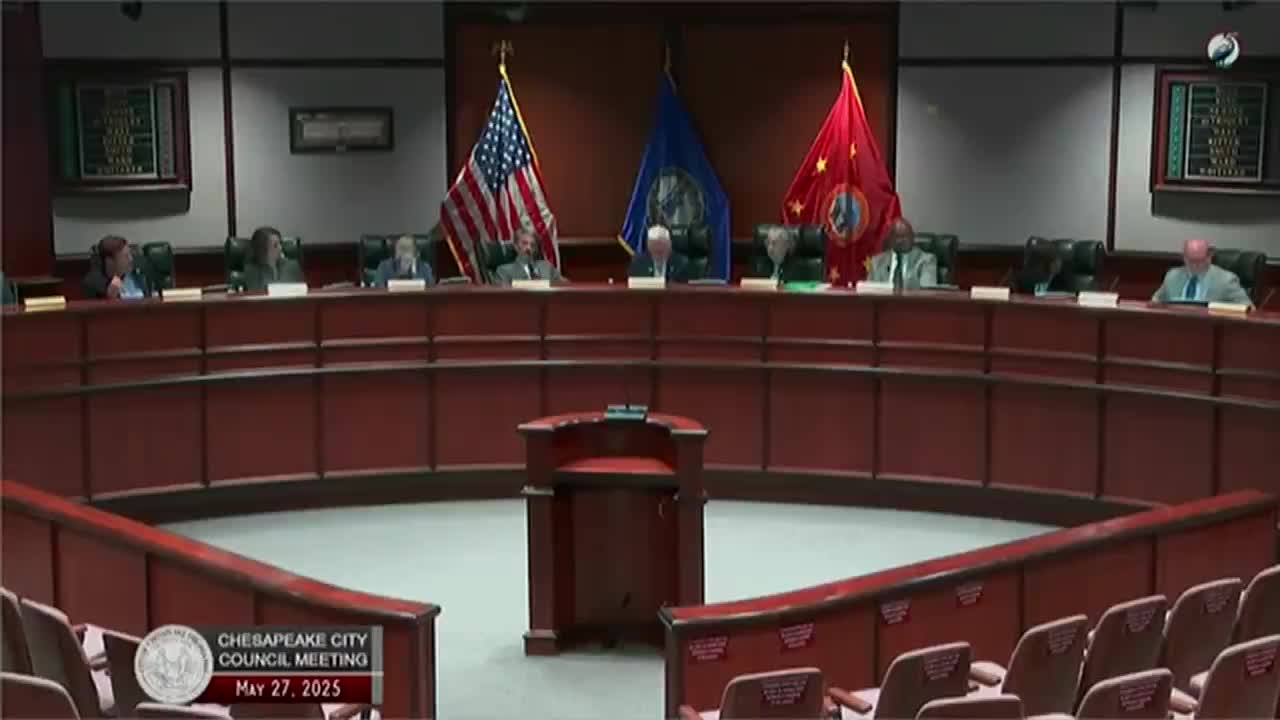
The Chesapeake City Council voted unanimously May 27 to ask the Planning Commission to study amendments to the city’s Urban Overlay that would allow higher permitted density for single-family development.
The initiating resolution directed staff and the Planning Commission to draft changes allowing single-family development consistent with historically established lot patterns, a measure city planners said would enable redevelopment of small platted lots—particularly in South Norfolk—without triggering inconsistent density calculations.
Why it matters: Planners said some historically platted lots are 25-by-100 feet and, when combined or redeveloped, the resulting density can exceed allowed units per acre under the current overlay. The initiating resolution aims to sync lot-dimension allowances with density rules so land-banked parcels and infill redevelopment can be built as single-family homes.
Council discussion and concerns Councilmember Ritter pressed staff for safeguards. "I love these initiating resolutions, but what I love less is when they come back and we can't make any changes because it wasn't specifically in the initiating resolution," Ritter said, asking staff to clarify whether lot dimensions, road frontage and setbacks would be examined.
Planning staff (Mr. McNamara) replied the initiating resolution specifically targets density and that prior changes had already permitted smaller lot dimensions. "When you look at the density of those lots with the dimensions, that comes up to about 8.7 units per acre, which is where the problem comes in because that is not allowed" under the current overlay, McNamara said, adding the amendment would "sync up to allow redevelopment of those lots with single-family homes."
Councilmember Knowles and others asked that staff analyze the proposal’s broader effects beyond South Norfolk: "Can we look into what that means for other areas than just South Norfolk?" Knowles asked. Staff said the Urban Overlay covers multiple areas and promised a full analysis of potential unintended consequences.
Next steps Council approved the initiating resolution (9-0) and staff indicated it will prepare a full analysis for the Planning Commission and return to council with details. Councilmembers suggested a work session with the Planning Commission to discuss final parameters before drafting text changes.
Ending: Councilmembers asked staff to focus both on enabling neighborhood stabilization while avoiding unintended multifamily conversions, and to present options that protect the stated goals of stabilizing historically platted neighborhoods.