Austin council work session hears widespread opposition to renewing automated license-plate reader program
Loading...
Summary
Dozens of residents, privacy advocates and technology experts urged the Austin City Council on June 3 to reject the proposed renewal of the city's automated license-plate reader (ALPR) program, saying the cameras and the contract with vendor Flock Safety could be used to track immigrants, people seeking reproductive care and protesters.
Dozens of residents, privacy advocates and technology experts urged the Austin City Council on June 3 to reject the proposed renewal of the city's automated license-plate reader (ALPR) program, saying the cameras and the contract with vendor Flock Safety could be used to track immigrants, people seeking reproductive care and protesters.
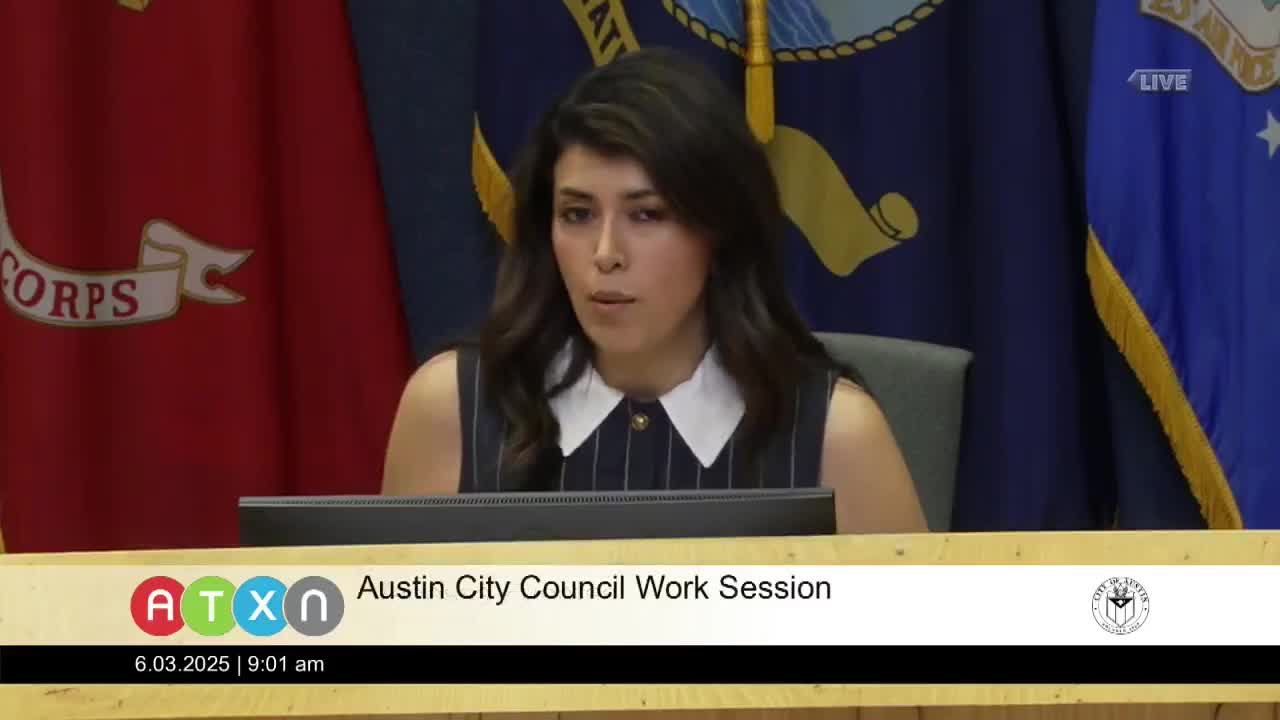
The concern dominated public comment at a City Hall work session where staff from the Austin Police Department detailed the pilot's results and audit recommendations and answered questions from council members. No formal vote was taken at the work session; the item remained scheduled for council consideration at a later meeting.
Why it matters: Speakers said ALPR data creates a long-lived surveillance record that can be aggregated and sold by private vendors and accessed by federal or out-of-jurisdiction law enforcement. City staff and APD leaders countered that the system has helped locate stolen vehicles and provided leads in violent-crime investigations, and that policy, technical and contractual safeguards limit sharing and retention.
Public comments
Marina Roberts, testifying for Workers Defense Action Fund, said Austin's interpretation of state law already makes ALPR data available to federal agencies and warned: "Immigrant Austinites are in danger and face escalating attacks regardless of their status." She urged council to block the contract renewal.
Rachel Shannon, a District 1 resident, spoke to the technology's permanence: "The only data that can never be leaked or misused is the data that was never captured in the first place," she said, urging a no vote.
Other speakers, from groups including EFF Austin and Grassroots Leadership as well as unaffiliated residents, raised related concerns: vendor business models that centralize and monetize location data; documented uses of ALPRs by other agencies to search nationwide camera networks; and the difficulty of ensuring deletion and preventing secondary uses. Kevin Welch, president of EFF Austin, highlighted audit findings and argued the public's privacy risk outweighed the program's modest returns.
APD presentation and claims of public-safety benefit
Assistant Chief Sheldon Askew and Chief Lisa Davis presented the department's review of the pilot, the audit responses and a list of cases where APD said ALPR data supported investigations. APD said the program located roughly 76 vehicles tied to investigations during the pilot-plus-extension period and that in one example a suspect in a homicide was identified within two hours.
APD told council it retains ALPR images collected under the city contract for seven days and asserted that access is tightly restricted and audited. Assistant Chief Askew said the department shared ALPR images on limited occasions during and after the trial period for investigations including arson, smuggling of persons, aggravated assault and auto theft; he listed a total of multiple sharing events and described the agency's review processes for external requests.
Audit findings and unresolved contract concerns
Council members and several speakers cited a city auditor report that showed shortcomings in APD's compliance and in the city's contract language with Flock. Councilmember Zoeb Cadrey (first reference: Zoeb Cadrey, council member) and others asked staff to reconcile counts of data-sharing incidents; the auditor's public report cited nine sharing events, while staff initially described a smaller number. Staff agreed to follow up on documented requests.
Multiple speakers and Councilmember Mike Siegel highlighted a pre-existing contract clause that, as written in 2023, allowed Flock to include agency data in a vendor-side 'aggregated data' product. Staff said it has negotiated changes and that language allowing the city to opt out of aggregated/scraped datasets had been added, but several council members and auditors warned that contractual language has been the core of public concern and may not fully prevent broad reuse by the vendor or its customers.
Questions from council
Council members pressed APD on the program's scale, oversight and mechanics. APD said that while 40 fixed cameras were deployed, the recent Axon Fleet 3 in-car camera rollout now places LPR-capable devices in most patrol cars as the fleet was refreshed, increasing the number of cameras available to the department. APD also said the contract cost for the Flock trial was roughly $114,000 for the year and cited a department vacancy shortfall of about 300 officers as part of the rationale for using technology to augment investigations.
On outcomes, APD reported that during the pilot period there were 4,664 auto-theft reports and 245 recoveries credited to ALPR matches. APD also said the pilot aided homicide and aggravated-robbery investigations and provided examples in which license-plate matches narrowed suspect leads.
Remaining disputes and next steps
Speakers and some council members said the program's risks exceed its benefits because private vendors can and do combine ALPR images with other data sources, and because state and federal enforcement priorities have shifted in ways they said increase the risks to immigrant and reproductive-rights communities. Others on the dais, including council members representing districts that reported high auto theft and violent crime, emphasized the investigatory value described by APD and asked for stronger, enforceable guardrails.
Councilmember Siegel, who pulled the item for discussion, presented a summary of public concerns and argued the contracting language still permitted Flock to benefit commercially from city data unless the city terminates the program. City staff and APD said they were continuing contract negotiations, implementing the city auditor's recommendations and preparing a public-facing dashboard and additional audit reporting.
No final council action was recorded at the June 3 work session. Staff said the item remained scheduled for a council meeting later in the week, at which point councilors may vote.
Ending
Council members asked for follow-up material, including a clearer list of data-sharing events documented by the auditor, details on Flock's aggregated-data practices and confirmation of whether new contractual language limits vendor-side uses. APD leaders said they would provide quarterly and ad hoc reports to the city manager's office and to oversight bodies as recommended by the auditor; several council members asked for an additional public safety committee briefing before any final vote.