Get Full Government Meeting Transcripts, Videos, & Alerts Forever!
Get email alerts on the Community Land Act topic
No spam. Unsubscribe anytime.
City Council hearing spotlights ‘Community Land Act’ package as route to permanently affordable housing
Summary
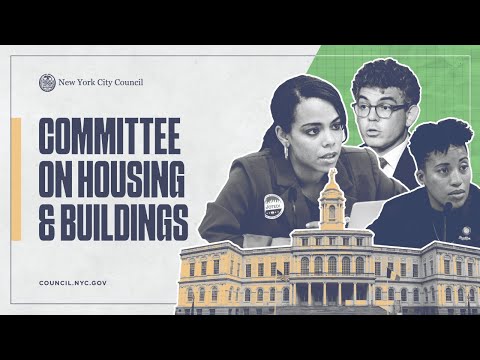
Council Member Pierina Sanchez, chair of the Committee on Housing and Buildings, opened a hearing on social housing and a package of bills called the Community Land Act, arguing the proposals would advance permanently affordable, community‑controlled housing.
Council Member Pierina Sanchez, chair of the New York City Council Committee on Housing and Buildings, opened a hearing on social housing and a package of local bills the council and advocates call the Community Land Act. "Simply put, social housing is housing built for the public good, not as a product whose goal is simply to maximize profit," Sanchez said, framing the hearing's purpose to explore how the proposals would create and preserve permanently affordable, community-controlled housing.
The bills discussed include Intro 78 (public land disposition priorities for mission-driven nonprofit developers and community land trusts), Intro 902 (a Community Opportunity to Purchase Act, or COPPA), Intro 570 (a municipal land bank), companion measures to expand statutory recognition and regulatory tools for community land trusts, and council resolutions urging the state to enact a Social Housing Development Authority and a Tenant Opportunity to Purchase Act (TOPA). Public Advocate Jumaane Williams told the committee that the proposals would help tenants, saying the Tenant Opportunity to Purchase concept "would place these properties in the hands of those who have a vested interest in maintaining residents in their homes."
Council members pressing the legislative case argued public land and transfer rules are critical leverage points. Council Member Ressler said nonprofit developers build more deeply affordable units on public sites than for‑profit teams and urged prioritizing community ownership of city land. Council Member Rivera described COPPA as "modeled on existing policies in cities such as San Francisco and Washington, D.C." and said it would let mission-driven groups match third‑party offers to keep buildings in nonprofit or community hands. Council Member Nurse said her bills would expand the legal definition and governance of community land trusts and require a city study on the feasibility of a municipal social housing agency. Council Member Brewer and others argued a land bank could acquire and warehouse tax‑delinquent or vacant properties so nonprofits could convert them to permanently affordable housing.
City agencies described existing tools and cautioned about tradeoffs. Lucy Joffe, deputy commissioner for policy and strategy at the Department of Housing Preservation and Development (HPD), said HPD already pursues permanent affordability through regulatory agreements, acquisition loans and other programs and that the agency works with community land trusts. HPD told the committee it has about 1,200 units on CLT-owned land in its pipeline and described an acquisition loan fund and Neighborhood Restore program that acquire and hold property for development. HPD said it supports the goals of many bills but warned that legally codifying some requirements — for example a categorical preference for nonprofits on all public sites — could narrow the pool of development partners and slow production. "We must balance our focus on new approaches with the need to build and preserve as much affordable housing as we can with the resources that we have," Joffe said.
Advocates including representatives of East New York Community Land Trust, Urban Homesteading Assistance Board, Pratt Center, New Economy Project and dozens of neighborhood CLTs urged stronger, citywide versions of the measures. East New York CLT and other witnesses described tenant takeovers and a recent CLT acquisition that converted a building to a limited‑equity co‑op, and they urged the council to abolish the city's tax lien sale and replace it with a land bank or other public mechanism. Will Spizak of New Economy Project said a public land preference need not slow development because HPD already uses rigorous RFP processes; he recommended the council also ensure joint‑venture paths are explicit so nonprofits can partner where needed.
Committee members repeatedly pressed HPD on data about outcomes by developer type and on the scale of public sites the city controls. HPD officials said the agency is refining term sheets, expanding capacity and using dedicated acquisition resources and that it can return data on how rental assistance and other tools affect who can ultimately live in subsidized units. HPD also summarized the New York City acquisition loan fund: since its creation it has supported more than a hundred projects, loaned about $780 million and has roughly $170 million outstanding in active loans, supporting an estimated 17,000 affordable units, the agency said.
The hearing drew dozens of public witnesses representing neighborhood CLTs, tenant groups, community development organizations and civic advocates who urged the council to pass the Community Land Act measures, expand funding for CLTs, and push the state to enact TOPA and a Social Housing Development Authority. Several witnesses described how local public sites and vacant lots could be used for deep affordability, community commercial space and resiliency projects. Testimony also included calls for protections of existing publicly subsidized housing, including Mitchell‑Lama and NYCHA buildings.
The committee held the bills for further consideration; no formal votes or final actions were taken at the hearing.