Get Full Government Meeting Transcripts, Videos, & Alerts Forever!
Get email alerts on the Energy Resilience Solar topic
No spam. Unsubscribe anytime.
Lawrence Berkeley study finds solar could meet island demand; local policy questions remain
Summary
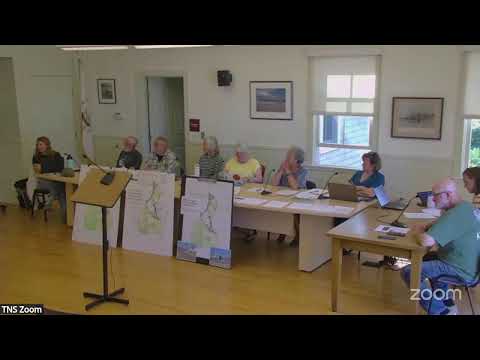
Peter Kappers, of Lawrence Berkeley National Laboratory, told the Block Island Coastal Resilience Committee that a recent Energy Technology Innovation Partnership (ETIP) analysis found rooftop and community solar could meet the island’s electricity needs under the study’s load assumptions.
Peter Kappers, of Lawrence Berkeley National Laboratory, told the Block Island Coastal Resilience Committee that a recent Energy Technology Innovation Partnership (ETIP) analysis found rooftop and community solar could meet the island’s electricity needs under the study’s load assumptions.
The study, Kappers said, estimated that community solar could generate as much as 40 megawatts at an instant and rooftop residential solar up to about 9.5 megawatts of instantaneous capacity, though his evaluation limited deployment to meet forecasted load rather than potential maximum generation. “Community solar could actually, generate a 40 megawatts,” Kappers said during the presentation.
Why it matters: Committee members said the analysis has implications for the island’s resilience to undersea cable outages and for reducing diesel dependence. At the same time, the committee flagged local policy and contract constraints that could prevent full benefit from added solar and storage.
Key details from the presentation
- Study scope and constraints: The ETIP analysis looked at rooftop solar for residential and commercial structures and community-scale ground-mounted solar on available land; it did not include investigation of wind energy. Kappers emphasized the team carefully screened land for zoning setbacks and conservation restrictions.
- Instantaneous vs. sustained generation: Kappers and committee members stressed megawatts in the report refer to instantaneous capacity, not continuous energy over time. He noted storage could absorb excess generation for later use, but his evaluation used the current state of battery technology.
- Grid and contractual constraints: The island’s cable agreement currently prohibits sending power back to the mainland grid, limiting the ability to export excess generation. Committee members also identified an island policy called “BASA” (buy-all, sell-all) as a focal point of debate; Kappers did not evaluate whether BASA is the best policy for encouraging rooftop adoption.
- Timing and next steps: Kappers said a more technical written report will be delivered to the Block Island Utility District in July. Committee members urged the utility and the public to review the report and to reopen discussion of local policies that affect adoption and resilience.
What committee members said
John Warfel, identified in the meeting as a commissioner of the Block Island Utility District, had earlier initiated the ETIP application to the Department of Energy. Committee members noted that the current utility contract timing (a contract change expected in November) and specific contract terms can affect which resources are curtailed when supply exceeds load.
One attendee, speaking from personal experience, said rooftop solar has reduced monthly bills: “My energy bill from the Block Island Power Company this month was negative,” the attendee said.
Actions and outstanding questions
No formal policy vote occurred at the June meeting. Committee members asked the utility district to open a public discussion on whether to revisit BASA and other local rules that affect small-scale solar economics and to review the November contract that will govern supply. Kappers’s July technical report was identified as a critical next step.
Ending
Committee members said they will monitor the ETIP technical report when it arrives and urged wider public engagement on whether local rules should change to enable more on-island generation and storage.