Get Full Government Meeting Transcripts, Videos, & Alerts Forever!
Get email alerts on the Public Defense Grants topic
No spam. Unsubscribe anytime.
ICJIA posts NOFO for JAG funds to support county public defenders; $850,000 available
Summary
The Illinois Criminal Justice Information Authority posted a notice of funding opportunity on June 3, 2025, for Edward Byrne Justice Assistance Grant funds to support public defense services. Applications are due July 3, 2025; questions are due June 20. Awards will range from $50,000 to $170,000 and must be submitted through Amplifund.
The Criminal Justice Information Authority, Illinois, posted a notice of funding opportunity (NOFO) on June 3, 2025, for Edward Byrne Justice Assistance Grant funding to support public defense services, a staff member said. Questions on the NOFO must be submitted by June 20, 2025, and applications are due July 3, 2025.
The NOFO makes $850,000 available in federal Justice Assistance Grant funds for projects meant to “support the work of the public defender’s office,” improve efficiency and outcomes for people being defended, and strengthen justice-system services, the staff member said. Individual county public defender offices may apply, or a county public defender may apply as a lead applicant with subgrantees; other government entities and nonprofit community-based organizations may serve only as subgrantees.
Applicants must be prequalified to do business with the State of Illinois, be registered in the Illinois Grant Accountability and Transparency Act (GATA) grantee portal, be in good standing with GATA prequalification requirements, and have an approved GATA state fiscal year internal control questionnaire before grant execution, the presenter said. The recording notes that the internal control questionnaire may be submitted with the application but must be approved before a grant is executed.
Amount and award limits
The NOFO sets a minimum request of $50,000 and a maximum request of $170,000; the recording warns that requests outside those ranges will receive point deductions. The authority said awarded amounts may be adjusted to align with set-aside limits described in the recording: 72% of the $850,000 set aside for local grants and 18% set aside for state grants.
Application platform and required documents
All applications must be submitted through Amplifund; emailed, mailed or hand-delivered submissions will not be accepted. The recording walks applicants through the Amplifund opportunity-detail page and the application “bubbles.” Required materials that must be completed in Amplifund by the July 3 deadline include the uniform grant application, the program narrative, the implementation schedule and other online fields. Two documents must be downloaded, completed, and reuploaded into Amplifund: the budget (with a supporting budget narrative) and the performance plan (goals, objectives and performance measures).
The presenter emphasized that budget items should meet four criteria: reasonableness, cost-effectiveness, necessity to the program, and allocability to the program’s public-defense purpose. Budget narratives should explain how each estimated amount was derived (for example, by vendor estimate or past costs). Applicants using subgrantees should place the total subaward amount for each subgrantee in a single line item for the application and provide narrative justification; ICJIA will request detailed subaward documentation from successful applicants later.
Scoring and program design guidance
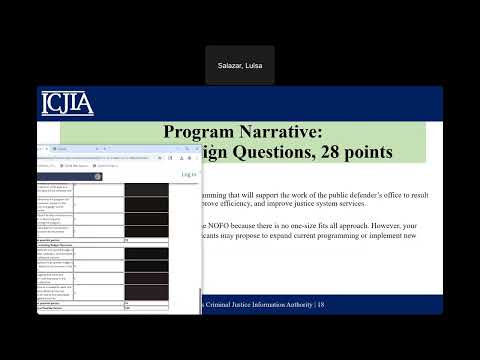
Program-design questions account for 28 points: two questions worth 14 points each. Reviewers will look for a clear program summary stating the problems and needs to be addressed, the proposed outcomes, and how the proposed services will improve defense services and system efficiency. The NOFO lists program suggestions reported by stakeholders as best practices; those suggestions are encouraged but not required. Practices that applicants implement must be evidence-based and will be scored as part of the program narrative.
Performance measures
Applicants must complete the standard performance-measure table and may add optional tables that align with selected program components (for example, mitigation programs, social-service client programs, forensics and specialty cases, training and internships). Every objective must be paired with a measurable performance indicator and should reflect what the applicant expects to accomplish within 12 months.
Logistics and support
The presenter reminded applicants to save frequently in Amplifund (the system times out after 20 minutes of inactivity) and pointed to tutorials and guides for registering in the GATA portal, adding Amplifund users, and completing the application. The recording also identifies a contact email for NOFO questions: cja.jag.NOFO00625@illinois.gov; questions submitted by the June 20 deadline will be posted on the ICJIA website.
Timing and program period
The recording states that the authority expects funding decisions to be reviewed by the budget committee and that recommended designations will be considered at the August 21, 2025, meeting. The presenter said the anticipated grant period of performance is October 1, 2025, through September 30, 2026, and that ICJIA may recommend subsequent grants contingent on satisfactory performance and fund availability for a maximum of 36 months.
What applicants should prepare
The presenter advised applicants to download the Word version of the program narrative questions (provided on the opportunity page) to draft responses offline and then copy and paste into Amplifund. The recording also reiterates the need for clear budget narratives, measurable performance objectives, and evidence-based program practices.
Ending
The presenter closed by restating the key dates — NOFO posted June 3, questions due June 20, applications due July 3, budget committee review August 21 — and wished applicants success on their submissions.