Get Full Government Meeting Transcripts, Videos, & Alerts Forever!
Get email alerts on the Public Safety topic
No spam. Unsubscribe anytime.
Benton County considers cuts, vacancy increases and jail bed changes in sheriffs budget review
Summary
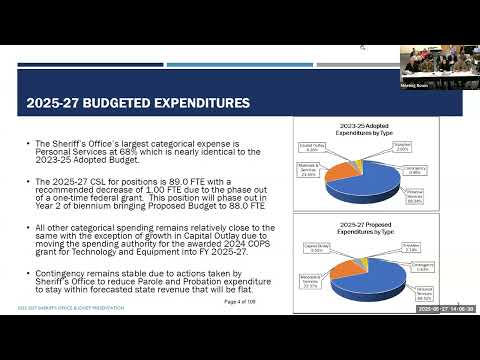
Benton County Budget Committee members heard a multi-hour presentation from county administrators and sheriffs office leaders on a proposed sheriffs-office budget that county staff described as the largest general fund investment in the county.
Benton County Budget Committee members heard a multi-hour presentation from county administrators and sheriffs office leaders on a proposed sheriffs-office budget that county staff described as the largest general fund investment in the county. Rick Krager, assistant county administrator, told the committee the sheriffs current-service-level budget is about $57.3 million, roughly a 20.4% increase over the 23-25 biennium numbers reported earlier.
The sheriffs office and county staff said staffing and personal services are the main cost drivers, and that a federal grant supporting a new communications system is producing a one-time spike in capital outlay. Krager noted corrections to numbers in the packet and emphasized the complexity of vacancy-factor calculations: "on the third bullet that says vacancy factor of 4.6, that is a 3.6," he said, adding that an earlier "average vacancy rate" line should read 5.1% rather than 6.5%.
Why it matters: the sheriffs budget is the countys single largest discretionary outlay. Decisions about vacancy rates, program continuations and where to cut carry direct consequences for patrol coverage, jail operations and community programs such as work crew and jail-based treatment.
County staff outlined both the current-service-level picture and a proposed budget that cuts some costs while keeping most services intact. Krager told the committee the sheriffs office would try to cover a $2,000,000 vacancy target primarily by managing hiring and retirements rather than involuntary layoffs. Sheriff leadership said maintaining 24/7 patrol and jail coverage is a priority and that cuts would be made with that constraint in mind.
Discussion highlights and proposals - Vacancy factor: County staff corrected the vacancy numbers and proposed increasing the sheriffs vacancy factor from 3.6% (current service level) toward 5.1% to achieve savings; sheriffs leadership urged returning any freed funds to avoid staff reductions. Sheriff: "I do not want to lose any of my staff," he told the committee. The office estimated a $578,000 saving from two deputy-equivalent vacancies if the factor is raised. - Program and cost shifts: The sheriff and budget staff said capital outlay rose because a federal grant funded communications upgrades; that grant money is one-time and inflates next-year capital costs. Fleet maintenance costs were reported up about 31% (from roughly $691,000 to over $1,000,000), a figure sheriff staff described as unsustainable. - Jail bed contracting: The sheriffs office described shifting some contracted jail beds away from Norcor/Linn County toward Clatsop County. Under the Norcor arrangement Benton County had been paying for a block of 20 beds regardless of occupancy; Clatsop County agreed to charge only for occupied beds, and staff said the change should save vehicle, deputy time and maintenance costs because transports will go to a nearer hub in Marion County (Salem) rather than farther destinations. - Jail-based treatment (MOUD) and the Section 1115 Medicaid waiver: Sheriff staff said the jails medication-opioid-use-disorder (MOUD) program is ending when state resources expire; that change removes roughly $300,000 in current spending. Capt. John Devaney told the committee the County had been planning to participate in a Section 1115 Medicaid waiver that would expand Medicaid billing for in-jail treatment, but OHA (Oregon Health Authority) informed sheriffs statewide that implementation is delayed (possibly to 2027). Staff noted capacity-building funds exist but said timing and eligibility for continued use are uncertain. - Alternatives to incarceration and work crew: The committee heard that the jail-run work crew program provides a commonly used sentencing alternative; parks funding that previously covered half the program has stopped and Republic Services now funds part of it. Sheriff staff and parole/probation sergeants said losing that funding risks reducing a widely used alternative to lockup and could increase jail bookings.
Other operational points - Parole and probation: The countys community corrections allocation from the state has fallen; parole/probation staffing was already being managed with frozen positions and vehicle reductions. County staff said the state allocation decreased in both overall pool size (statewide dollars) and Benton Countys percentage share (from 1.22% to 1.14%), producing a potential revenue shortfall of roughly $450,000 under a worst-case scenario. - Fleet and facilities: Fleet maintenance increases and an aging jail facility were repeatedly flagged as implementation risks; staff said transport distance changes will reduce fuel and vehicle wear. - Grants risk: Sheriff staff listed multiple federal and state grants that support overtime, emergency-management and specialty positions; they said several grants are uncertain or reduced (for example, a $33,000 cut to the Oregon State Marine Board grant was noted).
What the committee asked and next steps Committee members pressed about the Clatsop bed agreement (staff said there is no minimum or maximum in the Clatsop arrangement; the county budgeted an average of 12 beds), the reduction in marine grants and whether fleet maintenance is handled by internal public works (it is). Commissioners and committee members encouraged tours of Clatsop and further written detail on transport-cost savings. The sheriff and staff said they will manage the first year of a higher vacancy factor through retirements and not immediate layoffs where possible.
Ending note: The sheriffs presentation was the longest segment of the afternoon session. Committee members signaled they understood the competing priorities: preserving patrol and jail coverage while acknowledging constrained revenues, uncertain grant support and an aging facility. Formal budget decisions will come later in the committees deliberations; the items above reflect discussion and staff recommendations rather than recorded votes.