Get Full Government Meeting Transcripts, Videos, & Alerts Forever!
Get email alerts on the Floodplain Management topic
No spam. Unsubscribe anytime.
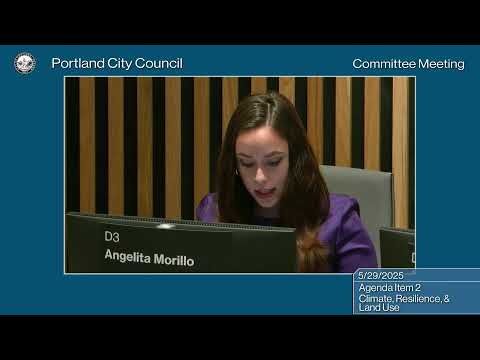
Portland staff present FEMA-driven floodplain code amendments as public and environmental groups urge stronger protections
Summary
Portland staff presented proposed amendments to the city's floodplain development code and asked the Climate Resilience and Land Use Committee to refer the package to full City Council so the city can remain in FEMA's National Flood Insurance Program.
Portland staff presented proposed amendments to Title 24, Chapter 50, the city's floodplain development regulations, and asked the Climate Resilience and Land Use Committee to refer the package to full City Council for adoption so the city can remain in the Federal Emergency Management Agency's National Flood Insurance Program (NFIP).
The amendments implement FEMA's interim "pre-implementation compliance measures" (PICMs), which FEMA requires by July 31; they add no-net-loss rules for three proxies of natural floodplain function (flood storage, water quality and vegetated riparian habitat), new submittal and inspection requirements, and a Pickham Riparian Buffer Zone that extends 170 feet from the ordinary high water mark within the FEMA 100-year floodplain.
Those attending the meeting said the changes are necessary to keep Portlanders eligible for federal flood insurance and associated disaster assistance. Doug Morgan, engineering manager with Portland Permitting and Development (PP&D), told the committee the city has regulated its floodplains since joining the NFIP in 1980 and that compliance with FEMA is a prerequisite to continued access to disaster recovery funds and federally backed flood insurance. Staff said Portland currently receives a 25% discount on flood insurance premiums under FEMA's Community Rating System (Class 5), and that failing to meet FEMA's timetable could jeopardize that status.
Why it matters: the amendments are staff'recommended interim steps to bring Portland into compliance with a 2016 National Marine Fisheries Service biological opinion (BiOp) that found NFIP implementation harmed listed salmonid species and orcas. FEMA developed the PICM pathway after litigation and directed jurisdictions to choose a compliance pathway by Dec. 1, 2024. Portland staff recommended adopting FEMA's model ordinance language for most mapped flood hazard areas while maintaining the city's higher standards already adopted in targeted zones (e.g., some South Reach and 2023 Floodplain Resilience Plan areas).
What the amendments would do: the PICM-based code would require compensatory flood storage at higher ratios closer to the river (staff described 2:1 in the riparian buffer and 1.5:1 landward) and require tree replacement and other vegetated habitat offsets. For non-water-dependent development within the Pickham Riparian Buffer Zone, the package would require a "beneficial gain" equal to 5% of the new development area to be planted with native vegetation. Staff said compensatory storage or habitat offset could be satisfied on-site, off-site on a parcel owned or controlled by the same owner, or by purchasing credits from an approved mitigation bank located in the same flood zone or reach.
Public comment and technical concerns: eight community speakers and attorneys for conservation groups urged stronger protections and changes to the draft code. Mary Seitz, staff attorney at the Northwest Environmental Defense Center (NEDC), said the BiOp requires a near-prohibition on development within the riparian buffer zone (RBZ) except for water-dependent uses, habitat restoration, activities producing "beneficial gain," or activities with no adverse effects. Seitz said the draft Title 24 language instead permits development with mitigation and that "the ordinance fails to include RPA 2b's generalized prohibition on the RBZ." Chelsea Stewart Fusick, staff attorney for the Center for Biological Diversity, urged the council to require mitigation on the same lot or parcel where possible (BiOp preference) and to narrow the grandfathering window for preexisting permits.
Other speakers included Sarah Taylor (resident and North Reach community member), Michelle Emmons (co-director, Willamette Riverkeeper), Jan Zuckerman (resident), Micah Meskel (urban conservation director, quoted in transcript as representing "Burt Alliance of Oregon"), Charise/Charice Bach (climate policy director, 350PDX), and Marnie Glickman (resident and coalition representative). Testifiers stressed continuous riparian habitat connectivity for juvenile salmon, criticized reliance on mitigation banks alone, and urged the city to align PICM implementation with the North Reach planning and other restoration work.
Staff and technical clarifications: Jeff Cottle (supervising planner, Bureau of Planning and Sustainability) and Jason Butler Brown (engineering supervisor, PP&D) explained the city's phased long-term compliance strategy, begun with a multi-bureau work plan signed in 2019 and updated in 2024, which includes River Plan South Reach (adopted 2020), the Floodplain Resilience Plan and zoning changes adopted in 2023, and ongoing projects for the Willamette North Reach and Columbia Corridor industrial lands. Staff said FEMA's final long-term implementation plan will require permanent updates (expected around 2027) but that PICMs are mandatory in the interim. Staff also acknowledged limited tribal outreach to date and said FEMA hosted webinars and indicated tribal consultation was ongoing at the federal level; city staff said they will expand tribal and community coordination in upcoming longer-term planning projects.
Economic and development impacts: staff presented a brief assessment of likely effects on industrial and residential development. They said roughly two-thirds of land subject to the PICM requirements in the mapped areas is industrial; on the residential side, most nonindustrial acres affected are in low-density residential or open-space zones (roughly 630 nonindustrial acres affected, about 275 zoned for low-density residential). Staff said existing landscaping and other code requirements can partially contribute to compliance, but the new beneficial-gain and storage requirements could reduce developable footprint and increase development costs, potentially affecting feasibility on some parcels.
Mitigation banking and local options: staff said there is currently one mitigation bank on the Willamette that provides flood-storage credits; the city is pursuing an "East Bank Crescent" mitigation bank as part of the OMSI redevelopment (30% design funding secured). Staff said mitigation can be "stacked" for storage and habitat credits but cautioned that mitigation banks alone may not replace distributed, connected riparian habitat as cautioned in the BiOp and by conservation groups.
Next steps and committee action: staff asked the committee to vote to refer the proposed PICM-driven Title 24 amendments to full council for adoption before the July 31 FEMA deadline. Committee members asked for additional briefings, flagged concerns about tribal consultation and public outreach, and discussed the legal question of whether the city can adopt standards more stringent than FEMA's model ordinance (the city attorney indicated yes). The committee scheduled a fuller discussion and potential amendments for the committee's next meeting (June 12) and noted that an emergency ordinance to meet the deadline would likely be required if changes are adopted at that point.
Ending note: the committee did not take a recorded vote on the referral in the transcript; staff said they will continue outreach and technical work and return to the committee and full council with finalized language and implementation details before the FEMA deadline.