Get Full Government Meeting Transcripts, Videos, & Alerts Forever!
Get email alerts on the Transportation topic
No spam. Unsubscribe anytime.
San Mateo presents first annual transportation review; staff, residents press for faster safety fixes
Summary
San Mateo City Manager Alex Zikian asked the council to take the transportation item first; Public Works engineering manager Jay Yu presented the city's first Transportation Program Annual Review, highlighting active-transportation, congestion, parking and safety programs and warning that most high-priority bike and pedestrian projects remain unfunded.
San Mateo City Manager Alex Zikian asked the council to take the transportation item first, and Jay Yu, engineering manager for public works, opened the department's first Transportation Program Annual Review on June 2, 2025. "My name is Jay Yu, the engineer manager for public works, and tonight, I'll be going over the annual transportation review," he told the council and a packed chamber.
The presentation summarized the city's transportation network, recent policy changes and where projects stand. Yu said the new General Plan "STRIVE San Mateo (General Plan 2040)" and earlier master plans (Bicycle Master Plan 2020, Pedestrian Master Plan) set policy directions favoring walking, biking and transit, but he warned many projects remain unfunded. He told council that "about 85% of commuters take vehicles" today and city goals seek a more balanced mode split.
Why it matters: the review framed near-term choices between implementing protected infrastructure and the practical limits of funding, staffing and constrained street right-of-way in a largely built-out city. Yu highlighted four programs: active transportation, congestion management, parking management and safety. He said the Bicycle Master Plan contains 170+ segments and roughly $40 million in project estimates but that most segments are unfunded; the city has completed about 6.4 miles (16.6%) of high and medium-high priority bike projects and is actively working on another 4.9 miles.
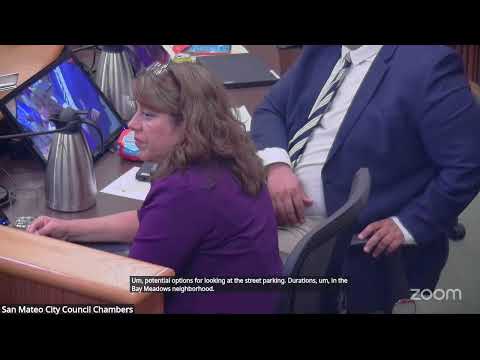
Public comments during the item made safety the dominant theme. Kevin Simpson urged better school crossing coverage and cited a bus-stop crossing near Humboldt and Cypress where he said there is no crossing guard and drivers run bus lights: "I don't wanna be there the day 1 of them gets run over," he said. A series of residents and local teachers asked the council for immediate traffic-calming and protected facilities on Alameda de las Pulgas (between 20th and 24th avenues) and on Humboldt and Poplar avenues, calling for elevated crosswalks, buffered or protected bike lanes and more enforcement. Elaine Salinger, a long-time Bicycle and Pedestrian Advisory Council member, said near-miss incidents are common and argued the city needs protected bike lanes: "the only way to really make yourself feel safe on the road is with a protected bike lane," she said.
Staff updates and next steps: Yu outlined a multi-step delivery timeline (typical funded project: ~26 months from grant award to construction, often longer for large projects) and said outreach and design consume most staff hours. He gave a detailed list of active and planned efforts: - Humboldt Bike Lane: council-directed alternative review (bike boulevard at Fremont plus lighting); staff will hold a June 18 community meeting and additional sessions in summer/fall, with SIC review in winter 2025 and council consideration in early 2026. - Complete Streets Plan: work paused for staff capacity but planned to resume in FY25-26 to consolidate existing plans. - Local Roadway Safety Program: 70% of the top-10, data-driven priority safety projects are in progress and funded after a May 2024 adoption. - Speed limits: the city completed a "slow for students" reduction covering 23 schools and is preparing a citywide speed survey to meet a 14-year recertification requirement described in the presentation (referenced as "CBC").
Safety metrics: Yu presented collision totals and trends: 2,224 collisions in 2024; less than 1% were fatal, 4% severe, and the majority minor. Pedestrian and bicycle incidents remain a focus: the city reported that a majority of serious crashes involve vulnerable users. Yu also showed San Mateo's published ranking in the California Office of Traffic Safety reports (category B cities): San Mateo ranked comparatively low in fatal/injury collisions in the 2018'22 series but had improved in the latest published set.
Parking and operations: Yu reported downtown garage utilization (weekday lunch and dinner and weekend peaks); he said some garages, including Kiku Crossing, remain underused while a few are near capacity at peak times. Staff are exploring digital parking-permit platforms, improved wayfinding signage and third-party vendor options to streamline residential and monthly permits. The presentation noted approximately 70% of active transportation projects are grant-funded (85% federal, 9% state, 5% county), making delivery vulnerable to funding cycles.
Council and staff discussion: Council members praised the data-driven presentation and pressed staff on next steps. Questions focused on mode-share measurement (American Community Survey cited), timing for the high-voltage streetlight conversion (targeted completion 2027 for remaining fixtures), and the staffing shortfall in transportation and traffic operations. Yu and Public Works staff described proposals for added consultant support to avoid review bottlenecks and a multi-agency construction coordination task force for concurrent developments.
Council direction and outstanding follow-ups: Council members urged staff to accelerate high-safety, high-impact projects and to return with specific recommendations on: - Parking management and pricing options for downtown garages, including digital wayfinding to route drivers to underutilized garages. - A timeline and cost options for expanding protected bike lanes on corridors flagged as high priority (Humboldt, Alameda corridors and north-south connections). - Staffing needs and funding options for traffic review and operations; staff will return with specific budget implications. - Follow-up on school crossing guard gaps (staff was asked to coordinate with the school district and police to investigate the Humboldt/Cypress bus-stop crossing guard request).
What remains unresolved: funding uncertainty (heavy reliance on federal grants), limited street right-of-way for some projects (about 46% of high/medium-high bike projects would require lane or parking reductions), and staff capacity to deliver both routine operations and an expanded portfolio of projects. Council members repeatedly asked staff to prioritize safety-focused projects that can be implemented without lane removals when feasible, while proceeding with grant-driven protected facilities where the safety benefit justifies impacts.
The department posted the full slide deck to the city agenda packet. Yu and traffic staff said they would return with additional project-level schedules, cost estimates and any request for budget or policy direction as those analyses conclude.