Get Full Government Meeting Transcripts, Videos, & Alerts Forever!
Get email alerts on the Short Term Rentals topic
No spam. Unsubscribe anytime.
West Fargo commission approves first reading of short-term rental ordinance requiring primary residency; 16-month grandfathering period included
Summary
The West Fargo City Commission voted 3-2 on first reading to adopt an ordinance amendment requiring short-term rentals to be accessory uses of primary residences, with a 16‑month transitional license for existing operators and a statement-based residency verification during application.
The West Fargo City Commission on Monday approved on first reading an ordinance amendment that would restrict short-term rentals to dwellings that are a primary residence for more than half the year and add licensing standards for operators.
The ordinance change, introduced by Aaron Nelson, the city’s director of planning and zoning, would make short-term rentals an accessory use of residential dwellings and require that the licensed premises be the operator’s or owner’s primary residence (defined in the ordinance as more than 183 days per calendar year). Existing short-term rental operators would be eligible for a transitional license that exempts them from the primary-residency requirement for 16 months; that grandfathering provision would sunset at the end of 2026.
City staff told commissioners the application form included in the packet is an example and that the final application would be refined if the ordinance is adopted. Under the draft, applicants would sign a statement attesting that the dwelling is a primary residence; staff said the signed attestation is how the city would initially verify residency. The ordinance sets the effective date at Sept. 1 to allow time to refine the application form and procedures.
Commissioners debated occupancy limits and how the city should verify primary residency. Commissioner Olson said the current draft could force long-running short-term rental operators to sell properties that are not primary residences; Olson pressed staff on verification, prorated refunds, and whether operators who rent long term could retain a license. Nelson said the staff draft allows an operator to be someone other than the owner (for example, a management company) provided a long‑term tenant resides at the property at least 183 days per year. Legal counsel Katie Smith confirmed the ordinance distinguishes between owner, tenant and operator so a tenant could apply for a license if they occupy the residence long term.
Public safety concerns were raised by Chief Nielsen, who said police frequently respond to short-term rental complaints and have limited recourse when renters do not come to the door. The ordinance would require licensed short-term-rental operators to comply with enforcement provisions; staff said an unlicensed operator would receive a 30‑day notice to apply and could be subject to fines and penalties afterward.
Tom Seymour, a West Fargo resident, addressed the commission during public comment and said he supported the primary-residence requirement because of concerns about property maintenance and damage.
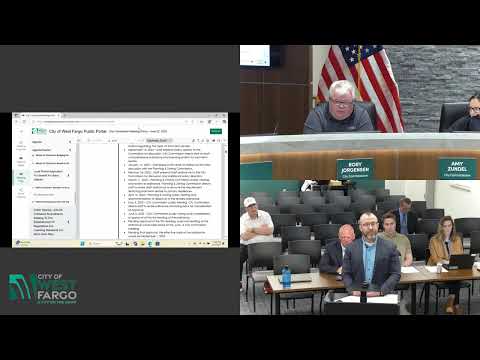
Commissioner Zundel moved to approve the ordinance as written; Commissioner Anderson seconded. After discussion, the motion passed on a 3–2 vote.
The ordinance now returns for any further readings required by city code before final adoption. If the ordinance is adopted as drafted, staff plans to finalize the application and enforcement procedures before the Sept. 1 effective date.