Crescent City Council approves five-year contract for officer body cameras, in-car cameras and evidence storage
Loading...
Summary
The Crescent City City Council voted unanimously to approve option 1 of a five-year agreement covering officer body cameras, tasers, in-car cameras and cloud evidence storage; council authorized the city manager to sign the contract.
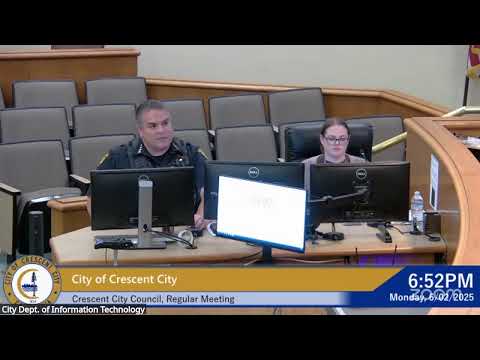
The Crescent City City Council on Tuesday approved a five-year contract option to continue and consolidate the city’s body camera, in-car camera and evidence-storage services.
The council directed staff to select contract option number 1 and authorized the city manager to sign the Accent contract, approving the purchase and service plan that covers 18 total positions. The motion passed on a unanimous voice vote: Council member Dooley, yes; Council member Tinkler, yes; Mayor Pro Tem Wright, yes.
The item consolidated multiple existing agreements for officer body cameras, tasers/electronic control devices and evidence storage into a single five‑year arrangement. City staff presented two options and recommended option 1, which covers all 18 positions discussed during the budget process. The first-year cost for the recommended option was presented as about $60,005.70, with a five-year total described by staff as “just under $300,000.”
Police staff described technical and operational features the contract would support. The Police Chief said the department’s body cameras automatically activate in a range of specified events — for example, when an officer draws a firearm, activates a Taser, or turns on emergency lights — and that the system captures a 30‑second pre‑activation clip. “It’s an insurance policy for the city,” the Police Chief said, describing benefits for officer safety, scene documentation and liability reduction.
Staff also described features intended to speed records sharing: the district attorney’s office has access licenses to download footage directly, and the system includes built‑in redaction software. The chief said the department is considering a drone purchase but has not bought one yet and clarified that the city does not possess larger military vehicles such as MRAPs.
Council members asked about staffing covered by the contract. Staff said option 1 would include equipment for two reserve officers (both former sworn officers who had volunteered) and for a proposed community service officer (CSO) position. Staff described the CSO as a non‑sworn, non‑armed position intended for code enforcement, animal control and similar duties. A council member noted the camera would protect volunteers and trainees as much as the public.
A member of the public who had experience with the department’s evidence system expressed concerns about deletion but was told the platform maintains an audit trail for every action; staff said deletions and other actions are logged and retained.
Staff said Measure S and the city’s budgeting choices helped make the purchase feasible. The contract and its storage features were presented as a continuation and consolidation of technology the department has used for multiple years.
The council’s approval authorized the city manager to execute the contract under the option the council selected; staff said unassigned cameras purchased under the option could be held in reserve or assigned to employees if a device fails.