Holyoke committee advances ordinance to create centralized finance office, debates residency and bargaining authority
Loading...
Summary
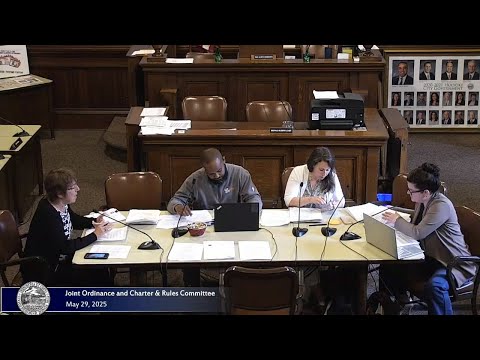
The Charter and Ordinance committees of Holyoke City Council advanced a substitute municipal modernization ordinance on May 29 that would create a Department of Administration and Finance and a CAFO (Chief Administrative and Financial Officer), after hours of debate over authority lines, residency for appointees, and who would lead contract negotiations.
The Charter and Ordinance committees of Holyoke City Council advanced a substitute municipal modernization ordinance on May 29 that would create a Department of Administration and Finance and a CAFO (Chief Administrative and Financial Officer), after hours of debate over authority lines, residency for appointees, and who would lead contract negotiations.
The committee meeting focused on how the CAFO would centralize financial functions, oversee personnel and bargaining strategy, and how the change would affect the law department and an independent director of internal audit. Committee members proposed and adopted several amendments, including language on a residency deadline for the CAFO and a timeline for certification of a treasurer/collector.
Councilor Jourdain, who helped draft the substitute ordinance, said the proposal is meant to create a “central business office” that consolidates payroll, personnel and accounting and to give the new CAFO authority over positions that now report to multiple departments. He described the proposed director of internal audit as having "almost like an inspector general of Holyoke type role," a position he and others said needs independent legal support from the council.
Councilor Linda Bacon pushed back on cost concerns and residency, telling colleagues she would not support adding three new positions "unless I can see no net increase in costs." Bacon and other councilors pressed for a side‑by‑side budget showing that translates proposed reorganization into neutral or reduced overall cost. Committee discussion referenced a citywide budget the chair described as reflecting an approximate 4.6% baseline increase, and Bacon said members were concerned that residents could face additional property tax pressure without demonstrated savings.
Residency and term length drew sustained debate. Committee members discussed a three‑year CAFO term (the draft used a three‑year confirmation term) and whether the CAFO should be required to live in Holyoke. Councilor Reagan proposed an amendment requiring the CAFO to "become a resident of the city within two years but no later than the end of the first contract term." That motion — later amended in committee wording to require residency "no later than the end of the first contract" — passed in a voice vote. Supporters said the change balances recruitment concerns with the council's interest in appointees who are invested in the city; opponents warned that strict residency requirements reduce the candidate pool given current housing market and relocation barriers.
The meeting also clarified hiring and qualification language for the combined treasurer/collector role. Committee members agreed to require that the appointed treasurer/collector obtain certification from the Massachusetts Treasurer and Collector Association (MCTA) within 36 months; that amendment passed by voice vote. The committee also approved language allowing, under special circumstances, a candidate's relevant education, experience and MCTA certification to be accepted in lieu of a college degree.
A central and contested change would give the CAFO a formal role in collective bargaining. The committee adopted revisions, drawn from a late memo by the city solicitor and further edited by councilors, that require the CAFO and the mayor to establish overall bargaining strategy and to assign members of any bargaining negotiation team. The amended language also makes the CAFO responsible for costing out bargaining proposals so the mayor and council will have an analysis of financial impact before final approval of any agreement. Supporters said the change is intended to place a technical, sustainability‑focused reviewer between negotiators and elected political pressures; law‑department representatives flagged potential charter conflicts and urged careful review.
City Solicitor Lisa Ball advised committee members in a written memo received the day of the meeting that some of the proposed ordinance language could conflict with Section 39 of the city charter (which assigns many legal functions to the city solicitor) and recommended that certain legal‑counsel changes be deferred to a phase‑2 review. Committee members agreed to adopt some of her suggested edits but left broader charter changes for future discussion.
Mayor Persia (speaking during the meeting) urged balancing the residency requirement with practical incentives and suggested the city consider relocation assistance — for example, a one‑time payment in the $10,000–$15,000 range — to help attract qualified candidates who would move to Holyoke.
Committee members agreed to continue detailed work on the draft at a follow‑up meeting and to return a revised ordinance for full council consideration. Several members emphasized the changes are intended as an iterative modernization: some elements (for example, detailed IT consolidation) were described as phase‑2 items requiring further study rather than immediate ordinance language.
Votes at a glance - Motion to take up item 6 (introduce and consider substitute modernization ordinance): moved and seconded by committee, approved by voice vote. - Residency amendment (final language: CAFO must "become a resident of the city no later than the end of the first contract term"): moved in committee, approved by voice vote. - MCTA certification timeline (add requirement that treasurer/collector obtain MCTA certification within 36 months): approved by voice vote. - Degree waiver under special circumstances (allowing relevant education, experience or MCTA certification to substitute for a college degree): approved by voice vote. - Amendment giving CAFO + mayor authority to establish bargaining strategy and assign negotiation team; CAFO to cost out bargaining proposals for financial impact: approved by voice vote. - Motion to table further action and adjourn: approved by voice vote.
What happens next The committee scheduled further meetings to refine remaining language and to reconcile solicitor recommendations with the council's policy objectives. Committee members asked for a detailed, line‑by‑line budget crosswalk showing where positions or funds would move within departments so councilors could judge whether the reorganization is budget‑neutral. The committee also asked for input from the school department on any proposed changes that would affect school finances or bargaining.
Who spoke (selected) - Megan McGrath Smith, chair, Charter & Rules Committee - Tessa Murphy Ramboletti, Council President - Linda Bacon, Councilor - Councilor Jourdain (sponsor/lead drafter of the substitute ordinance) - Rory (Councilor) — asked for clarification and advocated standards for qualifications - Kelly (personnel staff) — explained certification timeline for treasurer/collector - Lisa Ball, City Solicitor (memo and legal concerns) - Mayor Persia (commented on relocation incentives)
Ending note Committee members described the ordinance as a multi‑year modernization effort and agreed on next steps: additional edits reflecting solicitor input, a budget crosswalk and another committee meeting to resolve remaining issues before sending the proposal to the full council for consideration.