Get Full Government Meeting Transcripts, Videos, & Alerts Forever!
Get email alerts on the Municipal Budget topic
No spam. Unsubscribe anytime.
Rocky Mount releases $276.7 million proposed operating budget for FY 2025-26; no property tax increase
Summary
City staff presented a proposed $276.7 million operating budget that holds the property tax rate at $0.58 per $100 of assessed value, freezes 62 vacant positions, and recommends utility and fee increases to close a funding gap ahead of a June public hearing.
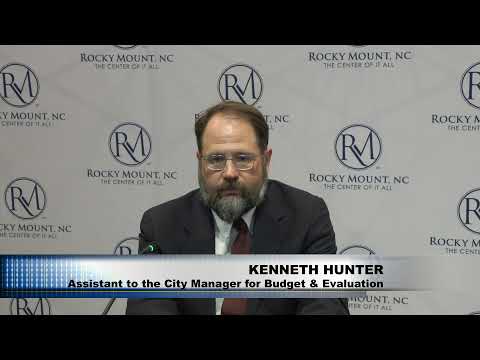
Kenneth Hunter, city assistant to the city manager for budget evaluation, presented the City of Rocky Mount’s proposed operating budget for fiscal year 2025–26 during a virtual town hall on May 29.
Hunter said the proposed operating budget across eight funds totals $276,722,140 and “is balanced and does align with the requirements for a balanced budget as established by North Carolina's Local Government Budget and Fiscal Control Act.” The proposal does not include a property tax rate increase; the rate would remain at $0.58 per $100 of assessed value.
The proposal covers eight operating funds: a general fund proposed at $95,385,470 (about $4 million below the current year), the Powell Bill fund at $2,425,000, the E‑911 fund at $250,000, and five utility funds — electric $99,283,390; gas $30,055,000; water $18,745,000; sewer $22,625,000; and stormwater $7,953,280. Hunter said the total is $7,227,220 less than the amount adopted for the current fiscal year.
Hunter said the general fund budget includes a $1,500,000 allocation “to rebuild those reserves” and that the proposed budget does not appropriate any fund balance. The proposal also recommends eliminating the 20‑cent Municipal Service District tax for downtown property, which Hunter said would reduce revenue by $75,000.
To balance revenues and expenditures without a tax increase, the presentation outlines several changes affecting households. The plan keeps the city’s property tax rate steady and includes fee and utility adjustments Hunter summarized as: about $1.35 per month on average for unspecified fee adjustments, a 10% sewer rate increase (about $2.00 per month for the average household), a $1 per unit monthly increase to the stormwater utility, and a roughly $2.25 monthly increase to monthly solid waste costs. Hunter said those changes together amount to an approximate average residential increase of $7.35 per month.
The proposed budget does not add new staff positions and recommends freezing 62 vacant positions across city departments: 54 in general‑fund departments and 8 in enterprise funds. Hunter provided a departmental breakdown: city manager’s office 4; human resources 3; finance 3; central services 1; technology services 3; business and collection services 10; police 9; public works 9; engineering 1; parks and recreation 8; development services 2; community development 1; energy resources 4; water resources 2; stormwater 2.
Hunter said staff identified approximately $17,600,000 in reductions from initial department requests — described in the presentation as a 20.1% reduction in operating expenditures and a 34.7% reduction in capital outlay from those initial requests. He said the city will also use about $1,000,000 in supplemental state grant funds to support its annual housing grant program and homelessness response efforts.
Several capital projects were deferred, Hunter said, citing examples presented previously to council: the Battleborough Community Building, improvements to the city warehouse, technology infrastructure upgrades, some police special response equipment, and two neighborhood park renovations (the first phase of Inglewood Park and work at Cloverdale Park). He said the budget still moves forward on prioritized maintenance and essential growth projects, including replacement of one piece of fire apparatus, heavy equipment for public works and parks, repairs to the solid waste transfer station, and utility projects Hunter listed as more than $10 million for electric transmission/distribution/expansion; $875,000 for gas system work; about $3,250,000 for water distribution and treatment; about $4,600,000 for sewer distribution and treatment; and roughly $1,100,000 for neighborhood stormwater drainage improvements.
Hunter discussed utility fund outlooks, saying electric margins are “relatively stable,” gas margins have decreased due to reduced usage and higher wholesale rates, and water and sewer usage remains steady with local development providing potential customer growth. He noted the stormwater fund’s rate recommendation is the first since 2014 to stabilize revenue for needed drainage projects.
Hunter outlined next steps and public participation: two budget work sessions (confirmed June 2 at 5 p.m. and a possible June 4 at 5 p.m. in the Committee Room at City Hall), a required public hearing during the City Council meeting on Monday, June 9 at 7 p.m. in council chambers, and budget adoption during the regular council meeting on Monday, June 23 at 4 p.m. The fiscal year begins July 1.
Hunter thanked City Manager Elton Daniels and the city communications staff — Grant Robertson, Robin Cox and Mark Adcox — for support on communications about the budget and invited residents to submit questions on the city’s YouTube channel and to attend the scheduled meetings.